
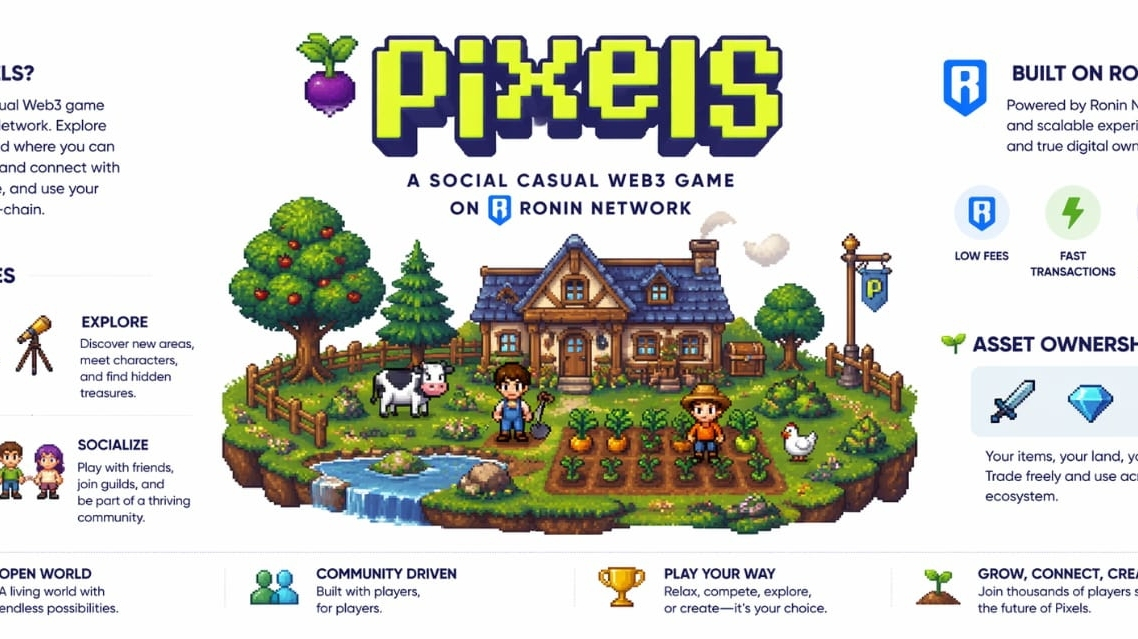
That may be the more revealing way to approach Pixels. The project is often described through its farming, social play, and open-world structure on the Ronin Network, but the more important issue sits behind those features. Web3 gaming has long tried to solve a problem of control. Players spend time, attention, and money inside virtual spaces, yet the rules of those spaces are usually owned by a company. Items can lose value overnight. Economies can be redesigned without warning. Entire games can fade away, taking years of player effort with them. Blockchain gaming entered this conversation by arguing that digital ownership could rebalance that relationship.
The difficulty is that the first generation of Web3 games often answered the wrong question too quickly. They assumed the central frustration of players was legal or technical ownership. In reality, many players were not primarily asking to own more. They were asking for worlds that felt less disposable. Modern gaming already suffers from a kind of instability. Live-service updates, seasonal resets, temporary rewards, and endless optimization can make digital spaces feel less like places and more like revolving systems of extraction. In that setting, simply putting assets on-chain did not necessarily make the experience more meaningful. In many cases, it only gave the same fragility a new vocabulary.
That is why earlier solutions often stalled. They were built around tradability, scarcity, and token participation, but they neglected the slower emotional work that makes a game endure. A durable game creates memory. It gives players routines, landmarks, and a sense that their time forms part of a larger rhythm. Many blockchain titles instead felt like economic frameworks with movement attached to them. They attracted attention through novelty, but novelty is not the same as attachment. Once the excitement of earning, trading, or early access faded, many players discovered there was not enough ordinary life inside the game to support long-term return.
Pixels stands out because it seems to move in the opposite direction. Rather than starting with grand claims about ownership, it starts with small habits. Planting, gathering, exploring, crafting, and meeting other players are modest actions, but modest actions are often what make virtual spaces believable. People do not remain in a world only because it is technically open. They remain because it fits into their day. A farming game, at its best, creates a soft form of repetition. It invites return through familiarity rather than urgency. That is a very different emotional model from the high-pressure atmosphere that defined much of early Web3 gaming.
Seen this way, Pixels is not just another blockchain game. It is part of a broader experiment: can Web3 support games built on routine instead of intensity? That is a meaningful shift. The project seems less interested in proving that blockchain can make games bigger, faster, or louder. It appears more interested in asking whether blockchain can sit quietly beneath a world that players treat almost like a daily environment. The choice of Ronin supports that approach. A gaming-focused network can reduce some of the mechanical friction that once made blockchain titles feel like technical exercises rather than accessible games.
Even so, this softer design raises difficult questions of its own. A calm atmosphere can attract players, but it can also conceal structural tension. A world centered on farming and social activity may look open and welcoming, yet the deeper systems still matter. Who advances faster? Who understands the surrounding ecosystem best? Who benefits most from being early, connected, or already comfortable with crypto tools? In blockchain environments, these differences rarely disappear. They often become part of the game’s hidden architecture.
That matters because Pixels may be inclusive in style without being fully inclusive in practice. Players familiar with Web3 logic are likely to navigate the system more easily. Those who enjoy low-intensity, community-based games may also find it appealing. But some people will still remain outside the circle. Traditional players who dislike blockchain as an idea may never enter. Others may find wallets, ecosystem language, or asset-linked expectations quietly discouraging even if the surface design feels friendly. There is a difference between a game being easy to understand and a game being easy to belong to.
There is also the question of whether comfort can carry enough depth. Games built around repetition live or die by texture. If the world feels alive, repetition becomes calming. If it does not, repetition begins to feel empty. Pixels seems aware of this challenge, which is why its social and exploratory elements matter as much as its farming loop. Still, the risk remains. A game built on gentle routine must continuously justify return without relying too heavily on outside incentives. That is especially hard in Web3, where players are often trained to notice value signals before they notice atmosphere.
So perhaps Pixels is best understood not as a breakthrough, but as a correction. It reflects a more mature instinct inside blockchain gaming: stop treating ownership as the beginning of meaning, and start building worlds where meaning might emerge before ownership becomes relevant. That is a healthier direction, but it is not a final answer. A calmer game can still reproduce old inequalities. A polished world can still depend on unstable assumptions. And a blockchain game that feels natural still has to explain why blockchain makes that natural feeling stronger rather than merely more complicated.
Maybe that is the most interesting thing about Pixels. It suggests that Web3 gaming may finally be moving away from the fantasy of constant disruption and toward something less dramatic but more serious: the attempt to create digital places that people inhabit rather than merely use.
If players end up caring most about routine, presence, and community, then what does that imply about the future of Web3 games themselves: are they evolving into better games, or quietly admitting that technology matters only after a world has already learned how to feel human?