For a long time, rewards in games followed a very simple path.
Do something, get something, repeat it again.
At the beginning, it feels good. You stay active, you see progress, and everything looks fine. But after some time, it starts to feel empty. You keep doing things, but it doesn’t really feel like it matters.That’s where most systems slowly break.
Too many rewards go out, but not enough value stays inside. Players come, take what they can, and leave. At first, new players replace them, so everything still looks active. But that doesn’t last forever. Once the flow slows down, the problem becomes clear.
This pattern has already played out many times The $PIXEL ecosystem is trying to move away from that pattern with something called Stacked.
The idea behind it is simple. Not every reward should go to everyone in the same way. Instead, rewards should go to the right player, at the right time, for the right reason.That might sound small, but it changes how the whole system behaves.
Because players are not all the same. Some log in for a short time and leave. Some stay longer and take part in the game. Some repeat the same action again and again. Others explore, build, and engage more deeply.If all of them are rewarded in the same way, the system becomes easy to farm.
Stacked tries to avoid that.It looks at how players behave inside the game. How long they stay. What they do before they leave. Which actions connect to longer play sessions. These small details start to matter.
Based on this, rewards are adjusted.So instead of being random or fixed, they are used more carefully.
There is also a smart layer behind this system and I Believe me ....that helps read patterns from player activity. It can be noticed when a group of players starts losing interest or when certain actions lead to better engagement. This makes it easier to adjust the system over time instead of relying on guesswork.
And if you don’t see the early signs, it becomes harder to fix later.
What makes this more interesting is that this approach has already been used inside the Pixels ecosystem. It has handled a large number of rewards across many players and has gone through real conditions, not just testing.
That gives it a different level of reliability.Another part that stands out is how value moves through the system.
In many cases, game studios spend a lot of money to bring players in. That money usually goes to ad platforms. Players come in, but many of them don’t stay long.Here, the direction is different.Instead of spending most of that value on ads, more of it can go directly to players who actually take part in the game. Players who show up, stay active, and contribute to the system.This changes the purpose of rewards.They are not just there to attract attention. They are there to support meaningful activity.That also affects how players behave.
If rewards are easy and equal for everything, players look for shortcuts. If rewards depend on how they engage, they start to play differently. They pay more attention. They think more about what they are doing.Over time, that creates a healthier system.
@Pixels also plays a key role here.
It is not just a token used inside one game. It becomes part of a wider system where value can move across different parts of the ecosystem. As more features or games connect, this creates more ways for value to stay inside instead of leaving immediately.That helps reduce pressure and keeps things more balanced.
At its core, the problem was never about giving rewards.The problem was giving them without thinking about what happens next.
If rewards leave the system right away, it weakens If they stay and move inside, it holds better over time.Stacked is built around this idea.
It doesn’t try to remove rewards.It tries to make them meaningful And that small shift might be what changes how these systems work in the long run.
$PIXEL #pixel

Artykuł
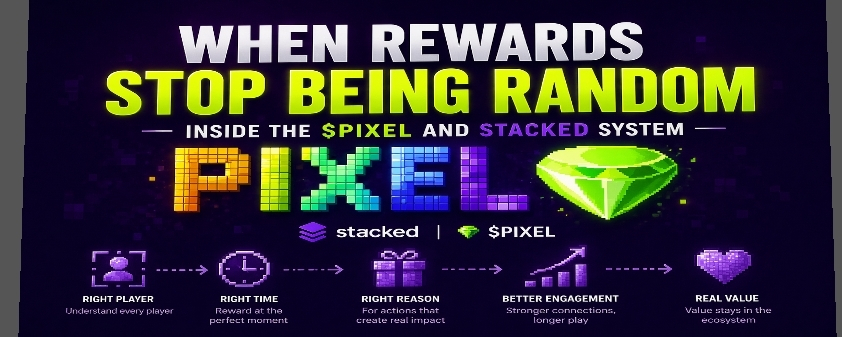
When Rewards Stop Being Random Inside the $PIXEL and Stacked System
--
Zastrzeżenie: zawiera opinie stron trzecich. To nie jest porada finansowa. Może zawierać treści sponsorowane. Zobacz Regulamin