
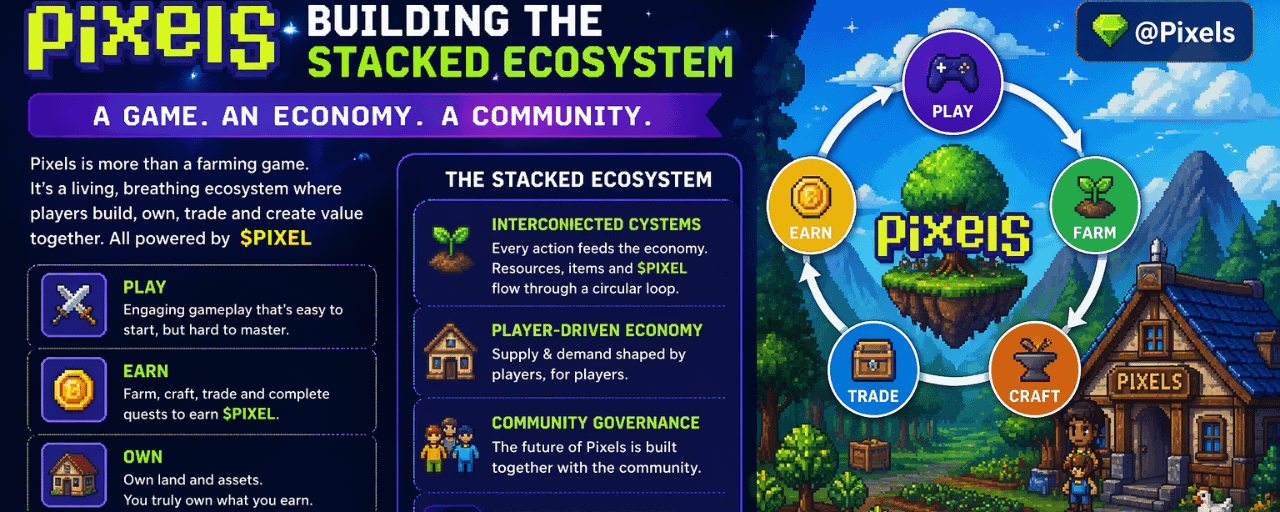
The evolution of @Pixels is becoming a strong case study for how Web3 games can move beyond simple play-to-earn models into something far more sustainable. What stands out is the idea of a “Stacked ecosystem,” where gameplay, resource generation, crafting, land ownership, and social interaction are all interconnected rather than isolated features.
In many early blockchain games, economies collapsed because value was not truly recycled within the system. With $PIXEL, the design appears to focus more on circular utility — where players are not just earning tokens, but actively participating in an economy that requires continuous interaction, decision-making, and strategy. This creates a healthier balance between supply and demand over time.
Another key factor is accessibility. @Pixels lowers the barrier for entry while still allowing depth for advanced players. Casual users can farm, explore, and interact, while more experienced players can optimize land, production chains, and economic strategies. This layered design is exactly what a “stacked” system should look like — simple on the surface, complex underneath.
If this model continues to evolve, #pixel could represent a shift in Web3 gaming toward ecosystems where value is built through participation, not just speculation. That’s what will ultimately separate short-lived projects from those that can sustain real user engagement over the long term.