
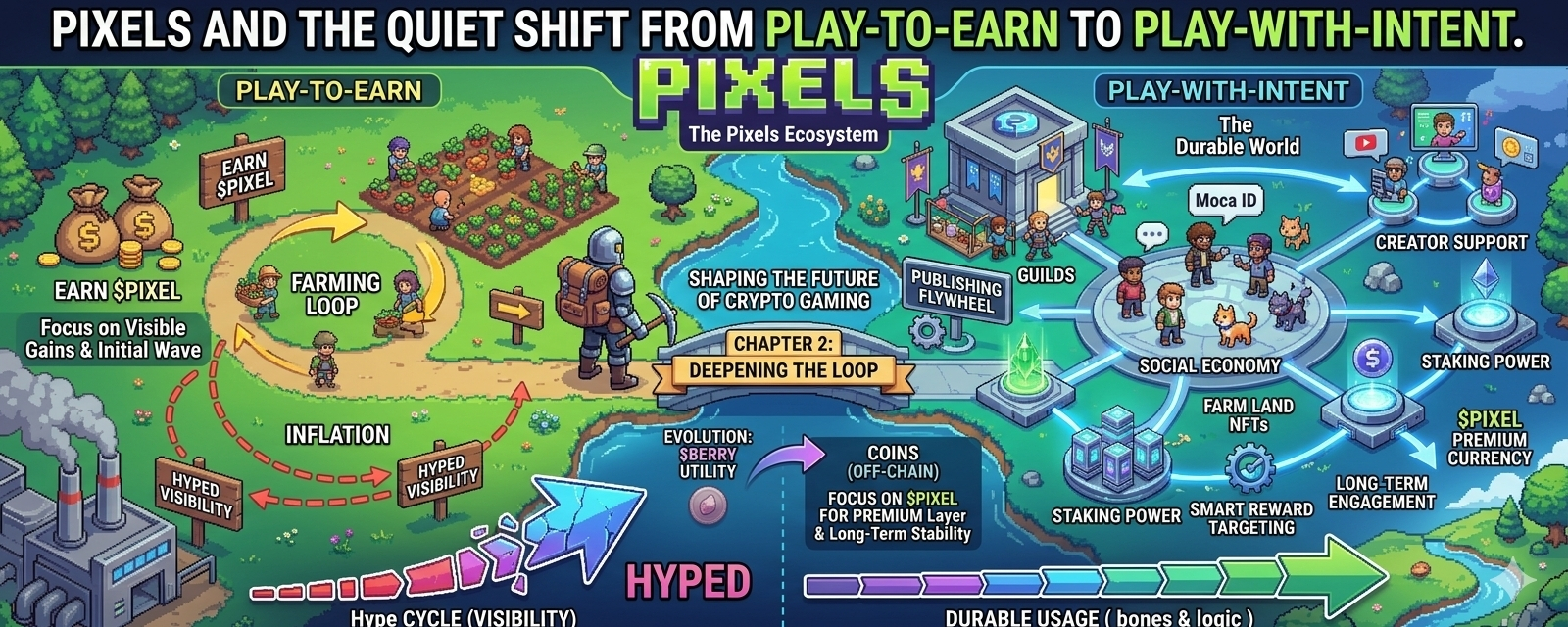
I ran into Pixels the way I usually notice games now: not through a loud launch thread, but through a quieter trail of mentions that kept following me around. That matters more than it used to. I have become less interested in whether a project is visible and more interested in whether it has bones: a real loop, a reason to return, and some internal logic that still makes sense after the first wave of excitement fades.
Pixels presents itself as an open-ended world of farming, exploration, and building, but the more important line is on its homepage: it is trying to become a platform where games can natively integrate digital collectibles, with land, guilds, avatars, and other shared structures built around ownership rather than pure spectacle. The official site leans hard into social play, crops, animals, energy, and collaboration, while the whitepaper frames the project as more than a single game and more than a typical P2E experiment. It is trying to solve the old problem of crypto gaming: how to turn incentives into something durable instead of merely extractive.
That is the first place I separate hype from usage. Visibility says a game exists. Usage says people return because the loop is worth their time. Pixels’ own language has shifted toward that second question. The whitepaper says the team is focused on “fun first,” smart reward targeting, and a publishing flywheel that uses player data and incentives to improve acquisition and ecosystem health. In other words, the project is not just selling a world; it is trying to engineer the conditions that keep a world inhabited. That is a more serious ambition, and also a harder one to fake.
The token, $PIXEL, sits inside that design as more than a decorative asset, but also less than a magical answer. In the current docs it is described as a premium in-game currency used for items, upgrades, cosmetics, land minting, build-time acceleration, temporary energy boosts, skins, XP and skill enhancers, crafting recipes, pets, and even merchandise. The same documentation is explicit that players do not need $PIXEL to progress. That is an important detail: the token is not positioned as a gatekeeper to basic participation, but as a premium layer that amplifies, personalizes, or coordinates the experience.
That distinction matters because a lot of gaming tokens fail by pretending they are both essential and optional at the same time. Pixels seems to have learned something from that mistake. Its FAQ says the game has moved to focus on and phase out $BERRY, with $BERRY holders rewarded in $PIXEL and the softer in-game currency shifted off-chain into Coins. The same FAQ says the move is meant to improve fairness, reduce market sell pressure, and simplify the economic model for long-term gameplay. Years earlier, the Ronin migration blog described $BERRY as the live in-game utility token. That evolution tells you something real about the project’s thinking: it is less attached to a single token narrative than to whatever structure keeps the economy from collapsing under its own inflation.
Staking is where $PIXEL starts to look more like an internal coordination layer than a simple spend token. Pixels’ help center says you can stake $PIXEL either in-game or through the dashboard. In-game staking is passive but requires recent activity and at least 100 $PIXEL; on-chain staking has no minimum deposit and no in-game activity requirement. Rewards are delivered automatically, and if a game leaves the ecosystem, users can reallocate their stake elsewhere. That is not the language of passive yield marketing; it is the language of an ecosystem trying to route attention and support toward specific projects inside a broader universe.
The most convincing parts of Pixels are not the places where the token is loudest. They are the places where the token becomes a coordination tool. Content Creator Codes give purchasers a 5% discount while routing a share of the purchase to creators or guild treasuries, with tiered rewards for higher-effort creators. Guild creation itself requires reputation and $PIXEL, and guild owners can receive a fee share from shard purchases. Farm Land NFTs also increase in-game staking power, which means ownership, activity, and long-term participation are linked rather than fully separated. Even the Mocaverse partnership is built around proof of participation, with RP missions gated by Moca ID ownership. These mechanics are not glamorous, but they are the kind that can make a world feel inhabited rather than merely traded.
That is also where my caution grows. A project can build a lot of motion without building much durability. Pixels’ own whitepaper says it wants targeted rewards, data-driven allocation, and better incentive alignment because traditional play-to-earn has been broken by sloppy economics. That is a fair diagnosis, but it is also a reminder that the hard part is not launching systems; it is keeping them honest when players adapt faster than designers expect. If the rewards simply chase whatever behavior is easiest to farm, the token becomes a leakage mechanism. If the economy keeps rewarding genuine contribution, it becomes infrastructure. The difference is subtle until it is not.
What would build conviction for me is not a bigger headline or a louder market cycle. It would be evidence that Chapter 2 actually deepens the loop the project claims to care about: regular updates, sustained activity, stable staking participation, creator and guild retention, and a clear reason for players to keep making things after the initial novelty wears off. The homepage says updates arrive every two weeks and that Chapter 2 is here; that is the kind of cadence that matters only if the content stays meaningful. The site also claims over 10 million players, but raw reach is not the same as durable usage, and in crypto gaming those two numbers often separate very quickly.
So Pixels looks to me like a project that has moved beyond the easy story. It is no longer just “a Web3 farming game on Ronin.” It is trying to be a social economy with land, pets, creator funnels, staking paths, and cross-community identity hooks, all tied together by a token that is supposed to organize participation rather than merely advertise it. That is a more credible design than the usual hype cycle, but it also sets a higher bar. Real value is not proven when the token trends or the community is loud. It is proven when meaningful participation survives after the first excitement has already spent itself.
