
I’ve spent enough time in farming games to know when an update is just more content and when it quietly changes the bargaining power inside the loop.
This one feels like the second kind. What caught my attention is that the Tier system does not just add more things to craft; it changes how progression, land value, and industrial access speak to each other.
The old friction in these economies is familiar. A player sees a cute social world, but underneath it the real experience gets shaped by bottlenecks: which land has usable industries, who gets access first, whether higher-skill players can actually express that skill through better production, and whether owning land creates productive capacity or just passive status.
In the network’s Chapter 2 transition, industry tiering was added across farming, cooking, woodworking, metalworking, stoneshaping, mines, and trees; more than 100 new recipes and items were introduced; growth and industry times were cut sharply; and NFT lands were opened up so owners could place as many industries as they could physically fit, subject to level requirements for placing the relevant tier. That is not a cosmetic patch. It is a redesign of throughput.
It feels a bit like replacing a street market with a layered industrial district where every workshop now has zoning rules, machine grades, and better logistics.
What I think the Tier 5 framing really changes is the way players read progression. The important shift is not “higher tier equals stronger item.
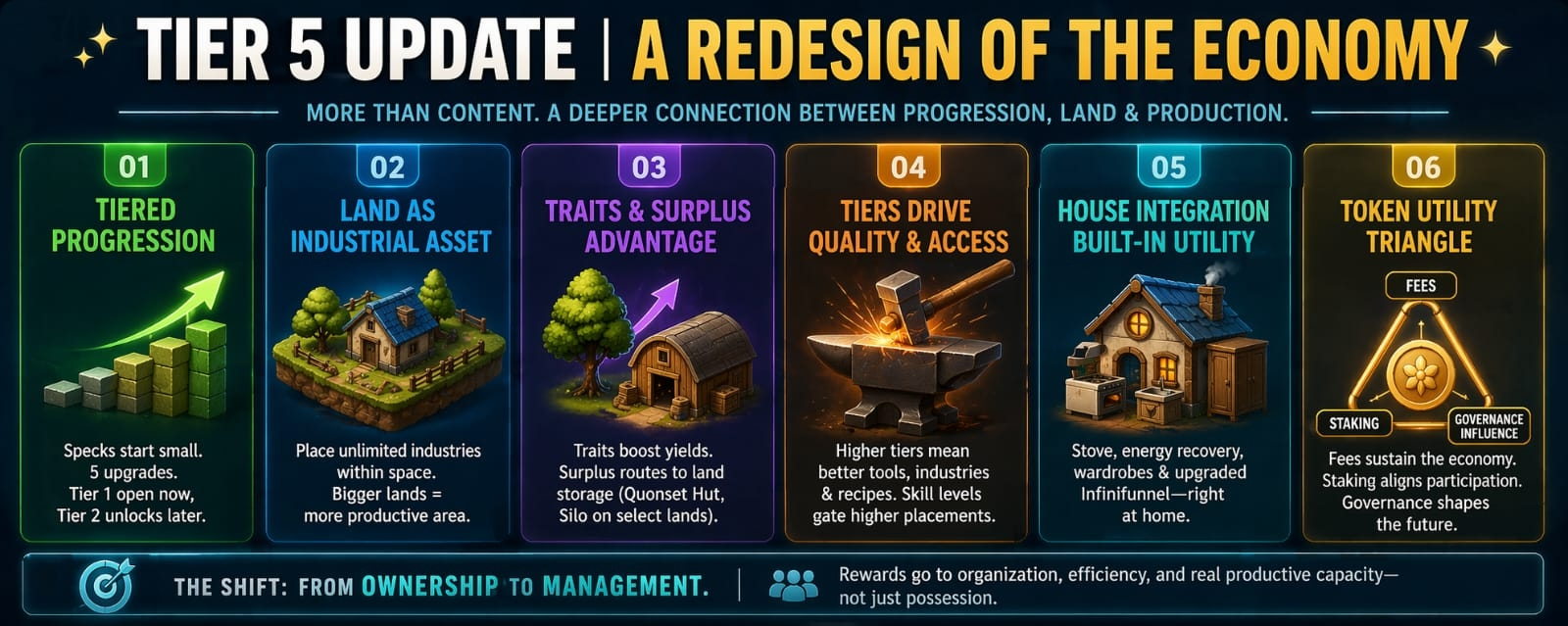
The deeper shift is that the economy becomes more legible as a stack. A beginner speck now starts with a basic productive footprint, specks have five possible upgrades, Tier 1 industries are available immediately, and Tier 2 access opens later in that upgrade path. At the land level, the map is no longer a flat background for harvesting.
It becomes an allocation surface where square footage, trait bonuses, storage, and player skill levels decide whether a space is merely decorative or genuinely industrial.
Large lands have more usable area than small ones, Light or Dense tree traits improve tree drop rates, and surplus systems route part of production back to owners through land storage like the Quonset Hut and, on some lands, the Silo.
That matters because gameplay tension usually comes from a mismatch between effort and infrastructure. If recipes deepen but access remains shallow, the result is friction without strategy. Here, the update tries to solve that by connecting each layer more tightly.
The state model is clearer now: land is not just a location, but a persistent container for industries, traits, permissions, surplus storage, and house-linked utility.
The production model is also clearer: tiers define the quality ceiling of tools and industries, skill levels gate who can place or fully exploit certain infrastructure, and land layout determines how much productive density an owner can actually support.
Even the house layer is folded back into the loop through built-in stoves, energy recovery, wardrobes, and access to the upgraded Infinifunnel.
I find that more interesting than a pure content drop because it creates a more explicit form of consensus selection inside the game economy.
Not blockchain consensus in the narrow validator sense, but rule consensus about who gets to produce, at what tier, on which surface, with what efficiency.
The network is increasingly choosing outcomes through skill-gated placement rules, land traits, surplus probabilities, and recipe dependencies rather than through loose social coordination alone.
In practice, that means the economy becomes less about wandering until you find a usable station and more about whether a landowner has assembled a coherent production graph.
That also changes how I read NFT lands. Before, a lot of game land in web3 could drift into symbolic ownership: technically scarce, but not always operationally meaningful. Here, land has stronger industrial semantics.
The removal of hard industry-count limits, the existence of higher-tier placements, and the role of land level in surplus rates all push ownership toward management rather than display.
If a land has stronger mining levels, its chance of receiving mining surplus rises; if storage is full, collection efficiency stalls; if the owner does not design around actual user flow, the extra square footage does not automatically become extra output.
In other words, the asset is no longer just land. It is negotiated capacity.
That phrase matters to me because price negotiation in game economies rarely happens only on a marketplace screen.
It happens through layout choices, access settings, trait advantages, queue availability, expected surplus, and the opportunity cost of using one tile or one production slot for one chain of recipes instead of another.
Once industries become tiered and more placeable, owners are implicitly negotiating with users over convenience, speed, and specialization.
The value of a plot starts to come less from abstract scarcity and more from how efficiently it converts foot traffic and player labor into useful output.
On the token side, I do not think the right reading is “utility because token.” The more grounded reading is that utility sits in a triangle of fees, staking, and governance-adjacent influence.
The official staking design already distinguishes in-game staking from dashboard staking, with active play required for in-game rewards, no minimum for external staking, and a three-day withdrawal lock after unstaking.
That structure tells me the team wants capital and participation to remain related, but not identical.
It also means token utility is trying to bridge two classes of actors: people optimizing around play loops and people allocating capital around the ecosystem’s broader growth.
So when I look at this update through a CreatorPad lens, I do not see a simple “Tier 5 makes everything bigger” story. I see a chain trying to tighten the relationship between progression and production.
More tiers, more recipes, more industrial density, more meaningful land traits, more explicit storage logic, more staking structure. The interesting question is whether that stack produces healthier specialization or just a more expensive form of coordination.
My current read is that it leans toward healthier specialization, because the mechanics now reward organization over mere possession.
But the real test is whether the network can keep high-tier infrastructure productive without making lower-tier play feel like waiting room labor.
