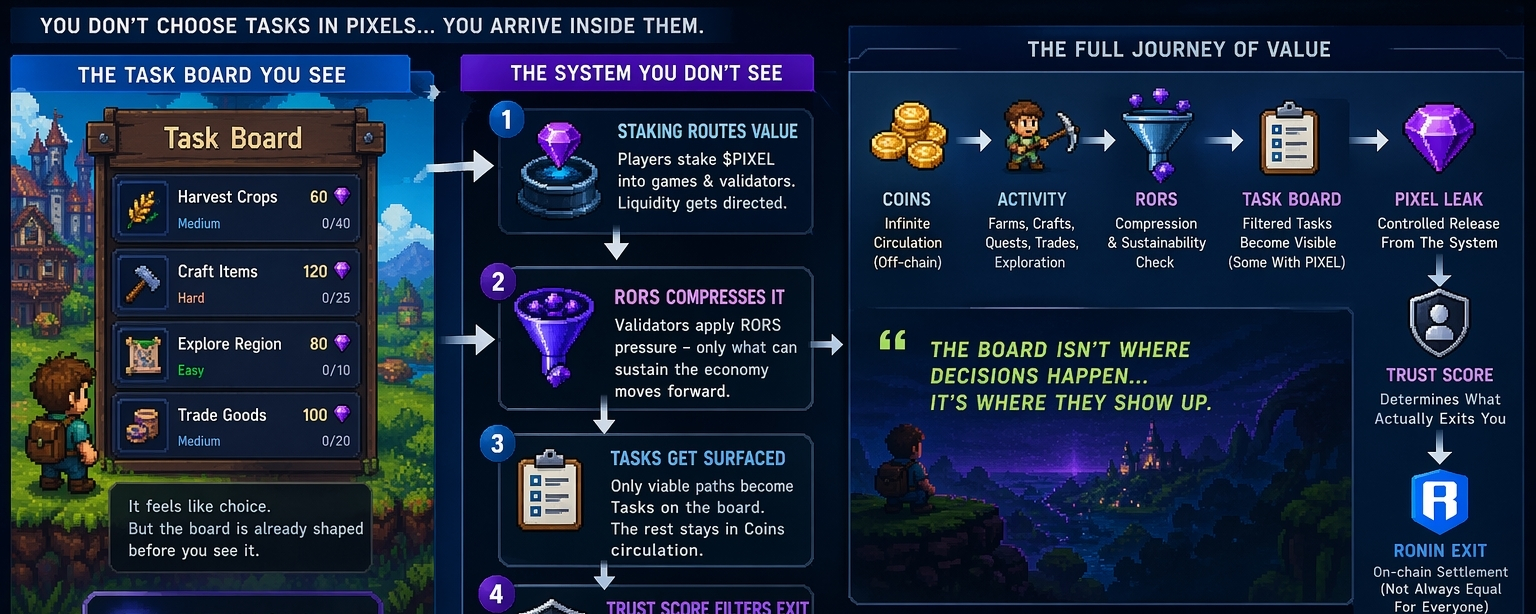


Open the Task Board, pick an activity, complete it, and earn $PIXEL. It looked like a standard cause-and-effect system. But over time, that sequence began to feel less reactive and more pre-arranged. The board never appeared raw or responsive. It felt composed in advance, as though I wasn’t selecting tasks, but arriving inside outcomes that had already been filtered.
That shift changes everything. Because if the Task Board is already shaped before interaction, then the visible layer of gameplay isn’t where decisions originate it’s where they surface. Some chains appear deep and well-funded, others thin and inconsequential. At first glance, this might seem like natural variation. But the consistency of that imbalance suggests something else: upstream constraint. Before any task becomes visible, it appears to pass through systems that determine whether it can sustain value distribution without destabilizing the broader economy.
This is where staking quietly enters the picture. Initially, it feels detached from gameplayba passive layer for holders rather than players. But that separation dissolves under closer observation. Staking doesn’t just lock tokens; it directs liquidity. It influences which validators carry weight, which game loops receive reward allocation, and ultimately which activities survive long enough to appear on the board. What looks like choice at the surface is already shaped by capital direction beneath it.
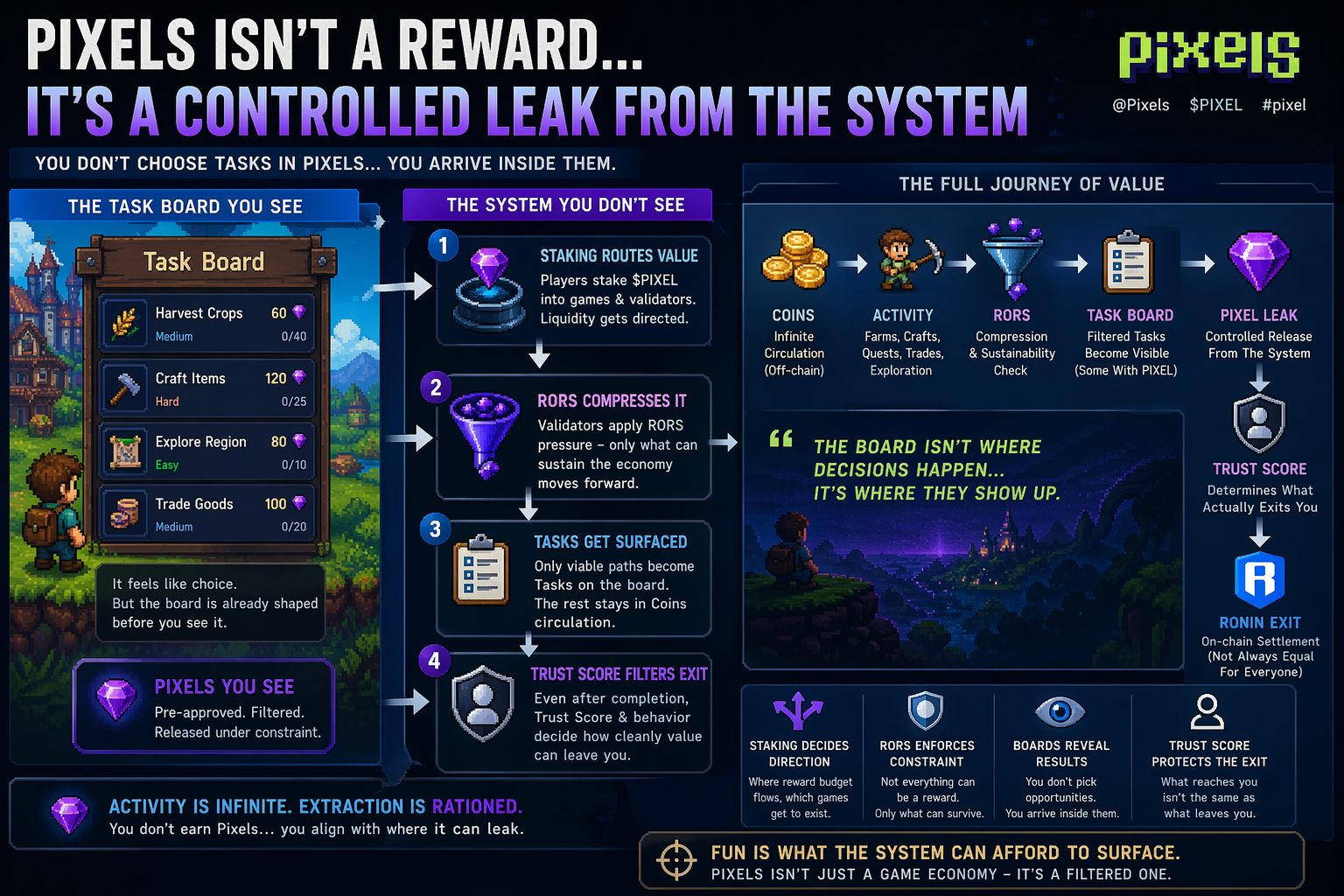
RORS introduces another layer of compression. It functions less like a metric and more like constant pressure—ensuring that not all activity translates into reward-bearing output. Coins circulate freely, supporting infinite engagement without restriction. But $PIXEL behaves differently. It appears selectively, attached to specific paths that have already passed through economic filters. This distinction is critical: activity is abundant, but value is rationed.
The implication is subtle but significant. Rewards are not simply generated by effort; they are allocated through constraint. When a task offers $PIXEL, it reflects a decision made upstream one that considers budget, sustainability, and system balance. What reaches the player is not raw output, but pre-approved distribution. The Task Board, then, becomes less of a generator and more of a display layer for filtered reward flow.
This dynamic extends beyond visibility into ownership itself. Inside the game, earning feels immediate. Tasks complete, balances update, and value appears accessible. But the moment that value approaches exit toward the Ronin network the system tightens. Withdrawal introduces friction not present during gameplay. Timing varies, outcomes differ between players, and progression feels evaluated rather than automatic.
This is where Trust Score and behavioral modeling seem to operate. Not as explicit barriers, but as subtle regulators. Two players can perform identical actions yet experience different exit conditions. One transitions smoothly, another encounters delay. The distinction suggests that earning and ownership are not equivalent stages. Value may exist within the system, but it is not fully realized until it successfully exits.
That separation reframes the entire economy. Pixels is not simply a reward token it functions as a controlled release mechanism. Value accumulates within an off-chain environment where activity is effectively infinite, but only a portion is allowed to pass through to on-chain settlement. The system must regulate this flow to maintain balance. If all generated value exited freely, sustainability would collapse.
Seen from this perspective, the experience inside Pixels is less about producing value and more about aligning with where value is permitted to move. Sessions begin to feel uneven not because of player inconsistency, but because of underlying allocation. Some boards feel “alive,” backed by routed liquidity and capable of supporting extraction. Others feel hollow, sustaining activity without any meaningful pathway to $PIXEL
This raises a deeper question about agency. If staking determines direction, RORS defines limits, and Trust Score influences exit, then where does player control truly sit? Actions still matter, but they operate within boundaries that are already narrowed. Progress may not be about increasing output, but about positioning drifting closer to zones where reward flow is active and sustainable.
In that sense, Pixels is not purely a game economy; it is a filtered system. Staking sets direction, constraints shape visibility, and exit conditions finalize ownership. Each layer reduces randomness while preserving the appearance of open interaction. From the inside, it feels like participation. From a structural view, it resembles navigation through pre-defined economic pathways.
The most important realization is that what appears as opportunity may already be the result of prior decisions. By the time a task reaches the board, its viability has been assessed. By the time $PIXEL appears, its release has been justified. And by the time a player attempts to withdraw, the system is already evaluating whether that value can safely leave.
This does not diminish the experience it clarifies it. Pixels is not attempting to eliminate the flaws of play-to-earn at the surface level. It addresses them earlier, at the point where value is routed, filtered, and controlled before it ever becomes visible. The result is a system where engagement remains fluid, but extraction is carefully managed.
Understanding this distinction shifts the focus. It’s no longer just about what to do within the game, but about recognizing the structure that defines what can emerge from it. Because in Pixels, the real economy isn’t only in what you play—it’s in what the system allows to exist.