
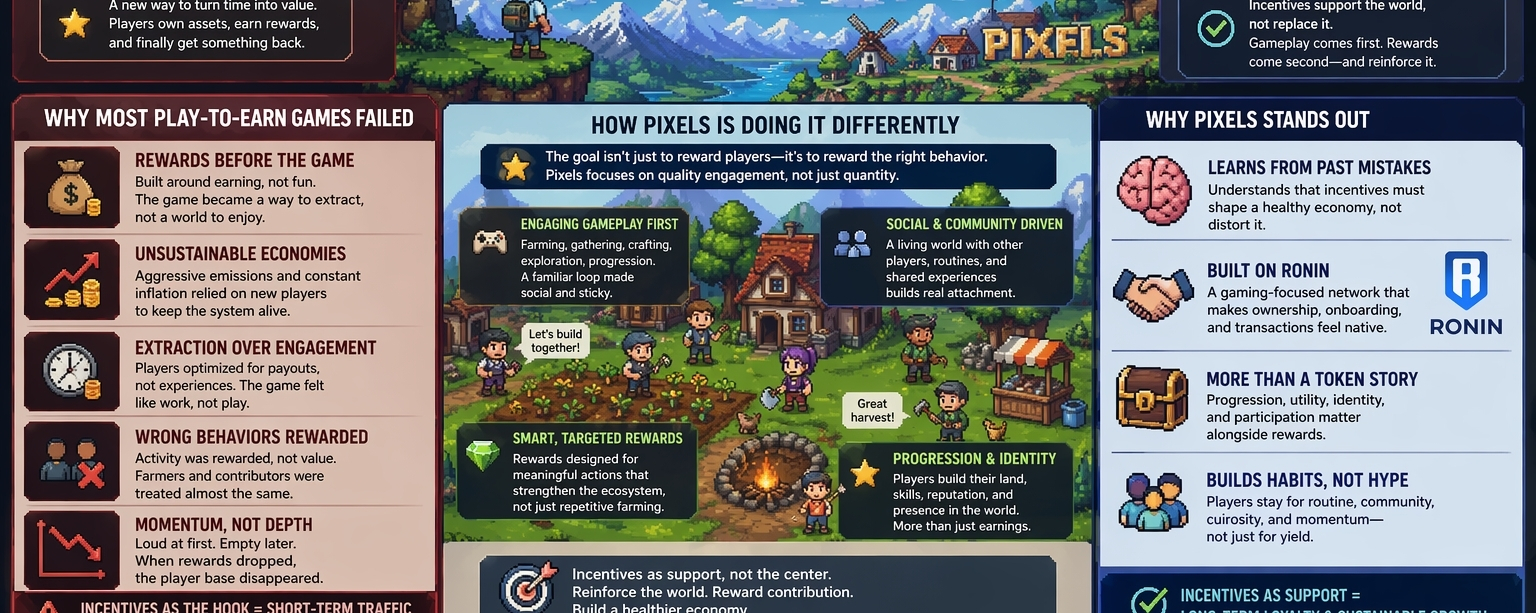
For a while, play-to-earn felt like the big breakthrough.
It gave Web3 gaming a narrative people could understand instantly. Play a game. Earn a token. Turn your time into something with market value. On the surface, it sounded like a smarter relationship between players and digital worlds. Instead of spending hours inside a game and walking away with nothing, people could finally own assets, earn rewards, and feel like their time meant something beyond entertainment.
That idea spread fast because it touched a real frustration. Traditional games had trained players for years to pour time, money, and attention into closed systems they never really owned. So when blockchain gaming arrived with the promise of real ownership and real rewards, people were ready to believe in it.
The problem was that belief moved faster than design.
A lot of early play-to-earn projects were built around the reward before they were built around the game. That sounds simple, but it changed everything. When the main reason people show up is to extract value, the system starts behaving less like a game and more like an economy under pressure. The world might look playful on the surface, but underneath it, everyone is doing the math.
That’s where things started to fall apart.
Most of those games were not really built on sustainable participation. They were built on incentive loops that only looked healthy as long as new people kept entering. Rewards were distributed aggressively. Emissions kept flowing. Players learned very quickly that the smartest way to engage was not always to enjoy the game, but to optimize the payout. Once that becomes the dominant behavior, the whole atmosphere changes.
The game stops feeling like a world.
It starts feeling like a system to work.
And once that happens, people treat their time differently. They stop asking whether something is fun, memorable, or worth coming back to. They start asking whether it still pays enough. Whether the token is holding up. Whether the grind is still worth it. Whether selling now is smarter than staying.
That shift may look small from the outside, but it rewires the whole experience.
A game can survive balance problems. It can survive content gaps. It can even survive a rough launch if players care enough about the world to stick around. But when the core relationship is built around extraction, patience disappears. As soon as rewards weaken, the emotional connection weakens too, because in many cases there was never much of one to begin with.
That is why so many play-to-earn games felt powerful at first and empty later.
They were driven by momentum, not depth.
The incentives were loud, but they were not always intelligent. They rewarded activity, but not necessarily meaningful activity. They encouraged participation, but not always the kind of participation that makes a game stronger over time. A player farming the system and a player contributing to a living economy were often treated almost the same way. That was one of the biggest structural mistakes in the entire model.
Not all activity creates value.
That should have been obvious from the start, but much of the sector acted as if user numbers alone were proof of health. They weren’t. A crowded system is not always a healthy one. Sometimes it is just a system under active extraction.
That’s what makes Pixels worth paying attention to.
Not because it has somehow removed every risk that comes with Web3 gaming. It hasn’t. And not because it can magically escape the economic realities that shaped the rest of the sector. It can’t. But it does seem to be approaching the incentive question from a more thoughtful angle.
Pixels does not feel like it is trying to repeat the loudest version of play-to-earn. It feels more like a response to its failures.
That difference matters.
Instead of building everything around the simple promise of earning, Pixels seems more focused on the relationship between gameplay, social activity, progression, and rewards. That may sound like a subtle distinction, but it changes the foundation. The question is no longer just, “How do we reward players?” It becomes, “What exactly should be rewarded, and why?”
That is a much better question.
Because most of the early damage in play-to-earn came from treating incentives too broadly. Reward the wrong behavior at scale, and players will naturally organize themselves around that behavior. If the easiest path to gain is repetitive extraction, that is what the ecosystem will attract. If the incentives ignore quality, long-term participation, or real engagement, then those things begin to matter less.
Pixels seems more aware of that trap than a lot of projects that came before it.
At its core, the game is still approachable. Farming, gathering, exploration, progression, crafting. The loop is familiar enough to be accessible, but it is wrapped in a social layer that makes the experience feel less transactional than many earlier Web3 titles. That matters more than people sometimes admit. When a game feels social, inhabited, and routine-driven, players behave differently. They are not just cycling through an earning loop. They are building habits. They are investing identity into the space. They are participating in something that starts to feel shared.
That kind of engagement is far more durable than raw yield-chasing.
And Pixels seems to understand that rewards work better when they sit inside a world people already want to spend time in.
That may be one of the clearest differences between Pixels and older play-to-earn games. In many earlier projects, the financial layer did most of the heavy lifting. It was the main attraction. In Pixels, the design at least appears to push toward something softer and more grounded: make the world sticky first, then layer rewards into that environment in a way that supports the ecosystem rather than distorting it completely.
That does not mean incentives disappear. It means they are being treated more carefully.
And honestly, that is what the space needed from the beginning.
The old play-to-earn model often felt like it had no real filter. Rewards were broad, obvious, and often too easy to farm in predictable ways. Pixels seems more interested in targeting value instead of spraying emissions everywhere and hoping the economy somehow balances itself later. That shift from blanket rewards to smarter reward design may end up being more important than any single token chart or launch moment.
Because blanket rewards are easy.
Useful rewards are hard.
Useful rewards require knowing which players are helping create a healthier economy and which players are just draining it. They require design that can tell the difference between routine participation and opportunistic extraction. They require the confidence to avoid overpaying for shallow engagement. Most early projects either could not do that or did not want to slow themselves down long enough to try.
Pixels looks like it is trying.
And that effort becomes even more important when you consider the network it sits on.
Being part of Ronin gives Pixels an environment that is already oriented toward gaming rather than forcing a game to live awkwardly inside infrastructure built for everything else. That does not solve the incentive problem on its own, but it helps create conditions where onboarding, asset ownership, and ecosystem activity feel more native to the experience instead of bolted on after the fact.
Infrastructure does not make a game good. But it does shape what kind of game can grow comfortably.
Pixels has also benefited from being more than just a token story. That is important. One of the weaknesses in earlier play-to-earn projects was that the entire conversation kept collapsing back into price, earnings, and speculative upside. Once that becomes the center of gravity, every design choice starts getting judged through a financial lens. The game loses room to breathe as a game.
Pixels still lives in the Web3 world, so it cannot fully escape that pressure. But it seems more interested in building an ecosystem where progression, utility, identity, and participation all matter alongside rewards, not beneath them.
That creates a healthier tone.
It also creates a healthier expectation.
Because the truth is, players do not stay in a world for long just because it pays them. They stay because it gives them routine, momentum, status, social presence, curiosity, or a feeling that their time is feeding into something larger than a short-term payout. The strongest game economies have always worked that way, even outside crypto. People return because the system becomes part of their day, not just part of their spreadsheet.
That is where many play-to-earn projects misunderstood human behavior.
They assumed value alone would create loyalty.
Usually it creates traffic first. Loyalty is much harder.
Pixels seems closer to understanding that loyalty has to be earned through texture. Through familiarity. Through social presence. Through systems that feel alive enough for people to care about even when they are not actively calculating output every minute. If that foundation gets strong enough, incentives become reinforcement instead of bait. And that is a much healthier role for rewards to play.
Maybe that is the simplest way to explain the difference.
Most play-to-earn games treated incentives as the hook.
Pixels appears to be trying to treat incentives as support.
That does not mean it is guaranteed to succeed. Web3 gaming is still young, still volatile, and still vulnerable to the same cycles that hurt earlier projects. There is no clean escape from that reality. Any game operating in this space has to wrestle with speculation, shifting player expectations, and the constant tension between economy and experience.
But there is still a meaningful difference between repeating a broken model and trying to build past it.
Pixels feels closer to the second path.
And that is why it stands out.
Not because it is perfect. Not because it has answered every question. But because it seems to recognize something that much of the first wave got wrong: incentives cannot carry a weak game forever, and a reward system is only as strong as the behavior it encourages.
That lesson was expensive for the sector.
A lot of projects learned it too late.
Pixels seems to have started there.
And in a space still trying to grow out of its first set of mistakes, that alone makes it worth taking seriously.
