
I’ve seen too many GameFi platforms promise that “this time infrastructure will change everything.” New chains, new SDKs, new systems for developers—and yet the same cycle keeps repeating. Games struggle to retain players, tokens lose momentum, and the infrastructure ends up looking better on paper than it does in reality.
From my perspective, GameFi has never really lacked tools. What it lacks is something much simpler: a place where players actually want to stay long enough for those tools to matter.
That’s been the core issue for years.
Most previous systems started by designing the token economy first and the gameplay second. Rewards came before experience. The result was predictable—players joined for profits, not because they cared about the game itself, and once those profits dropped, they disappeared just as quickly.
Too many projects became “games that make money” instead of games people would play even without the earning aspect.
And when every project exists as its own isolated silo, the problem gets worse. Players can’t carry progress or value across games. Studios can’t inherit communities or user behavior. Liquidity, attention, and engagement all get fragmented, forcing every new project to spend heavily just to restart the same cycle again.
That’s the part I keep coming back to.
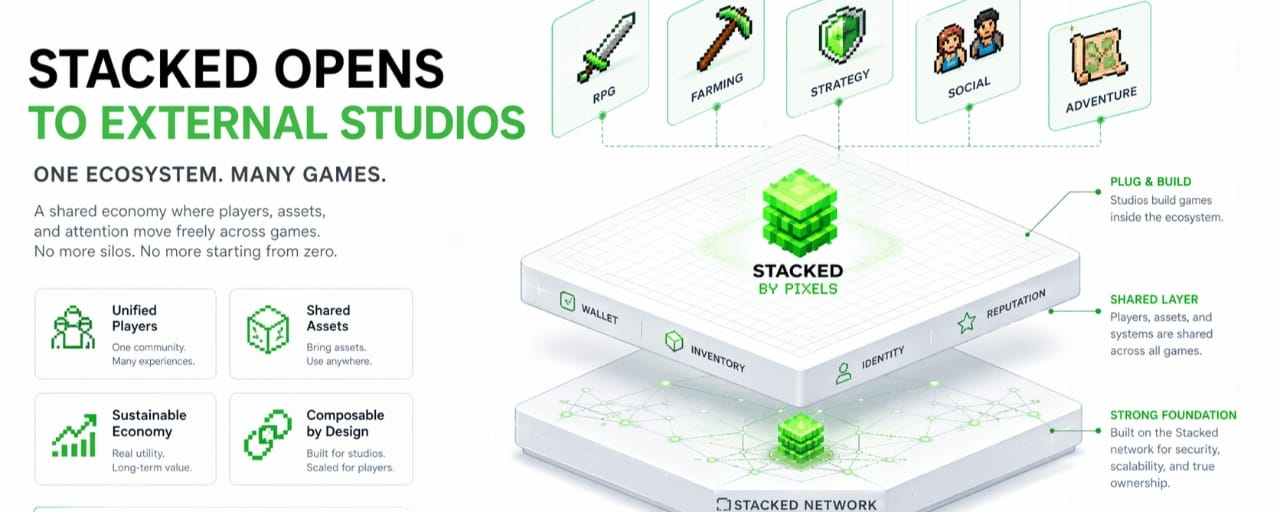
What makes Stacked interesting is that Pixels seems to be approaching this differently. Instead of simply creating another game, they’re trying to build a shared economic layer where outside studios can plug into an ecosystem that already exists.
This sounds familiar—many projects have said something similar—but the difference here seems to be the focus.
It’s less about providing another technical framework and more about opening access to an environment that already has active players, capital flow, and established behavior patterns.
Studios aren’t just launching games from zero—they’re building inside a system where players are already present.
Players don’t necessarily need to leave one ecosystem to try something new; they move within the same environment. Assets, attention, and habits can stay inside the loop.
At least in theory, this helps solve one of GameFi’s oldest problems: fragmentation.
But theory is always easier than reality.
Do players actually care about ecosystem depth, or are they still just following short-term rewards? Are studios truly benefiting from network effects, or are they still forced to acquire users from scratch? And most importantly, does the gameplay itself create retention, or is everything still just another reward layer built on top of weak foundations?
It feels like Pixels is betting that long-term retention won’t come from one successful game, but from an ecosystem where players have multiple reasons to stay.
That idea makes sense—but it’s also much harder to execute.
Because building a game is one thing. Building an environment is something else entirely.
Environments can’t be faked.
They need sustainable activity, players who remain even when rewards cool down, and engagement that exists beyond token incentives. There has to be value that doesn’t show up neatly on dashboards.
That’s why I don’t see opening Stacked to outside studios as an immediate breakthrough. It feels more like an experiment—testing whether GameFi can move beyond isolated titles and become something more interconnected.
It’s a strong idea, but also a fragile one.
Because in the end, everything still comes back to the same question:
Why do players stay?
Not because of the system. Not because of the whitepaper. Not because of the token model.
But because they genuinely want to be there.
And that answer still isn’t clear—which is exactly why I’m still watching closely.