
I am a student, and along with my studies and work, I spend time exploring Web3 games, especially the @Pixels ecosystem. Not in a very technical way, but by actually playing, observing, and trying to understand how things work in real experience.
One thing I have noticed while exploring Pixel is that it doesn’t feel like just a token system. It feels like a growing ecosystem. But at the same time, it also made me think deeply about how GameFi works.
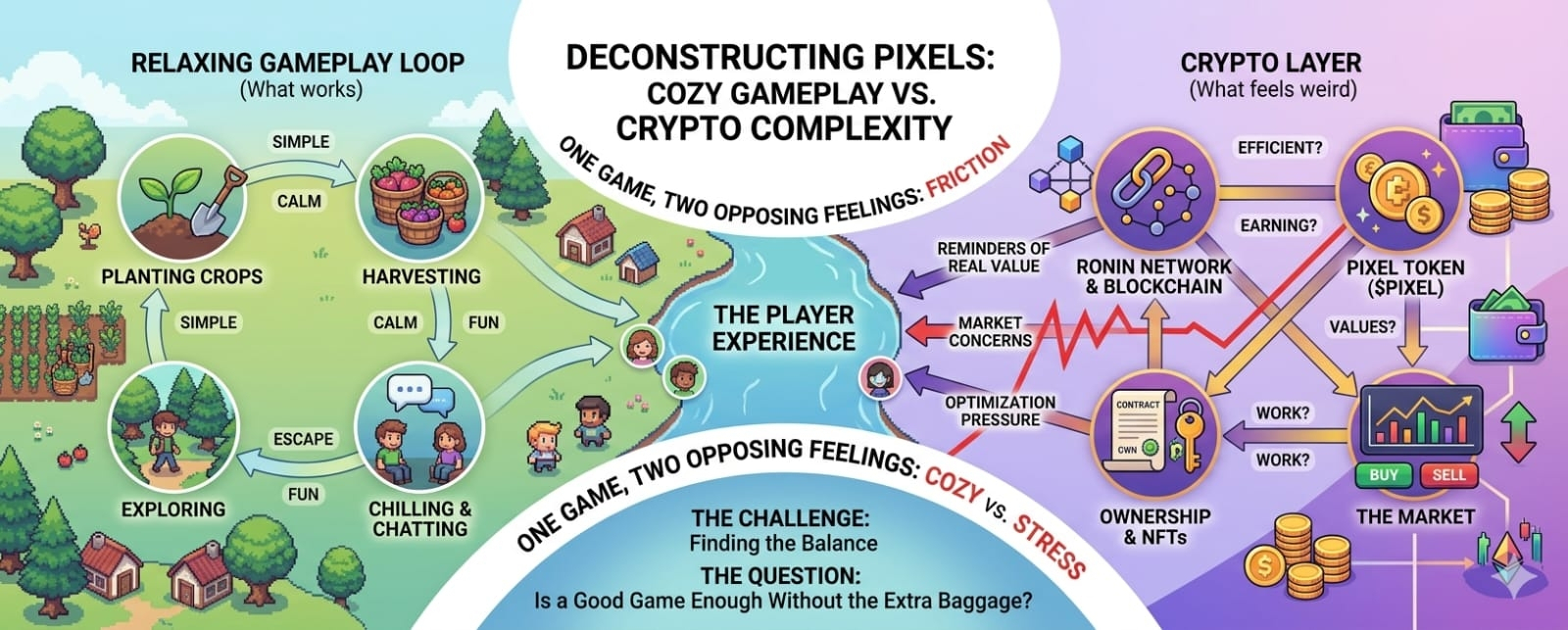
In the beginning, when I started playing, everything felt simple and enjoyable. Farming, collecting, interacting—these small activities felt relaxing. I was not thinking about earning much. I was just exploring and enjoying the game.
But slowly, as I understood more about the Pixel coin and its value, my thinking also started changing.
I began to focus more on rewards.
I started asking myself: How much can I earn from this?
Is this activity worth my time?
What is the best way to maximize output?
Without realizing, I shifted from enjoying the game to optimizing everything.
This is something I have seen not only in Pixel, but in many GameFi projects.
At first, earning feels like a bonus. But later, it becomes the main reason. And when that happens, the experience starts changing. The game feels less like a game and more like a system to manage.
But what I found interesting in Pixel is that it is trying to balance this.
It is not only about earning. It is also about building an ecosystem where players can stay engaged. Farming, trading, and interacting are not just tasks—they are part of a loop that keeps the system active.
From my observation, Pixel is slowly moving towards a more sustainable model.
Instead of giving easy rewards, it is trying to create a balanced economy. Where effort matters. Where rewards are controlled. And where players need to actually participate, not just extract value.
This is important because most GameFi projects fail when rewards are too easy. People come, farm, and leave.
But in Pixel, I feel there is an attempt to reduce that behavior.
Another thing I find interesting is how the ecosystem is expanding. It’s not just one game. There are layers being built—different experiences, different ways to engage. This creates long-term value.🚀
Also, the idea of community involvement is growing slowly. Not everything is fully decentralized, but there is a direction. Control is gradually shifting, which feels more stable.
From my small level of research and personal experience, I feel Pixel is not perfect—but it is learning.
It is trying to fix one of the biggest problems in GameFi: How to keep players interested beyond just earning.
Because in the end, I have realized one simple thing:
Players don’t stay for rewards only.
They stay where they feel connected.
If Pixel can maintain that balance between fun and earning, it has a strong chance to grow.
Otherwise, it can also follow the same path as many other projects.
For me, Pixel is not just about a coin.
It is like a live example of how GameFi is evolving.
And maybe, it is not just growth.
Maybe it is a correction.
At the end, players don’t follow rewards—they follow feelings.@Pixels
