
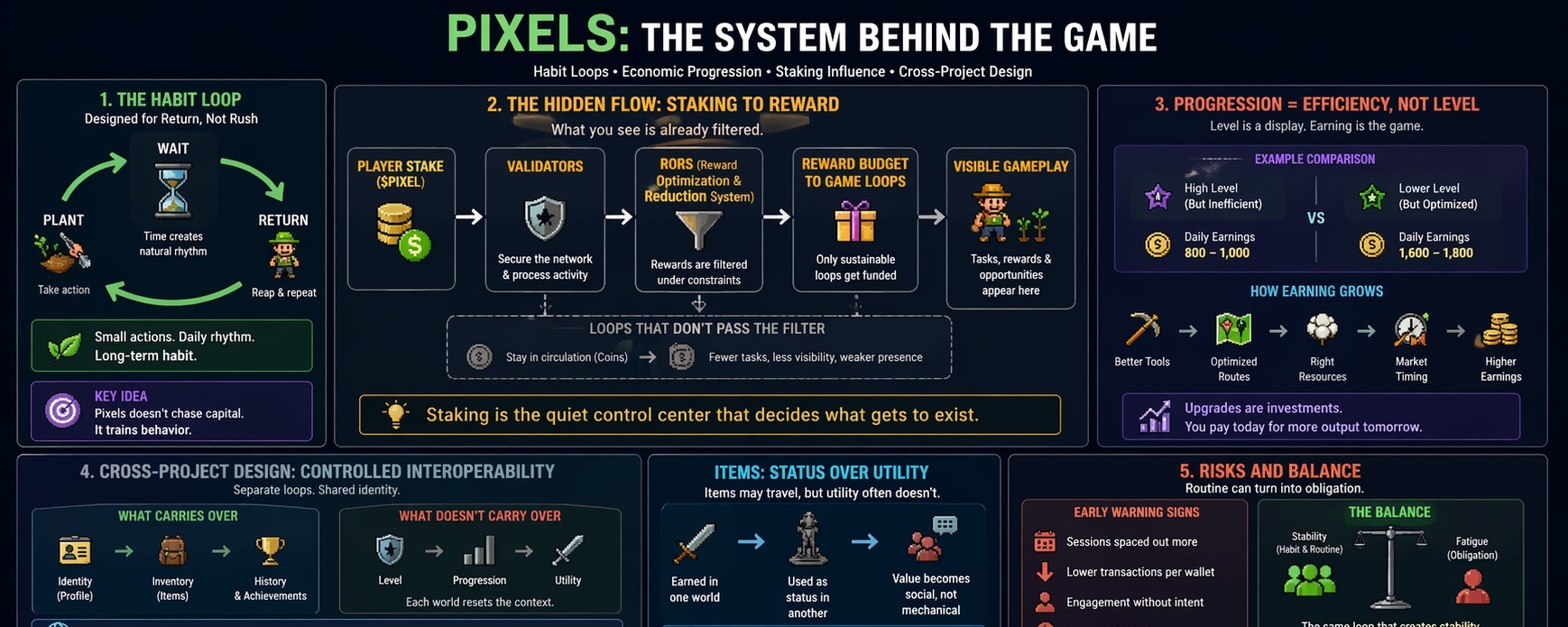
@Pixels In the world of Web3 gaming, most projects try to define themselves through hype, bold promises, or rapid capital inflows, but Pixels takes a quieter and more deliberate path. It doesn’t try to impress immediately or chase speculative attention; instead, it builds a system that gradually shapes user behavior, which ultimately becomes its strongest foundation. On the surface, Pixels looks simple—farming, gathering, and completing small tasks—but beneath that simplicity lies a carefully designed behavioral loop. Players plant, wait, and return, and that waiting period is not a limitation but a mechanism that creates rhythm and habit. Over time, these small, repeatable actions form consistent engagement, making the system less about excitement and more about routine participation.
Unlike many crypto projects that prioritize capital, Pixels focuses on stabilizing behavior. This distinction matters because capital tends to settle where user behavior becomes predictable. Instead of relying on large, irregular inflows, Pixels builds value through frequent, low-intensity interactions. Daily transactions, even if small, are more meaningful than occasional spikes, as they indicate that users are embedded in the system. This shifts how progression works as well. In most games, higher levels signal advancement, but in Pixels, level is largely a surface metric. True progression is defined by efficiency—how effectively a player can generate value within the system. A lower-level player with optimized strategies can outperform a higher-level player who lacks consistency or market awareness, turning the game into a micro-economic environment rather than a linear progression model.
Upgrades in Pixels further reinforce this economic layer. They are not simply about becoming stronger but about making calculated investment decisions. When players upgrade tools or improve their processes, they are essentially trading upfront costs for increased future output, similar to optimizing a production line. However, this advantage is not permanent. As more players optimize, overall supply increases, which can push prices down and reduce individual profitability. This introduces a competitive dynamic where progression is not just personal but relative to the broader system. At the same time, there is a deeper layer operating beneath visible gameplay. Rewards do not appear randomly; they are filtered through staking and validator mechanisms before becoming accessible. This means that what players see—the available tasks, active loops, and rewarding activities—has already passed through a system that determines what is sustainable. Many potential loops never fully surface; they simply remain invisible due to insufficient support.
This is where staking emerges as a quiet but central force within Pixels. Initially perceived as separate from gameplay, it actually shapes the direction of the entire system by influencing how rewards are distributed and which activities remain viable. In this sense, players are not just participating in the game; they are indirectly contributing to what is allowed to exist within it. The system also maintains a delicate balance between social and economic elements. It is neither purely financial nor purely social, which makes it more resilient. Systems that are too financial invite exploitation, while purely social systems struggle to sustain value. Pixels operates in the middle, where ambiguity becomes a strength, allowing value to persist without being easily extracted.
Another area where Pixels stands out is its approach to cross-project ecosystems. While many Web3 platforms attempt to unify everything into a shared universe, Pixels intentionally maintains separation between different game loops. Identity and inventory may carry across worlds, but utility does not. An item earned in one environment may exist in another, but its function may change or disappear entirely. This design prevents players from exploiting a single optimized loop across multiple systems and preserves the uniqueness of each experience. As a result, items take on a new role—not just as tools, but as symbols of history and status. Their value becomes social as much as functional, shifting how players perceive ownership.
Despite its strengths, Pixels is not without risk. The same routines that create stability can also lead to fatigue if they begin to feel like obligations rather than choices. When players return out of necessity instead of interest, engagement can decline. Early warning signs often appear subtly, such as reduced session frequency or fewer interactions per wallet. These shifts can indicate that the behavioral loop is weakening. Looking at the bigger picture, Pixels functions less like a traditional game and more like a form of habit-forming infrastructure. It trains users to interact on-chain regularly without friction, embedding these actions into daily behavior. This has broader implications for Web3 adoption, as it lowers the cognitive barrier to participation.
Ultimately, Pixels represents a system where progression is tied to efficiency, staking influences direction, gameplay reflects a filtered reality, and the economy operates as a competitive environment shaped by collective behavior. It doesn’t rely on constant narratives or hype cycles to sustain attention; instead, the loop itself becomes the justification for its existence. This shifts the core question away from short-term gains. It’s no longer just about how much a player earns, but about what their participation helps sustain over time. And in that subtle shift, Pixels reveals its most important idea: value is not only created through capital, but through consistent attention and the behaviors that support it.
