
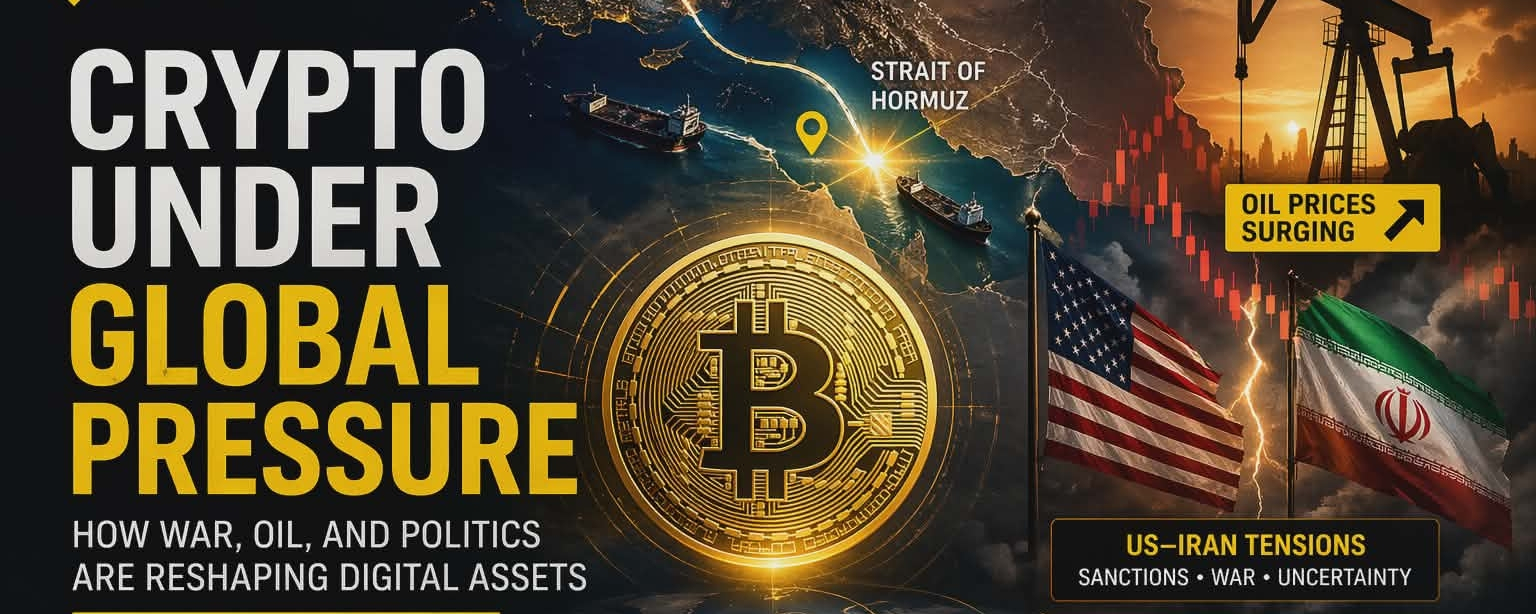
⚡ From the Strait of Hormuz crisis to US–Iran tensions — why crypto markets now move with global power dynamics
🧭 Introduction: Crypto Is No Longer Isolated
Cryptocurrency was once seen as a purely technological revolution — independent from governments and global systems. But in today’s world, that idea no longer holds.
Assets like Bitcoin and Ethereum are now deeply connected to global economics, war, and political decisions.
The reality is simple:
Crypto has become part of the global financial system — and it reacts to global shocks.
🛢️ 1. The Strait of Hormuz: A Global Trigger Point
The Strait of Hormuz is one of the most critical trade routes in the world, responsible for transporting nearly 20% of global oil.
When tensions rise in this region:
⚠️ Oil supply becomes uncertain
📈 Prices surge rapidly
🌐 Global markets react instantly
This is not just an energy issue — it’s a macroeconomic shock that spreads across all financial markets, including crypto.
📊 2. Oil Shock and Its Direct Impact on Crypto
The relationship between oil and crypto may not seem obvious at first, but it follows a clear chain:
🛢️ Oil Disruption → 📉 Inflation Rise → 📊 Interest Rate Hikes → 💧 Liquidity Drop → 📉 Crypto Decline
When oil prices increase:
📈 Inflation rises globally
🏦 Central banks tighten monetary policy
⚖️ Investors move away from risky assets
As a result, crypto markets often experience sharp volatility or downward pressure in the short term.
⚔️ 3. US–Iran Tensions and Financial Disruption
Ongoing tensions between the United States and Iran are not just geopolitical headlines — they directly affect financial systems.
Sanctions and restrictions:
🚫 Limit access to global banking
🔄 Disrupt international trade
🔁 Increase reliance on alternative systems
In such environments, cryptocurrencies emerge as a practical solution for cross-border transactions, bypassing traditional financial barriers.
🪙 4. Crypto as a Tool During Conflict
In times of war or sanctions, crypto transforms from an investment asset into a functional financial tool.
Key roles include:
🌍 Borderless transactions
🛡️ Sanction-resistant payments
💰 Emergency value storage
This shows that crypto is not only speculative — it has real-world utility in crisis situations.
📉 5. Market Psychology and Volatility
Geopolitical instability strongly affects investor behavior.
During global tensions:
😰 Fear increases across markets
💵 Investors shift to safer assets or cash
🔄 Crypto sees rapid price swings
Unlike traditional markets, crypto operates 24/7 — meaning it often reacts faster and more aggressively to global events.
⚖️ 6. The Dual Nature of Crypto
Today, cryptocurrency has two distinct identities:
📉 Short-Term: Risk Asset
📊 Moves with global markets
⬇️ Drops during uncertainty
📉 Sensitive to interest rates
🚀 Long-Term: Financial Alternative
🏦 Independent of central banks
🚫 Resistant to censorship
🌐 Enables global financial access
This dual nature is what makes crypto both volatile and powerful.
🌐 7. The Bigger Picture: A New Financial Landscape
Global systems are changing.
🛢️ Energy routes influence liquidity
⚔️ Political conflicts shape capital flow
📈 Sanctions drive crypto adoption
The Strait of Hormuz is no longer just a geographic location — it is now a trigger point for financial markets, including crypto.
🧠 Conclusion: Understanding Crypto Means Understanding the World
Crypto markets are no longer driven by hype alone.
To truly understand them, one must track:
🌍 Geopolitical conflicts
🛢️ Oil and energy markets
🏦 Central bank policies
📊 Global economic shifts
Final Thought:
📉 Watching charts is not enough anymore.
🌍 To trade crypto effectively, you must follow global politics.