
At the beginning, entering Pixels feels completely normal. Just like any other system—you log in, open the task board, see a list of tasks, complete them, and receive something in return. A simple loop: action → completion → reward. At first glance, it all feels logical and straightforward, leaving no reason to question anything. But as time passes and you repeat this loop again and again, a subtle discomfort begins to emerge… as if everything isn’t exactly what it seems.
This discomfort doesn’t appear immediately. In the beginning, everything feels fine. But slowly, a realization starts forming—that maybe the system isn’t building itself around your actions. Instead, it feels like it is already built before you even arrive. The Pixels task board never feels raw. It doesn’t feel like it takes shape after what you do. It always appears pre-structured, pre-balanced, already arranged. As if you didn’t trigger it—you stepped into it.
At this point, a fundamental question begins to surface:
When was all of this actually decided?
Was it decided the moment you opened the board?
Or before that?
Or somewhere even earlier, at a point where you weren’t paying attention?
This question may seem small, but its implications run deep. Because if the system isn’t truly responding after your actions, but instead presenting a pre-prepared state, then the entire logic you believed in—cause and effect—starts to shift.
We usually assume:
“I act → the system responds → I receive a reward.”
But here, it begins to feel like:
“The system already has a response → I align my actions → the reward appears.”
The sequence flips. And that’s where the discomfort begins.
Whenever you log into Pixels and open the task board, it doesn’t feel like a simple list. It carries weight, structure, and hierarchy. Some paths feel dense, as if they are backed by something deeper. Others feel thin, almost empty. Some seem intentionally arranged, not random at all. It gives the impression that these paths weren’t created in that moment—they already existed, already filtered, already decided in terms of which ones would survive.
This introduces the idea of limitation.
Not everything is allowed to exist in the system. Not every task, not every path, not every reward can survive. Some possibilities simply don’t appear because they are not sustainable within the system.
This is where the difference between Coins and Pixels becomes clear.
Coins behave like an open loop. They are always available, always circulating, with no visible restrictions. They flow freely within the system.
But Pixels—that’s where selectivity begins.
With Pixels, every path has to justify itself. Every outcome must prove it can sustain value. This is where filtering starts. What you see on the board has already passed through an unseen process—one that determines what can exist and what cannot.
Then comes staking, which adds another layer to this structure.
Staking doesn’t feel like something happening in real time. It feels like something that has already happened. As if liquidity has already been distributed, certain loops already funded, certain paths already carrying more weight.
So when you make a choice, are you truly choosing?
Or are you stepping into paths where value was already placed?
This raises a deeper question about agency—your control within the system.
If value has already been routed, if paths have already been filtered, if the system has already decided what survives… then what role do you actually play?
There’s also an invisible pressure within the system—a kind of internal limiter. You don’t see it directly, but you feel it in how controlled everything is. Nothing overflows. Nothing breaks the system. Every reward appears as if it has already been approved, already tested to ensure it can exist without destabilizing the system.
This means the task board doesn’t create opportunities…
it reveals only what has already been allowed.
So what are you really interacting with?
Live rewards—or pre-approved outcomes?
Because it doesn’t feel like the system is asking anything from you. It feels like it’s showing you something that has already been decided. Not reacting—just revealing.
Then there’s Trust Score, which exists further along this chain. It may not directly shape what you see, but it shapes what you keep. What reaches you is not guaranteed to leave with you in the same form. There’s another layer of filtering at the end, quietly deciding what value actually passes through.
This leads to a powerful realization:
What reaches you is not the same as what leaves you.
And that changes everything.
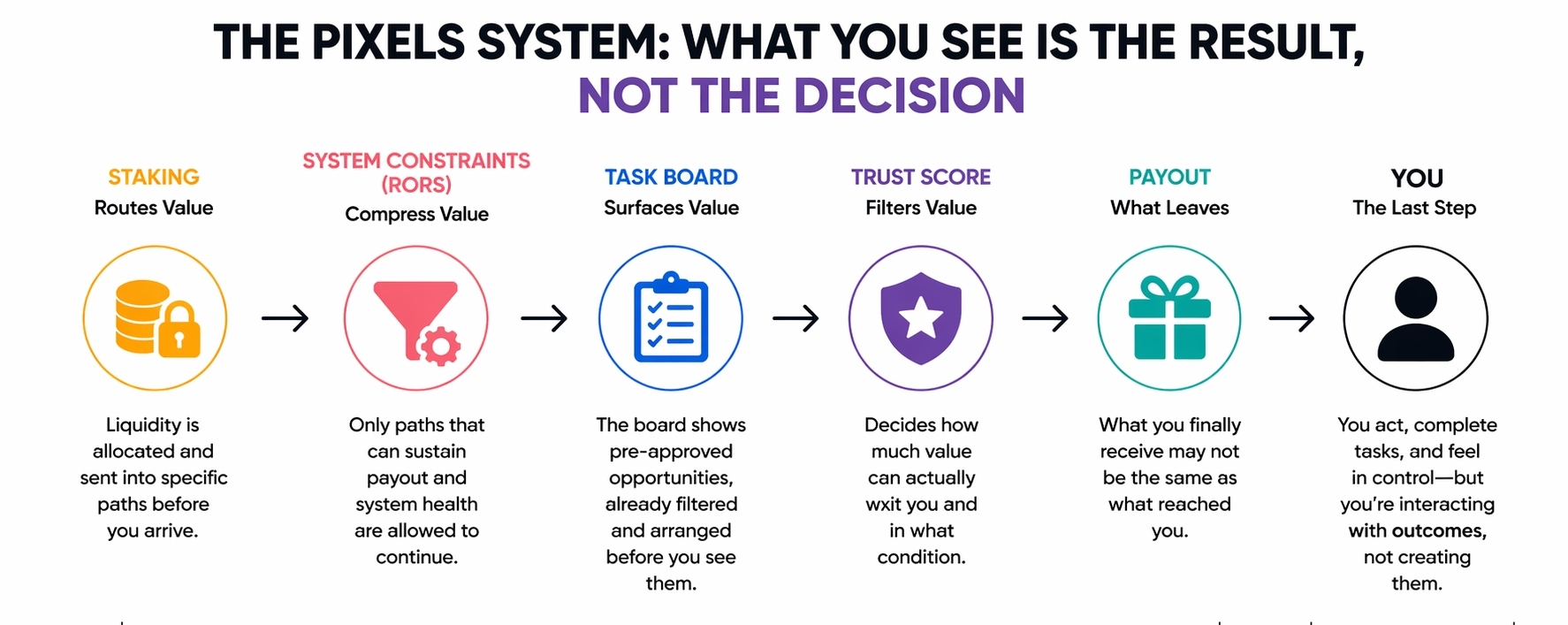
Now the system appears as a full chain:
Staking routes the value
System constraints compress it
The task board surfaces it
Trust Score filters what exits
And you exist at the very end of that chain.
So the real question becomes:
Where do you actually act?
You still play, complete tasks, and make decisions. But those decisions no longer feel like they create new possibilities. Instead, they feel like movement within boundaries that were already defined.
This completely reshapes the meaning of effort.
Effort is no longer just about doing more—it becomes about being in the right place.
That’s why not all sessions feel the same.
Some days, the board feels alive—like it’s backed by something real, like your actions are connected to actual value. Other days, it feels thin. Not empty, but hollow. As if what you’re seeing was never meant to carry value in the first place.
Same time. Same actions. Same player.
Different outcomes.
So what changed?
Was it you—or the system?
Did you move closer to value… or did value move somewhere else?
The uncomfortable thought is this:
Most of what you do may never have been meant to convert into value at all.
Not because you failed—but because that path was never funded to begin with.
In other words, much of your activity might simply exist to keep the system running—not to generate rewards.
If that’s true, then what you see is not neutral reality… it’s already filtered reality.
And it goes even deeper.
By the time a reward appears, it may already be too late to influence it. The real decisions may have been made earlier—through staking, system limits, and behavioral modeling.
Your role may just be the final step—the visible moment that makes it feel like you earned something.
But maybe that’s just an appearance.
Because from the inside, arrival always feels like agency.
But what if it isn’t?
What if playing isn’t about creating outcomes—but confirming them?
Confirming patterns the system already predicted
Confirming behaviors it already modeled
Confirming placements it already made
Then “getting better” takes on a completely different meaning.
Better at what?
Completing tasks—or positioning yourself where tasks actually matter?
And how would you even tell the difference?
Because inside the system, everything feels earned the moment it appears. But that feeling doesn’t prove anything. It only proves you were there when it surfaced.
Maybe progress isn’t about doing more…
Maybe it’s about drifting closer to where value already exists.
And whether that’s something you control…
or something the system gradually adjusts around you…
That remains unclear.
So in the end, you return to the same unresolved question:
If the Pixels task board already carries decisions before you see it…
then what actually changes when you play?
Are you shaping anything…
or just moving through versions that were already defined?
And when you log in again tomorrow, and the board looks slightly different…
Are you seeing a new opportunity?
Or just another arrangement—
where value was already routed, compressed, and approved long before you arrived…
and you’re still catching up to it, without realizing how far behind you’ve been all along?