
I didn’t expect to get pulled in this deeply by something that looked, at first glance, like a simple “earn a cut from your land” mechanic.
I’ve seen that model before. You buy land, you wait, you collect. Passive yield dressed up as gameplay.
But this time felt different. And I noticed it in a strange way through a small moment that reminded me of something from real life.
A few years ago, a friend of mine inherited a piece of farmland. He didn’t know how to farm, didn’t have the time either. Instead of selling it, he let someone else work the land and they split the harvest. At first it sounded simple. But over time, I realized something: the value wasn’t just the land it was how the land was managed, what tools were available, how reliable the arrangement was. The farmer stayed because the setup worked. The owner earned because the system made sense.
That same feeling hit me when I started looking at Pixels’ sharecropping layer.
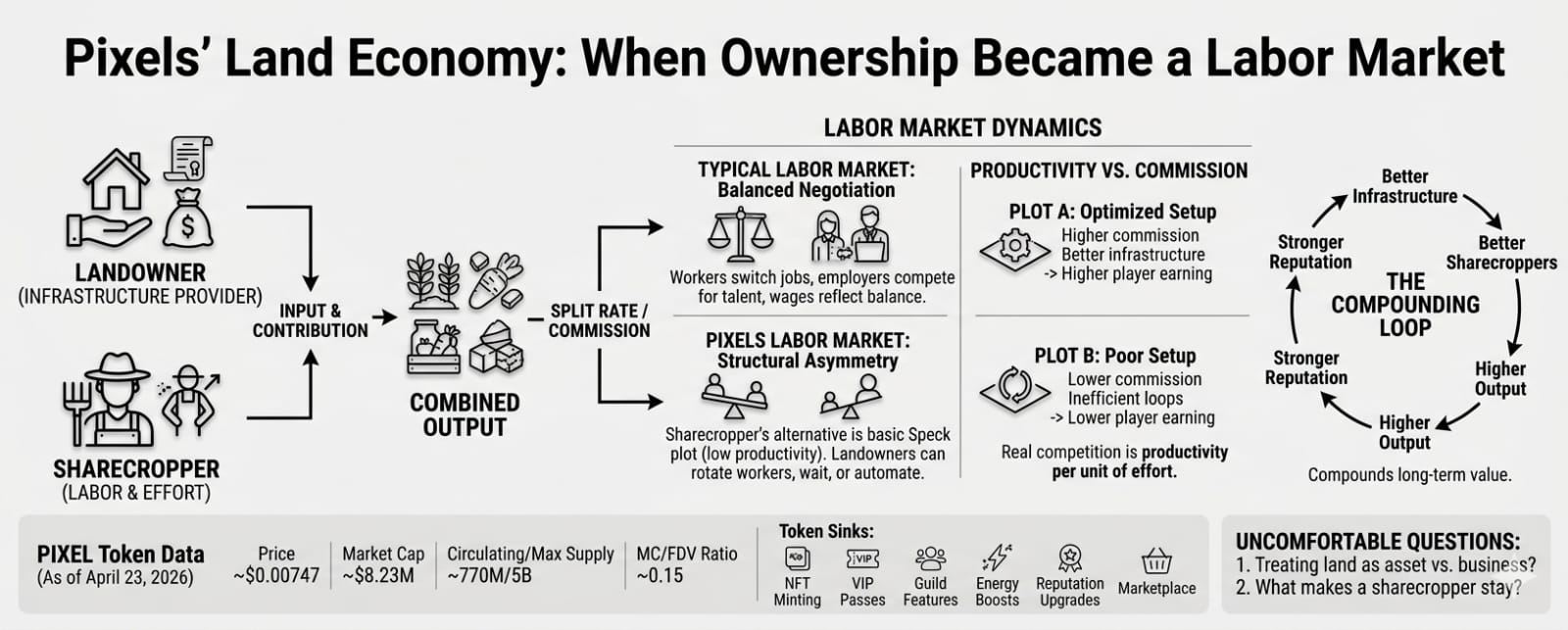
Because this isn’t just passive land ownership. It’s a separation of roles ownership and labor that quietly turns land into infrastructure and players into participants in a labor market.
And that changes everything.
In Pixels, landowners can host sharecroppers, set commission rates, and configure their plots with industries like mills, presses, and production chains. Sharecroppers bring the effort. Landowners provide the environment. Output is split.
That split? That’s not just a reward. It’s a price.
And like any price, it’s shaped by power.
Here’s where it gets interesting and a bit uncomfortable.
In a typical labor market, both sides have options. Workers can switch jobs. Employers compete for talent. That balance shapes wages.
But in Pixels, I noticed something different.
A sharecropper’s alternative is usually a basic Speck plot lower productivity, fewer tools, slower output. Meanwhile, landowners can rotate workers, automate parts of production, or just wait. That asymmetry matters.
It means the “market rate” for sharecropping isn’t purely neutral. It reflects who has better outside options.
And that’s where the system stops being just clever design and starts becoming something structurally meaningful.
I tried to test this myself.
I spent a few sessions moving between different plots, working under different setups. One landowner had optimized everything clean layout, efficient production loops, good access to resources. The commission was higher, but I still earned more overall because output was stronger.
Another plot had a lower commission but poor setup. I earned less, even though the split looked better on paper.
That’s when it clicked.
The real competition isn’t just commission rates. It’s productivity per unit of effort.
So landowners who invest in infrastructure upgrades, layout, production flow aren’t just improving their land. They’re making a stronger offer to labor.
And that creates a second layer most people ignore: reputation.
I started noticing that certain plots were always active. The same names farming there. Consistent output. Those landowners weren’t just earning they were attracting better players.
It reminded me of platforms in the real world. The ones that consistently offer better tools and environments tend to attract higher-quality participants. Over time, that compounds.
In Pixels, that compounding effect is subtle but powerful.
Better infrastructure → better sharecroppers → higher output → stronger reputation → even better sharecroppers.
That loop doesn’t show up in the NFT floor price. But it absolutely shows up in long-term value.
Now, step back and connect this to the token itself.
As of April 23, 2026, PIXEL is trading around $0.00747, with roughly $8.23M in 24-hour volume and a market cap of about $5.74M. The fully diluted valuation sits near $37.24M, with a circulating supply of ~770M out of a 5B max supply. That puts the market cap to FDV ratio at around 0.15.
Which basically tells you this: most of the supply is still ahead of the market.
Tokenomist data shows about 15.42% of supply unlocked, with the next unlock scheduled for May 19, 2026, and a full vesting timeline stretching into 2029. The allocations are spread across ecosystem rewards (34%), treasury (17%), private investors (14%), team (12.5%), advisors (9.5%), and others.
So the pressure is real. Dilution isn’t theoretical, it’s scheduled.
That’s why the in-game economy matters so much.
PIXEL isn’t just a reward token. It’s used for premium purchases NFT minting, VIP passes, guild features, energy boosts, reputation upgrades, pet systems, and marketplace activity. These are actual sinks.
And the demand side has shown signs of life. Back in 2024, the game reported over 1M daily active users at peak periods, with 109K paying wallets and about 10M PIXEL spent in a single month. The Return on Rewards ratio ended at 0.5 meaning half of distributed tokens were being spent back into the system.
That’s not perfect. But it’s not dead either.
Still, the chart tells a brutal story.
From an all-time high of $1.02 to $0.00747 now down over 99%.
That kind of drawdown wipes out hype. It forces reality.
And what’s left standing is the actual system.
Which brings me back to land.
Because if Pixels succeeds, it won’t be because land exists. It’ll be because land is used.
Used as infrastructure. Used to coordinate labor. Used to create productive loops that generate real in-game demand.
And here’s the uncomfortable question I keep coming back to:
Are most landowners actually building that?
Or are they still thinking like early NFT holders waiting for appreciation without engaging the system that creates it?
Because the players who understand both layers the economic design and the behavioral side are quietly positioning themselves differently.
They’re not just holding land.
They’re running operations.
And in a system like this, that difference compounds.
So I’m curious,,
If you owned land in Pixels, would you treat it like an asset or like a business?
And if you were a sharecropper, what would make you stay on one plot instead of moving to another?

#BinanceLaunchesGoldvs.BTCTradingCompetition
#CHIPPricePump #JustinSunSuesWorldLibertyFinancial #KelpDAOExploitFreeze