
Let’s try to understand what the real story is.
Before the Token Speaks
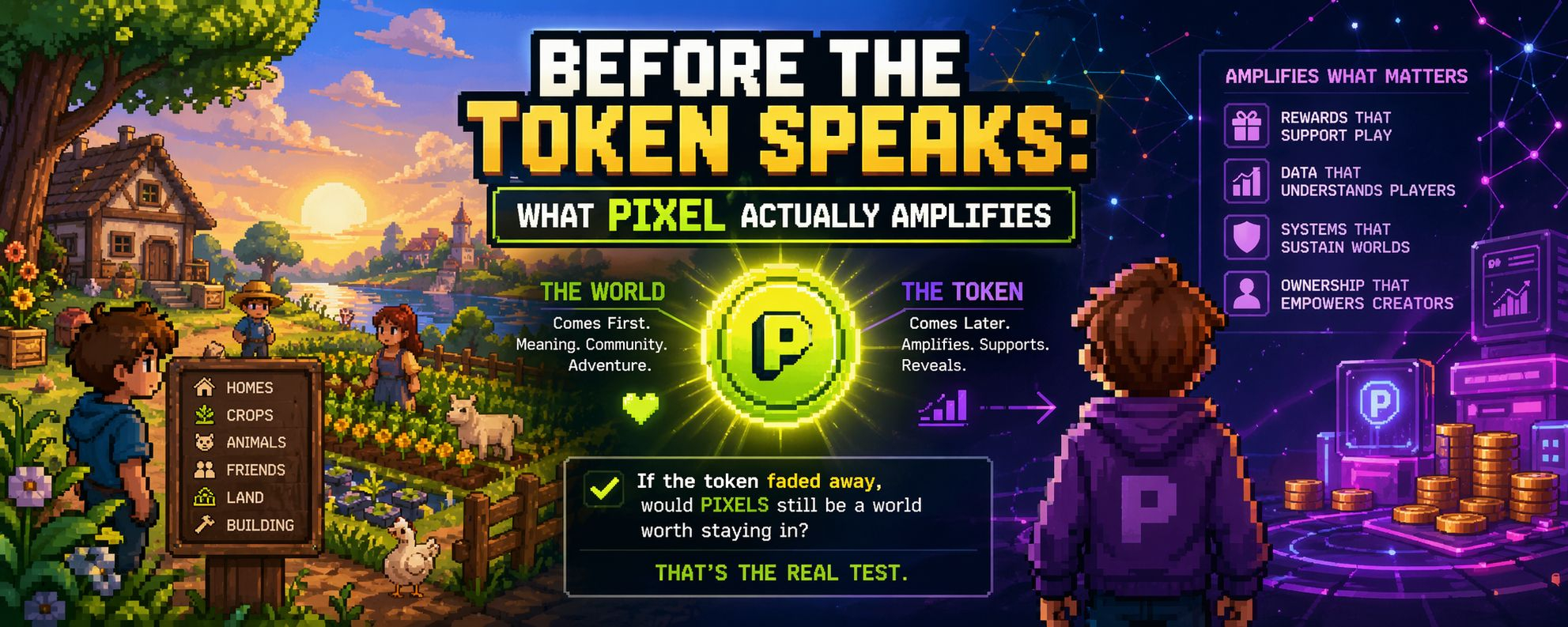
What stayed with me first was not the token. It was the feeling of a place trying to present itself as a place. Pixels talks about homes, crops, animals, friends, land, and small acts of building. Even when ownership comes up, it is usually tied to what players do inside the world, not just to the asset itself. I keep coming back to that order. It feels deliberate. The world is introduced first. The token comes later. And that makes me ask a simple question: if the world comes first, then what exactly is the token there to amplify?
There is an easy answer, and it is the one I do not find very interesting. The token could amplify attention. It could amplify speculation. It could amplify bursts of activity that look exciting for a while and then leave the world feeling thinner than before. Web3 games have fallen into that pattern more than once. They built the economy first and hoped meaning would somehow grow around it later.
Pixels seems to be trying to argue for a different order. On its site, the emphasis is on adventure, community, land, and creation. In the litepaper, the idea of “Fun First” is not treated like a side note. It sits close to the center of the project’s self-image. That matters to me, because it suggests that the token is not supposed to carry the whole experience on its back. It is supposed to strengthen something that already feels alive.
But that is also where the tension starts.
If fun really comes first, then the token cannot become the main reason people are there. It has to support the parts of the world that already matter. It has to reward what players naturally value inside the game. The moment it starts directing all attention toward optimization, the balance shifts. The token stops amplifying the world and starts quietly rewriting it.
That is what makes Pixels more interesting to me than its calm, cozy surface might suggest. The project is not just talking about rewards in a vague way. The litepaper points toward data systems and smart reward targeting, which means rewards are not simply handed out to “play” in some broad, innocent sense. Certain actions are selected. Certain behaviors are treated as more valuable than others. And once that happens, another question appears: who decides what “valuable player behavior” really means?
That question matters more than people sometimes admit. Is exploration valuable because it makes the world feel bigger and more alive? Is social play valuable because it helps people stay longer? Is repetition valuable because it keeps the economy stable? These are not small design choices. They shape the mood of a world. They shape what players notice, what they repeat, and what they slowly become.
I think you can already feel that split inside Pixels itself. One version of the project feels warm and human-sized. It is about farming, wandering around, building, and being around other people. The other version is more structured and more economic. It is about rewards, staking, ownership, and a system designed to make participation measurable. The project clearly wants both. It wants the softness of a social world and the precision of an economic layer sitting underneath it.
I do not think that makes the project dishonest. If anything, it may be the real experiment. A game world without an economy can feel decorative. An economy without a believable world feels cold almost immediately. Pixels seems to understand that. That is probably why the language of the world matters so much in the way it presents itself. It wants players to feel that the token is not the point. The token is there to make an already meaningful world more legible, more active, more durable.
Still, that promise has to be tested over time. A token with its own contract, supply structure, and staking logic is not some tiny detail sitting quietly in the background. It has weight. And weight changes behavior. If that weight begins pulling attention away from the world and toward extraction alone, then the order flips without anyone needing to say it out loud. The world no longer comes first. It simply becomes the setting around the token.
That is why I keep returning to one quiet check in my own mind. If the token faded into the background for a moment, would Pixels still feel like a world worth staying in? I think that is the real question underneath everything else. And maybe that is the fairest way to think about PIXEL too: not as the reason the world matters, but as the thing that reveals whether the world was strong enough to matter before the token ever began to speak.
