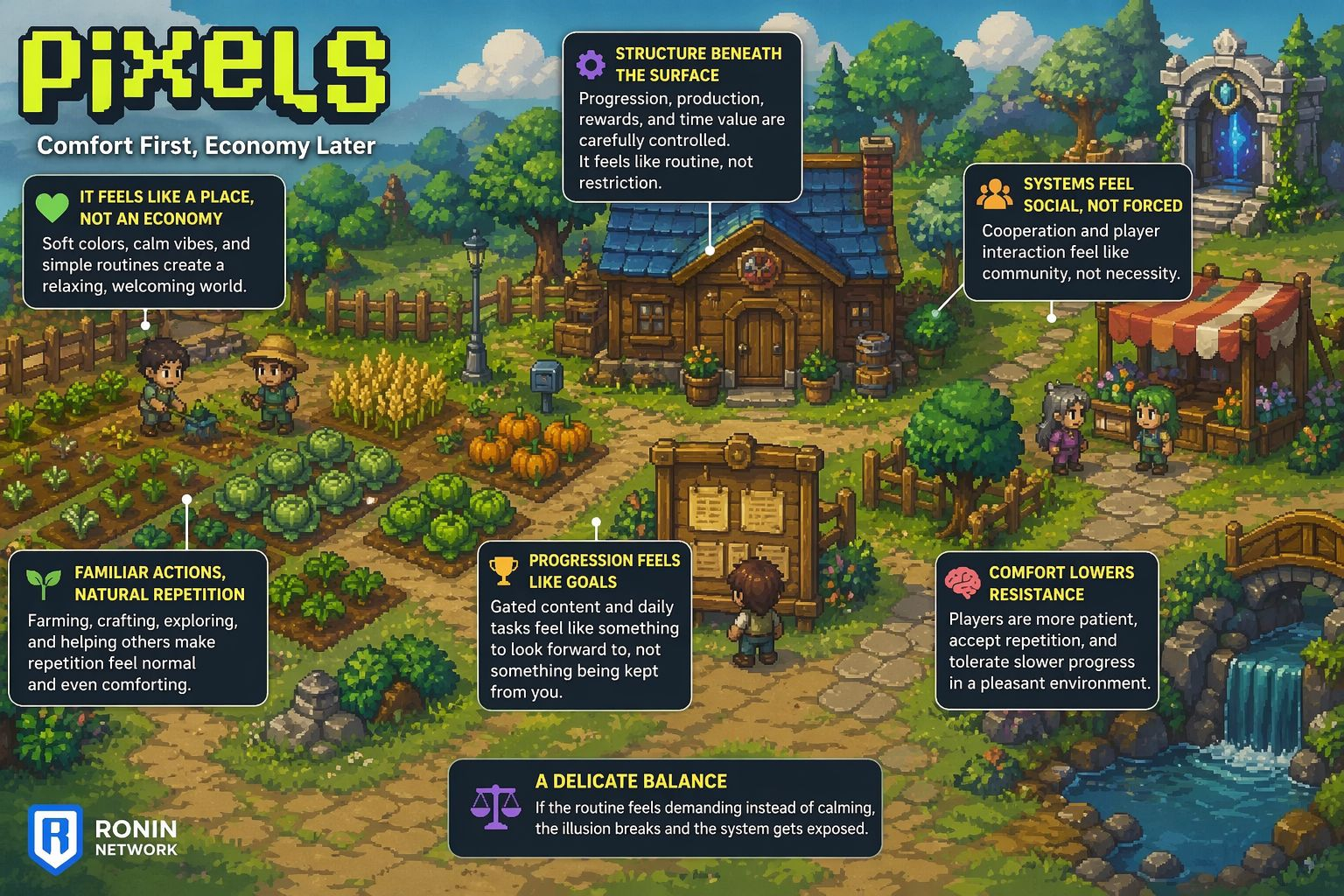
When you first enter Pixels (PIXEL), it does not feel like an economy. It feels like a place. The atmosphere is calm, the visuals are soft, and the pace is slow. Nothing pushes you to rush, and nothing demands immediate optimization. That quiet introduction is not just aesthetic—it is intentional.
The cozy design is not only about making the game approachable. It plays a deeper role. Pixels uses comfort to make structure feel natural. Systems that might seem restrictive in another environment are accepted here without resistance because they are wrapped in familiarity and ease.
Beneath that surface, the game is carefully structured. Progression is controlled, production is guided, and rewards are distributed with purpose. Even the value of your time is shaped. But it does not feel like control. It feels like routine, and that distinction changes everything.
In many Web3 games, the economy becomes visible too quickly. Players begin to notice the grind, the imbalance, and the extraction. Once that happens, the experience starts to feel like work. Pixels avoids that early break. It introduces players to familiar actions like farming, crafting, and exploring, allowing repetition to feel normal rather than forced.
You find yourself repeating tasks not because the rewards are extraordinary, but because the environment makes it feel acceptable. That is the quiet strength of the design. It lowers resistance before asking for effort.
As a result, progression systems feel like goals instead of restrictions. Daily tasks feel like structure instead of pressure. Even reliance on other players feels social rather than necessary. The system turns coordination into something that resembles community.
This is not accidental. It is deliberate framing.
Pixels understands that building an economy is not enough. The real challenge is getting players to exist within it comfortably. By softening the experience, the game makes its systems easier to accept, easier to stay in, and easier to return to.
There is also a psychological element. In a pleasant environment, players become more patient. They accept slower progress and question less. The atmosphere gives the system time to adjust and guide behavior without resistance.
However, this balance is fragile.
If the routine ever shifts from calming to demanding, the illusion can break. What once felt relaxing can become an obligation. And when that happens, the softness no longer hides the system—it reveals it.
That tension defines Pixels.
It is not just a game built on incentives. It is a system that shapes how those incentives are felt. Pixels does not remove its economy—it cushions it.