
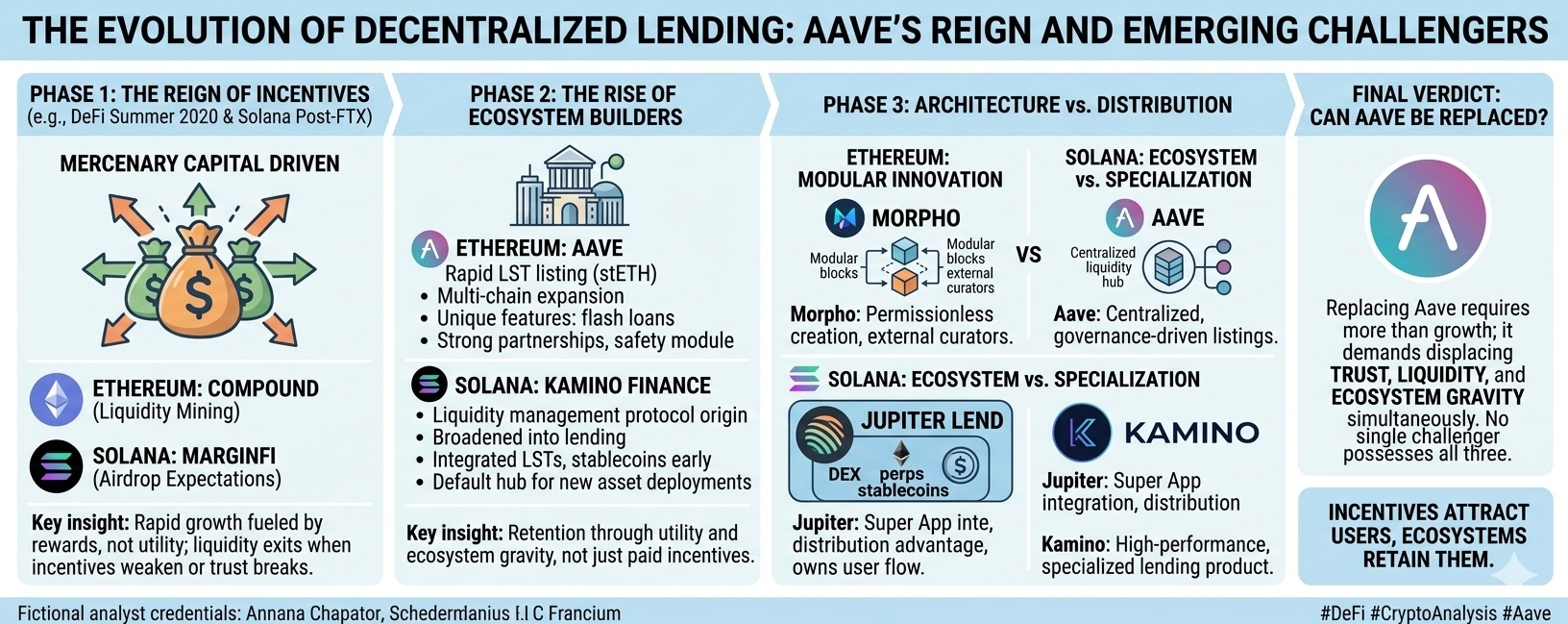
The decentralized lending market is entering a new competitive phase. While Aave remains dominant, rising challengers like Morpho, Jupiter (via Jupiter Lend), and Kamino Finance are reshaping the landscape.
To understand whether Aave can be replaced, we need to break the evolution of lending into three distinct phases across both Ethereum and Solana ecosystems.
Phase 1: The Reign of Compound and MarginFi
The first phase of DeFi lending was driven largely by incentives rather than product strength.
On Ethereum, Compound sparked the DeFi Summer of 2020 through liquidity mining. Its rapid TVL growth was fueled by token rewards, not deep utility.
Similarly, on Solana, MarginFi attracted capital through airdrop expectations post-FTX collapse.
Key Insight:
Both leaders relied on mercenary capital. When incentives weakened or trust broke, liquidity exited quickly.
Phase 2: The Rise of Aave and Kamino
This phase marked a shift from incentives to product depth and ecosystem integration.
Why Aave Won on Ethereum
Aave overtook Compound through several structural advantages:
▪ Rapid listing of new collateral (LSTs like stETH, wstETH)
▪ Early multi-chain expansion (Polygon, Avalanche)
▪ Unique features like flash loans and a safety module
▪ Strong ecosystem partnerships
Aave didn’t just attract liquidity—it retained it through utility and trust.
Why Kamino Won on Solana
Kamino Finance followed a different path:
▪ Started as a liquidity management protocol
▪ Expanded into lending as part of a broader system
▪ Integrated new assets early (LSTs, stablecoins, yield tokens)
▪ Became the default hub for new asset deployments
Key Insight:
Winners in Phase 2 weren’t those who paid users the most—but those who built ecosystems around themselves.
Phase 3: Morpho and Jupiter Lend Arrive
We are now entering Phase 3, where competition is no longer about basic lending—but architecture and distribution power.
Ethereum: Morpho vs Aave
Morpho introduces a fundamentally different model:
▪ Permissionless market creation (Morpho Blue)
▪ Risk managed by external curators
▪ Modular, infrastructure-first approach
In contrast, Aave remains a centralized liquidity hub with governance-driven listings.
Important Reality:
Morpho’s rising TVL ratio (now ~42% of Aave) looks impressive—but part of this is due to lower exposure to systemic shocks, not necessarily superior dominance.
Solana: Jupiter Lend vs Kamino
Jupiter is not just competing—it’s absorbing users into a broader ecosystem:
▪ Integrated within a super app (DEX, perps, stablecoins, etc.)
▪ Strong distribution advantage
▪ Convenience over optimization
Meanwhile, Kamino remains a specialized, high-performance product.
Key Insight:
Jupiter’s strength is not better lending—it’s owning the user flow.
Why I Don’t Think This Time Will Be Different
Despite rising challengers, the structural position of Aave remains extremely strong.
▪ It holds the most trusted collateral markets
▪ It benefits from network effects of integration
▪ It continues evolving (e.g., Aave v4 modular design)
Unlike past leaders:
Compound declined due to governance failures and leadership shift
MarginFi lost trust due to broken airdrop expectations
Aave has shown none of these weaknesses at scale.
What Situations Could Change the Outcome
Aave’s dominance is not guaranteed. Key risks include:
▪ Failure of Aave v4 to gain adoption
▪ Loss of key collateral trust (e.g., LST ecosystem shocks)
▪ Faster innovation cycles from modular competitors like Morpho
▪ User migration toward super apps like Jupiter
On Solana:
▪ A major failure in Kamino’s core collateral (e.g., PRIME exposure)
▪ Jupiter achieving dominant lending liquidity through distribution
Core Experience for Protocol Growth
Across all phases, one lesson stands out:
Incentives attract users—but ecosystems retain them.
Successful protocols like Aave and Kamino Finance:
▪ Partnered with asset issuers early
▪ Captured new narratives (LSTs, stablecoins, yield tokens)
▪ Built deep integrations rather than shallow incentives
Protocols that relied purely on token rewards eventually collapsed under their own economics.
Final Verdict
Aave is not easily replaceable.
Morpho may redefine backend infrastructure.
Jupiter may dominate user access.
Kamino may remain Solana’s top product.
But replacing Aave requires more than growth—it requires displacing trust, liquidity, and ecosystem gravity simultaneously.
Right now, no single protocol checks all three boxes.