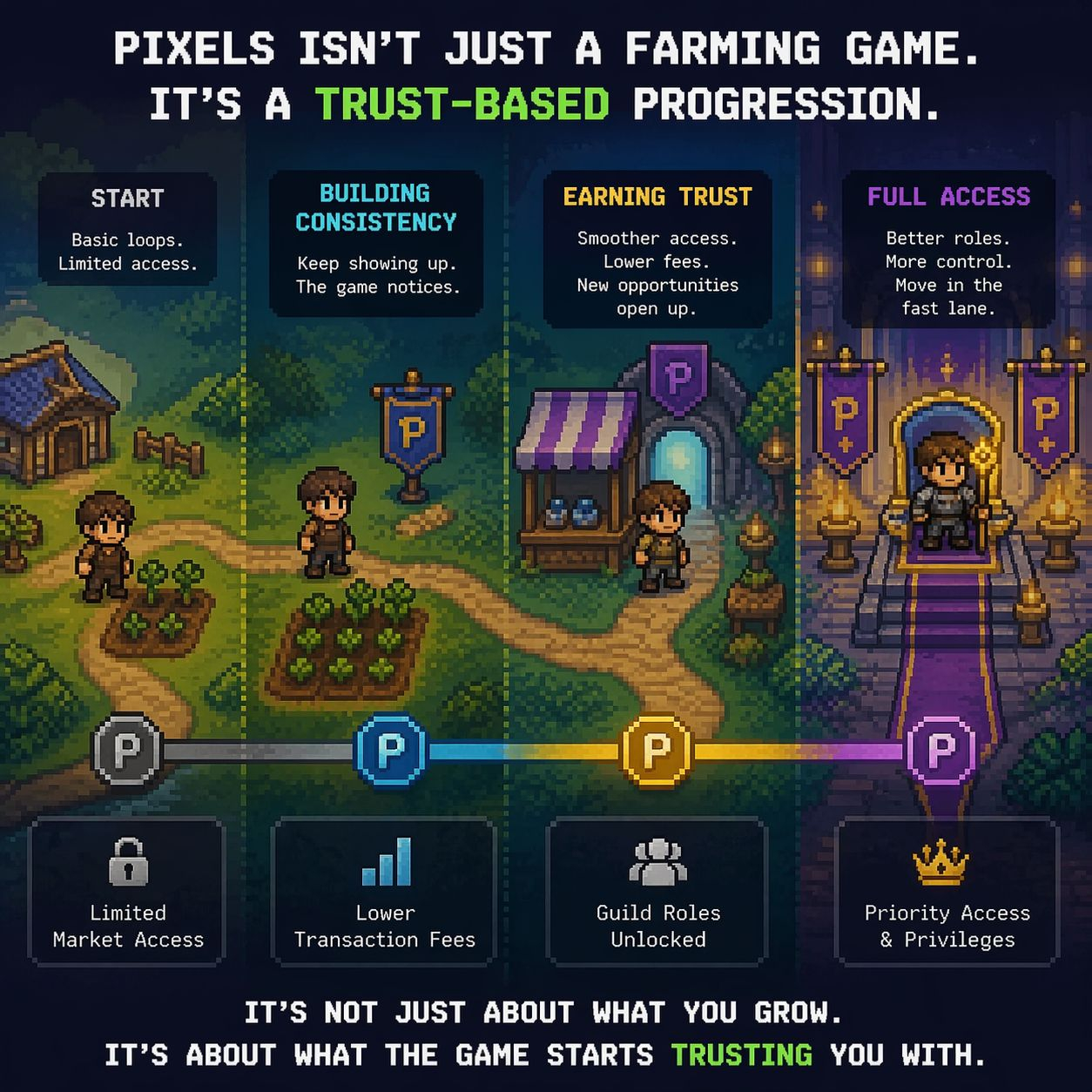
On the surface, Pixels looks like a calm, familiar world — plant your crops, explore the map, build your space, and repeat. It’s the kind of game that feels easy to pick up, almost relaxing in its simplicity. But the longer you stay, the more you begin to notice that something deeper is happening beneath that cozy layer.
Pixels (PIXEL), built on the Ronin Network, isn’t just about farming mechanics or casual gameplay loops. It’s about how the game slowly starts responding to you as a player. In the early stages, everything feels the same for everyone — limited access, basic interactions, and a steady grind. But over time, that experience begins to shift in subtle ways.
You might notice that navigating the marketplace feels smoother. Certain opportunities start appearing more naturally. Roles, access points, and advantages that once felt distant begin to open up without forcing them. It doesn’t feel random — it feels earned, but not in the traditional sense of just doing more work.
That’s where Pixels separates itself. Progress here isn’t only about how much you produce or how long you play. It’s about how the system begins to recognize your consistency and presence. The game quietly builds a level of trust with you, and that trust changes how efficiently you move through its world.
Instead of pushing players to simply grind harder, Pixels creates a sense of progression tied to access. The more the game “leans on you,” the less friction you feel. Actions become smoother, decisions become faster, and your overall experience starts to feel more refined.
This is what gives Pixels its unique edge. It may look like a farming game, but it doesn’t behave like one. Underneath, it’s closer to a system where players gradually qualify for better positioning, rather than just earning rewards in a linear way.
In that sense, Pixels shifts the narrative. It’s no longer just about play-to-earn. It starts to feel like play-to-qualify — where your real progress is measured by how much the game is willing to open up to you.