
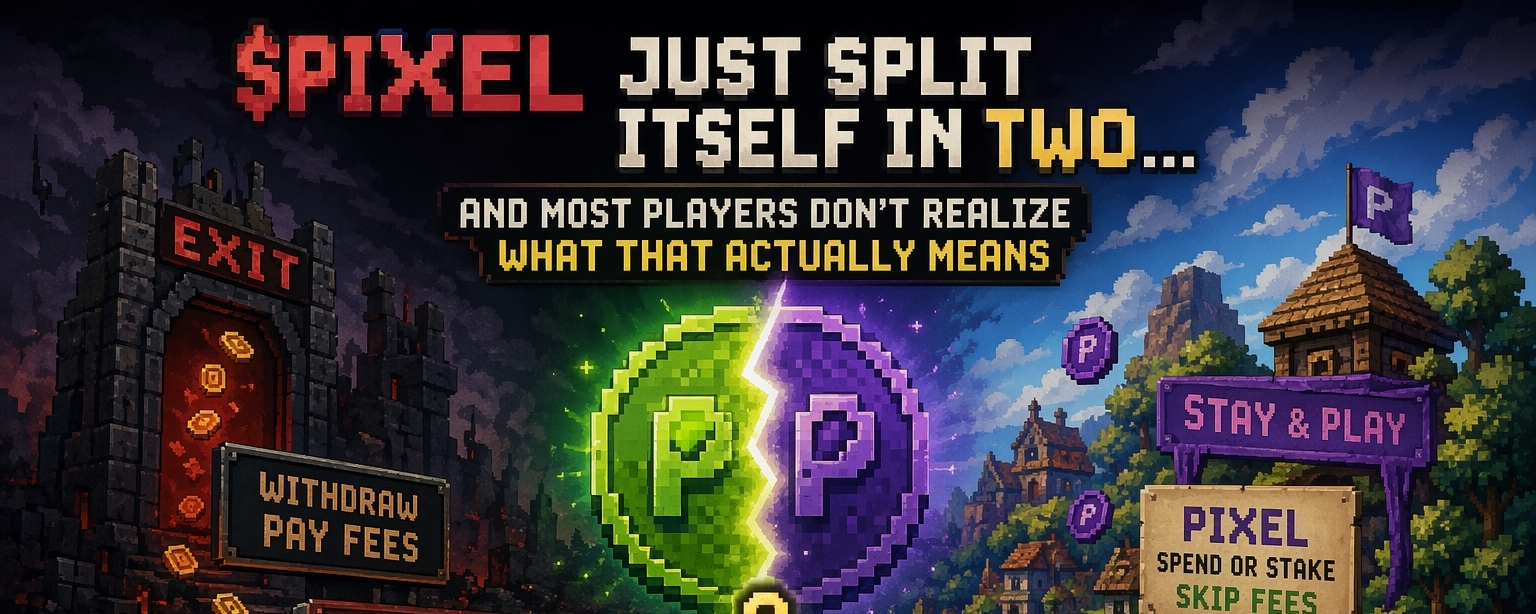
$PIXEL Just Split Itself in Two… And Most Players Don't Realize What That Actually Means
I noticed something that didn't quite land the first time I read it.
Pixels quietly announced PIXEL. A new token, backed 1:1 by PIXEL, but it can't be sold. Spend it or stake it, that's it. And the first reaction most people had was okay, another in-game currency, another layer, whatever. But the more I sat with it, the more it started to feel like something different. Not cosmetic. Structural.
Because what they've actually done is split a single token into two behaviors.
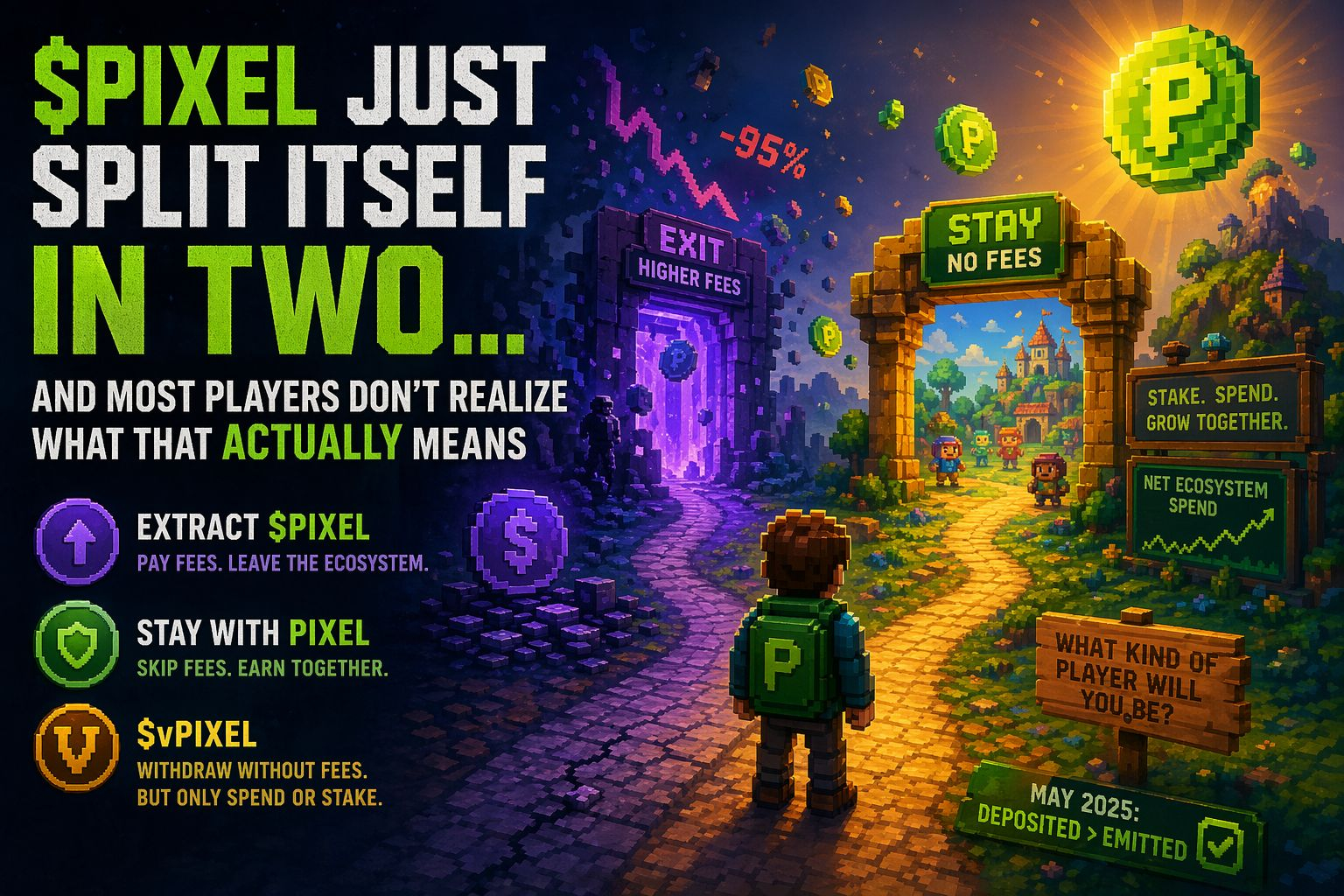
$PIXEL is what you extract. PIXEL is what you stay inside. Same underlying value, but the path you choose now says something about your relationship with the ecosystem. Leave and pay fees. Stay and skip them. It doesn't sound dramatic, but that's kind of the point. The best design decisions in games never announce themselves.
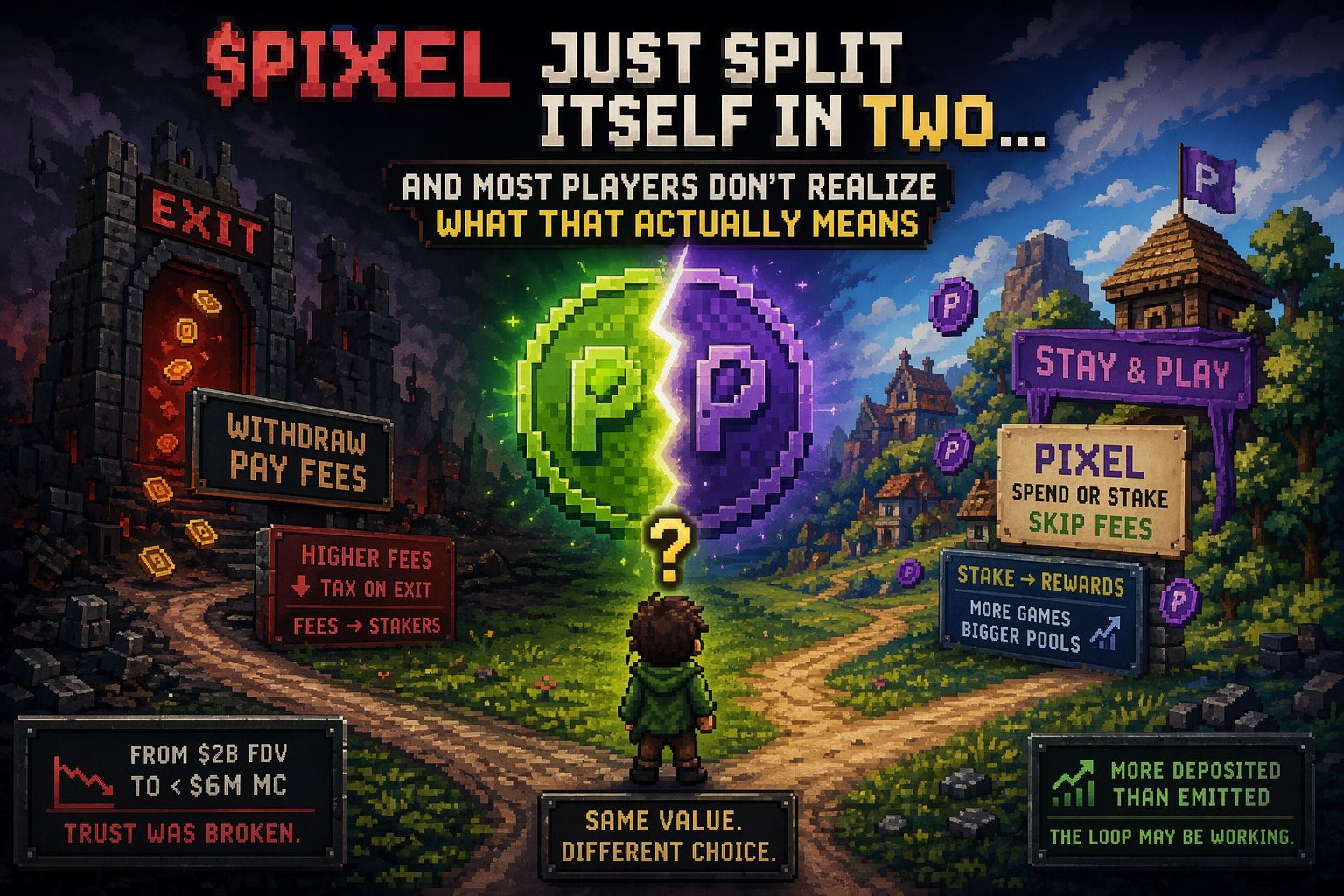
Players who withdraw PIXEL face heavier fees, while those fees get redistributed to stakers.
That's not just tokenomics. That's a behavioral tax on exit. And when you add PIXEL into that picture a token you can withdraw with no fees but only spend or stake what emerges is a quiet fork in the road that most people are walking past without really noticing.
You're no longer just deciding what to do with your rewards. You're deciding what kind of participant you are.
And that shift matters more than it looks, because Pixels has been doing something unusual in the background for a while now. The team is openly aiming for what the CEO calls "net ecosystem spend" a state where in-game spending consistently exceeds token distribution.
That's not a marketing line. That's a full admission that the economic model has been running in reverse, emitting more than it pulls back in. And they're trying to close that gap not by cutting rewards, but by changing what staying inside the system feels like.
PIXEL is part of that answer. Not the whole answer. But a real part.
What I keep returning to is how this changes the texture of the staking system they launched alongside it. The more PIXEL players stake to a game, the bigger that game's reward pool becomes which means staking isn't passive anymore. It's directional. You're not just locking tokens to earn yield, you're allocating weight to specific games inside the ecosystem. That's a fundamentally different relationship than most people are used to in GameFi.
It also means the ecosystem can grow without the token supply having to grow with it. If new games enter the network and pull staked PIXEL toward them, demand can expand across the system without needing more emissions. That's a real design difference. I'm not sure it works at scale yet. But it's not the usual playbook.
In May 2025, Pixels reported that for the first time, more tokens were deposited than emitted.
That milestone sounds small. It isn't. It's the first actual signal that the behavioral loop might be working that players are choosing to stay inside often enough to flip the direction of flow. For a game that peaked at over a million daily users and then watched that number fall as the economics failed to hold, that's meaningful.
But there's something uncomfortable sitting underneath all of this that I don't think gets talked about enough.
The PIXEL token reached a fully diluted valuation of over $2 billion before falling roughly 95% from its all-time high.

And right now, with a market cap sitting below $6 million, most of the people who were loudest about Pixels during the peak are gone. The ones still playing are the ones who actually like the game. Which, strangely, might be the best possible condition for the new model to take root.
Because PIXEL isn't designed for people chasing price. It's designed for people who want to stay in the loop, skip fees, earn across multiple games, and treat the ecosystem like somewhere they live rather than somewhere they extract from. That's a small population right now. But it's a real one.
What I can't quite resolve is whether this is a sustainable system or an elegant looking compression of the same old problem. The fees, the staking, the spend-only token these are all friction mechanisms. They work when people have a reason to stay. They collapse when the reason disappears.
And Pixels has burned that trust once already.
So the real question isn't whether the model is clever. It clearly is. The question is whether the game underneath it is good enough to make people choose PIXEL over just walking away. That part isn't a tokenomics problem. It's a product problem.
And I'm not sure the market has priced in either outcome.
