
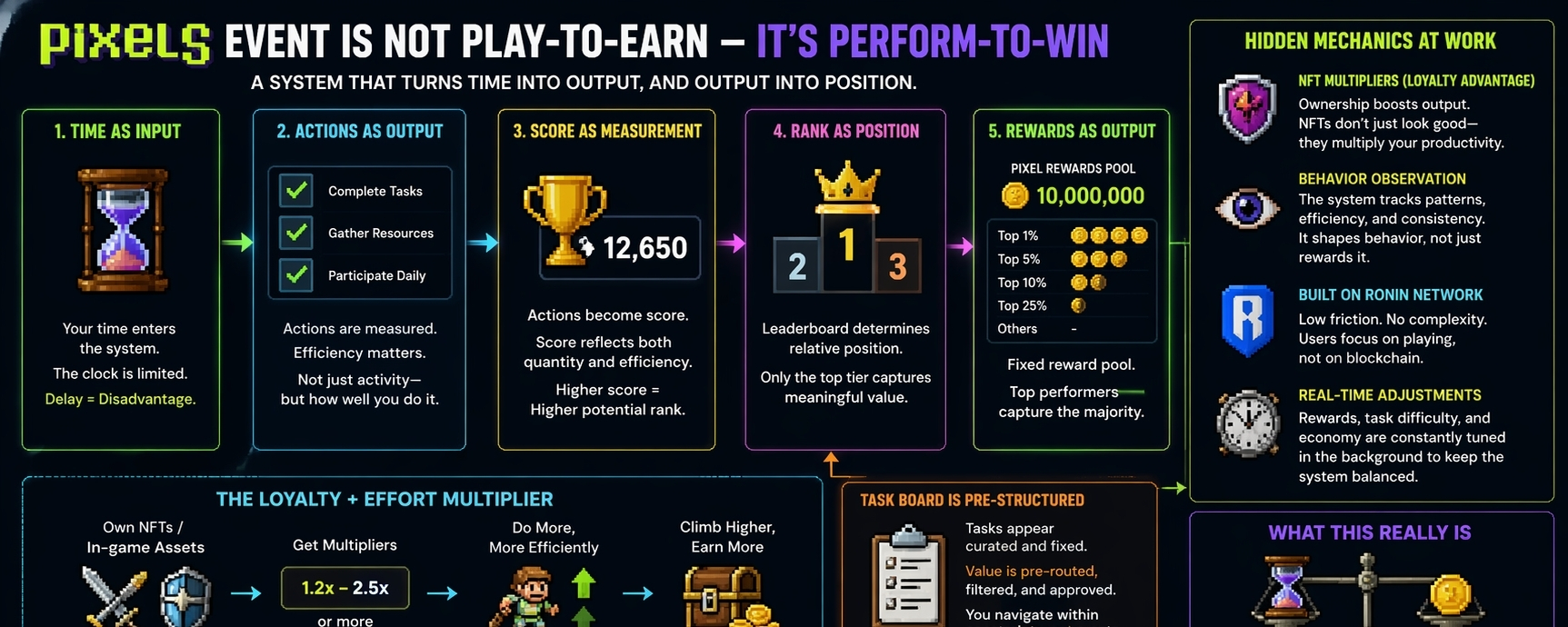
@Pixels The new event inside Pixels might look like a simple loop complete tasks, earn points, climb the leaderboard, and receive PIXEL rewards—but underneath, it feels more like an economic system resetting itself than a game update. What’s really happening is that time is being converted into measurable output: actions become score, score becomes rank, and rank determines access to a fixed reward pool where only the top performers capture meaningful value. This creates pressure immediately, because with a limited timeframe, participation turns into competition, and the longer you wait, the further behind you fall. Features like NFT multipliers quietly layer in a loyalty advantage, where ownership amplifies productivity, tying capital to effort without explicitly forcing it. At the same time, the system isn’t just tracking what you do—it’s observing how efficiently you do it, shaping behavior rather than just rewarding activity. Running on the low-friction environment of the Ronin Network, Pixels removes enough complexity that users don’t feel like they’re interacting with blockchain infrastructure at all, allowing time—not just money—to become the primary input. The result is a loop built on predictability and repetition, where habit drives engagement and stabilizes the economy. Even the task board doesn’t feel reactive; it feels pre-structured, as if value has already been routed, filtered, and approved before it appears, leaving players to navigate within constraints rather than create new outcomes. Beneath it all, real-time adjustments to rewards and behavior keep the system balanced, preventing both over-extraction and stagnation. So while it appears to be a standard “play-to-earn” event from the outside, in reality it’s a controlled environment where time, efficiency, and positioning compete under invisible rules—messy, unequal, and sometimes opaque, but undeniably alive.
