
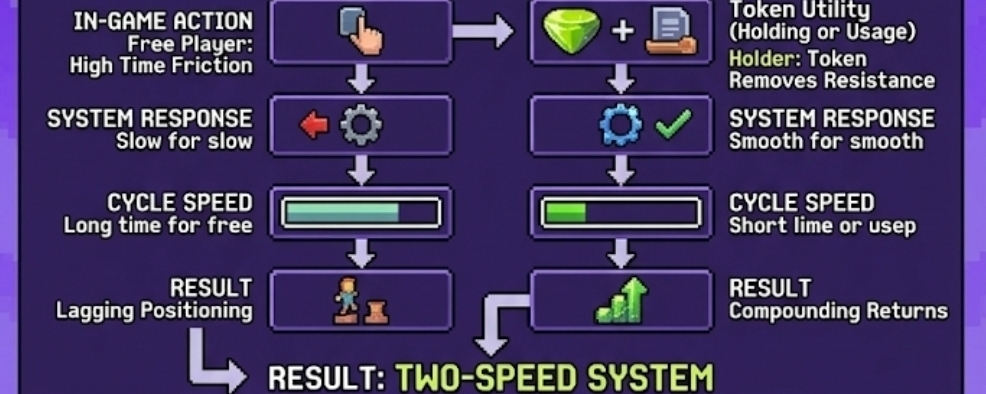


I didn’t fully understand what was happening in @Pixels at first. On the surface, everything felt familiar players farming, crafting, trading, moving through loops that looked like any other Web3 game economy. It felt active, even crowded at times. Nothing seemed out of place.
But the longer I stayed, the harder it became to ignore a subtle imbalance.
It wasn’t obvious. No broken mechanics, no clear barriers. Everyone appeared to be doing roughly the same things—running similar routines, investing similar time. Yet outcomes didn’t align the way you’d expect. Some players consistently ended up in stronger positions. Not dramatically ahead, just… ahead enough to matter.
At first, I dismissed it. Maybe better timing. Maybe deeper experience. But over time, that explanation stopped holding up.
That’s when I started paying closer attention to wherePIXEL actually fits into the system.
On paper, the structure looks straightforward. Most in-game activity happens off-chain farming, crafting, resource movement. It’s smooth, almost frictionless. Then, when something meaningful appears upgrades, land opportunities, higher-value interactions that’s where PIXEL comes into play.
A familiar design. Low-cost activity paired with higher-cost finalization.
But in practice, the separation between those two layers feels more significant than expected.
Day-to-day gameplay exists in a kind of continuous flow. You can stay active for hours without being forced into a decision. It feels open, flexible, even forgiving. But the moment a valuable opportunity appears, something scarce, time-sensitive, or strategically important, the system shifts.
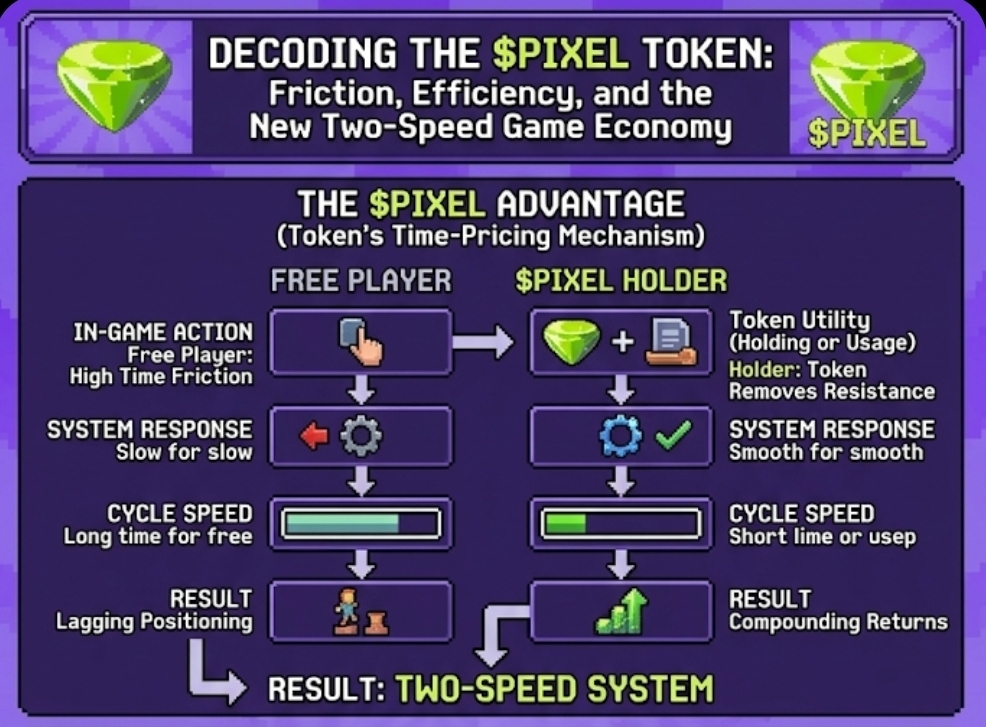
Speed suddenly matters.
Not in the sense of grinding faster, but in being ready to act instantly.
And that’s where PIXEL changes from a utility into something closer to access.
If you already hold it, you move without hesitation. If you don’t, you pause, adjust, or miss the window entirely. It’s a small difference in isolation, but over time it compounds. The same participants tend to appear at key conversion points—those moments where activity turns into something permanent or valuable.
I’ve seen this pattern before, just not framed inside a game environment.
In financial markets, the edge rarely comes from effort alone. It comes from positioning—being liquid, being ready, being present when opportunity compresses into a short window. Everyone else may be active, but not everyone is effectively competing.
Pixels is beginning to reflect a similar structure.
What makes it more interesting is that the system doesn’t present itself this way. It still feels open. Anyone can join, participate, and contribute. And technically, that remains true. But not every action carries the same weight. Some actions circulate within the system, while others cross a threshold and become locked-in value.
$PIXEL seems to sit exactly at that threshold.
It doesn’t determine what you do inside the game. It determines whether what you’ve done actually converts into something that matters.
That distinction shifts how I think about fairness within the ecosystem.
If everything were purely effort-based, outcomes would eventually converge. Players running optimized loops would see diminishing differences over time. But once a system introduces selective conversion points, scarcity moves away from resources and toward something less visible.
Access.
Or more precisely, access to moments where value is finalized.
From a design perspective, this makes sense. Not every action can or should be elevated to the same level. A system needs filters, otherwise it becomes inefficient and chaotic. Especially when bridging off-chain activity with on-chain constraints, some form of gating becomes inevitable.
But once that gate exists, something has to regulate who passes through it—and when.
That’s where PIXEL starts behaving less like a standard reward token and more like a coordination layer.
It quietly organizes who gets to act at the moments that matter most.
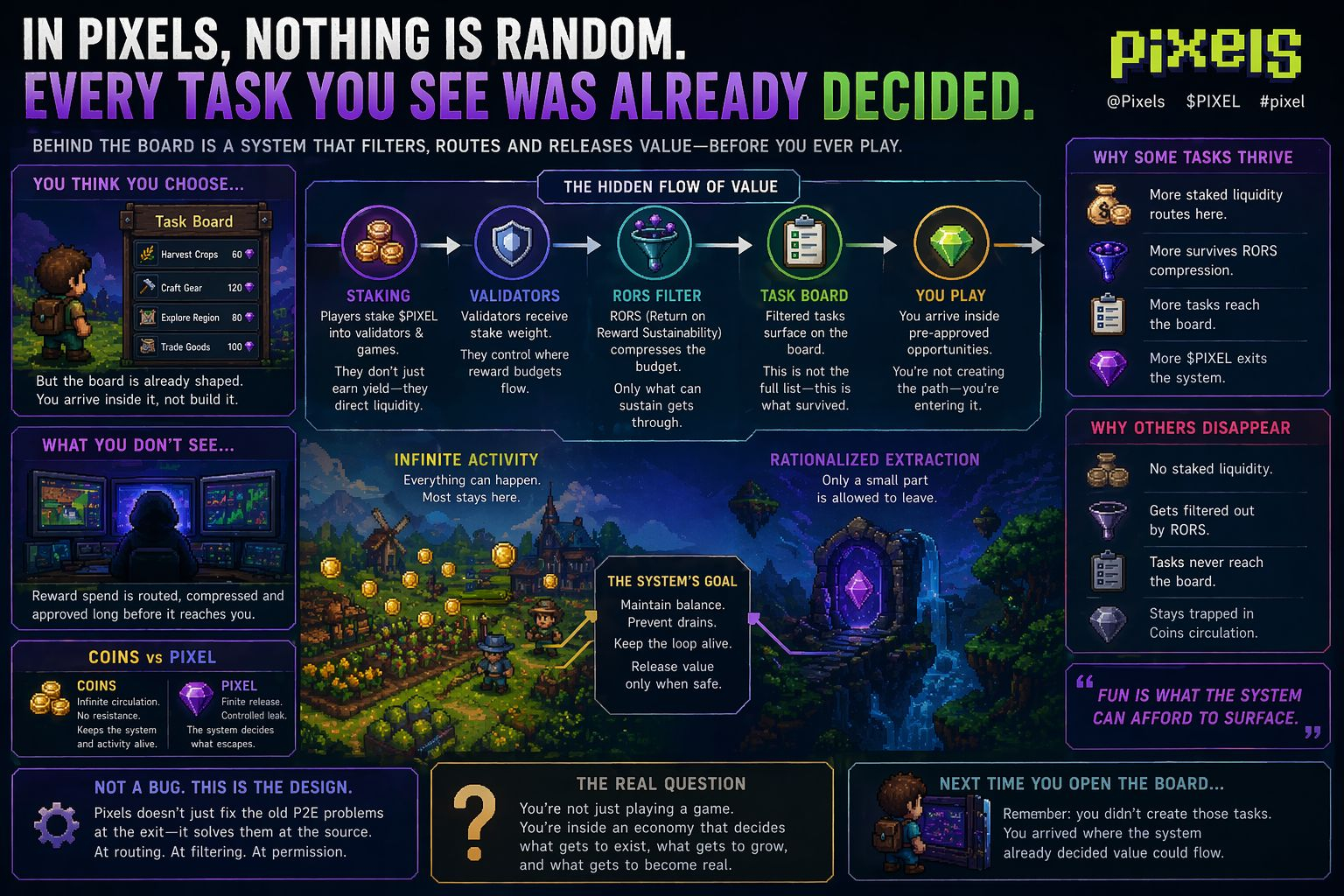
There’s a practical benefit to this structure. It prevents overload. It introduces pacing. It creates a rhythm between activity and finality that keeps the system from collapsing under constant output.
But it also introduces drift.
Players begin to notice patterns. They always do. Over time, behavior shifts away from casual exploration toward targeted execution. Less wandering, more anticipation. Less experimentation, more positioning.
The system starts to feel less like a sandbox and more like a sequence of checkpoints.
And that’s where fragility can emerge.
If too many participants begin focusing on the same high-value moments, the advantage of being prepared becomes even more pronounced. Those already holding $PIXEL or simply understanding when and how to deploy it begin to compound their position. Not aggressively, but consistently.
Meanwhile, new entrants continue to engage, contribute, and generate activity. But their presence doesn’t always translate into the same level of economic visibility. They exist within the system, but not always at the points where outcomes are determined.
This gap is difficult to detect from surface-level metrics.
User growth can remain strong. Activity can increase. The world can feel vibrant and alive. Yet the actual points where value crystallizes may become increasingly selective over time.
That’s why I find it difficult to view $PIXEL purely as a utility or reward token.
It feels closer to a mechanism that sits between effort and outcome, quietly influencing which actions scale and which remain background noise.
I’m not entirely convinced this is a fully intentional design. It may simply be an emergent property of combining large-scale off-chain interaction with selective on-chain finality. But intentional or not, the effect is there.
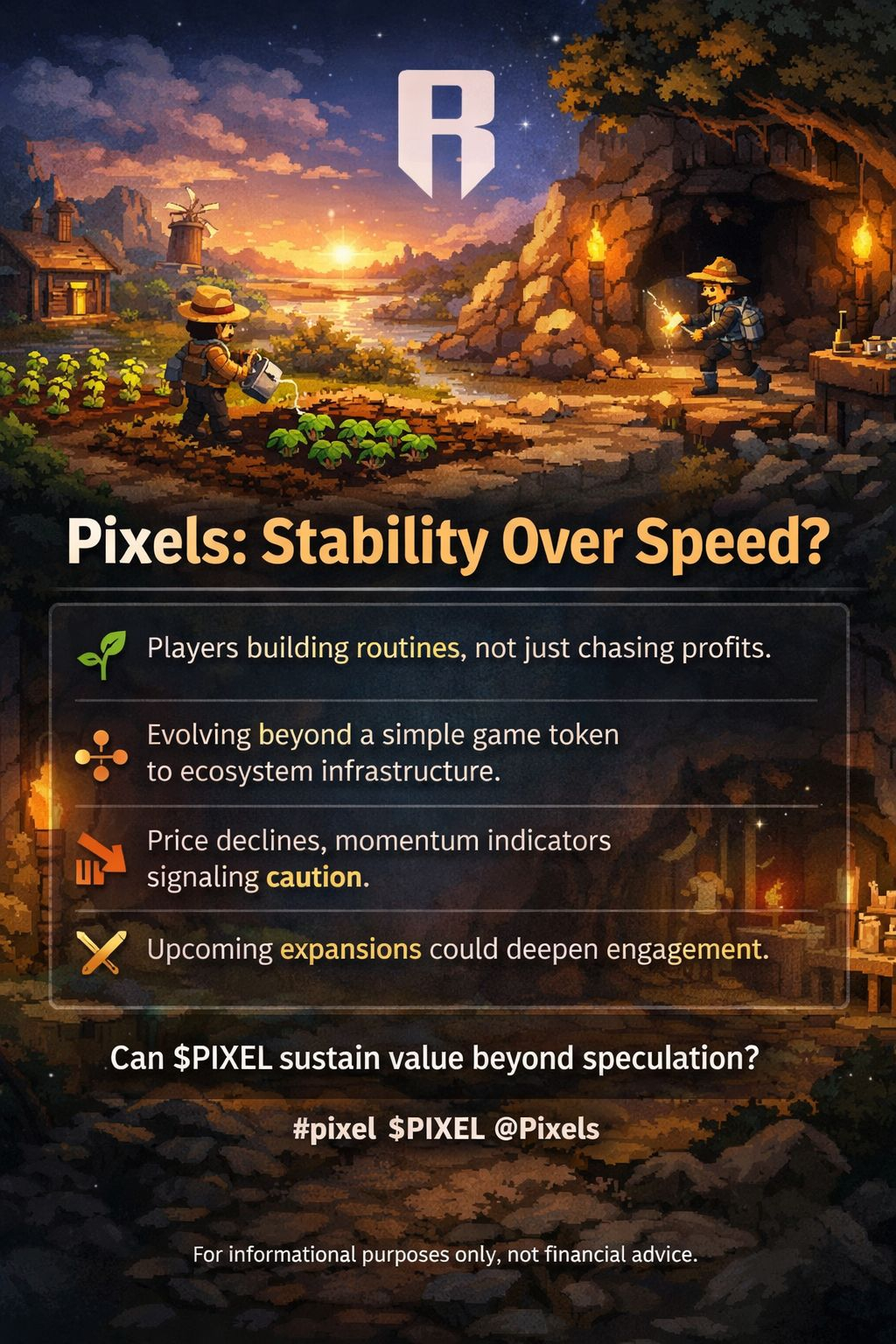
And it changes how I interpret the system.
The usual metrics player count, transaction volume, engagement rates still matter. But they may not capture the full picture. The more meaningful signal might be harder to quantify.
Who consistently appears at the exact moments when activity converts into value… and who doesn’t.
Because in the end, Pixels doesn’t restrict participation.
It quietly shapes progression.
And that difference is where the real story of may be PIXEL unfolding.
This content is for informational purposes only and not financial advice.
#pixel