
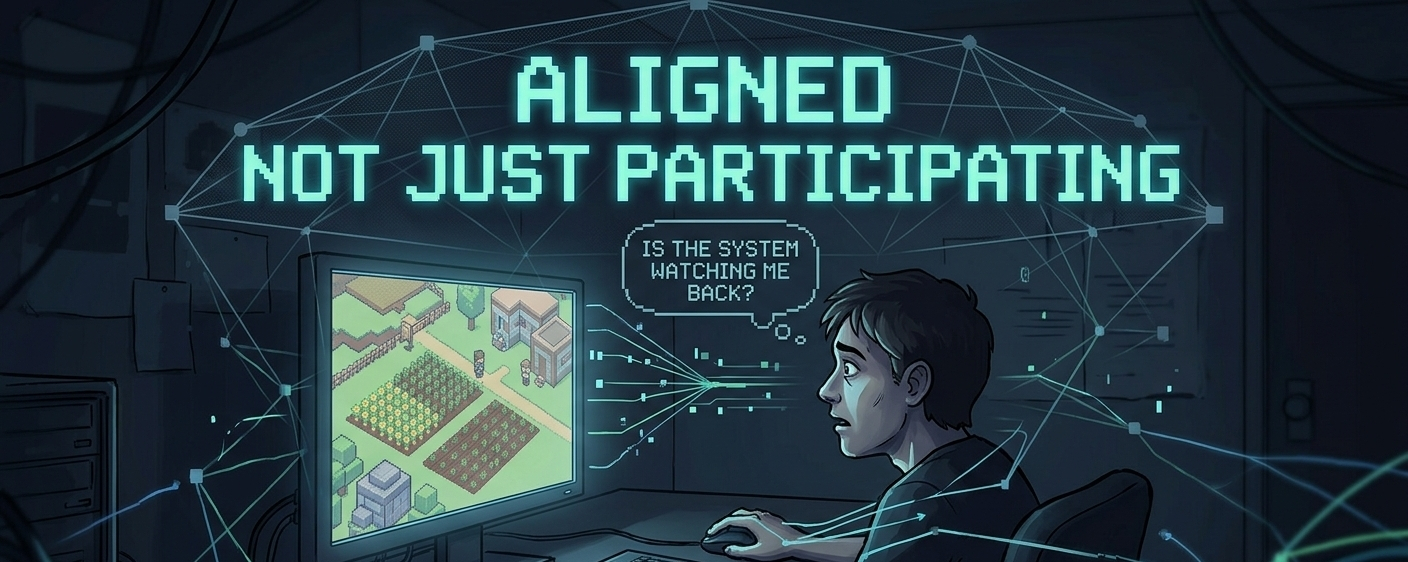
At first, I didn’t really understand what I was looking at.
Pixels felt like one of those Web3 experiments that tries to wrap familiar gameplay in unfamiliar economic language. You log in, you farm, you move around, you collect things. It looks simple enough on the surface. Almost deliberately so.
But I remember the early confusion wasn’t about controls or mechanics. It was about meaning.
Why does everything feel like it has a second layer I’m not seeing yet?
There’s farming, but it doesn’t feel like just farming. There’s exploration, but it doesn’t feel like just moving across a map. There are rewards, but they don’t behave like traditional game rewards. At first, I wrote it off as design noise — the kind of ambiguity you ignore until the game reveals itself properly.
It didn’t.
Instead, it slowly started to insist that I pay attention.
The first shift was subtle. I noticed I wasn’t just “playing” anymore in the usual sense. I was repeating patterns. Returning to certain actions. Adjusting timing without fully knowing why. I told myself it was efficiency — a normal optimization instinct any player develops.
But it didn’t feel like optimization in hindsight. It felt more like adaptation.
Like the system was gently teaching me what mattered without ever explicitly saying it.
That’s where things started to change.
I began noticing how deeply interconnected everything was. Farming wasn’t isolated. It fed into progression. Exploration wasn’t separate from reward cycles. Creation wasn’t cosmetic — it quietly influenced how value circulated within the world. And somewhere in that loop, the idea of “effort” started to detach from the idea of “outcome.”
That’s when I first thought: this doesn’t behave like a game. It behaves like a system.
And systems, I realized, don’t just respond to you. They respond with you.
The more time I spent inside it, the more I started seeing connections to the broader ecosystem around it — especially the underlying incentives tied to PIXEL. What initially looked like a reward layer began to feel more like a feedback mechanism. Not something you “earn,” but something you participate in shaping.
At that point, my thinking started shifting from actions to positioning.
I stopped asking, “What do I do next?” and started asking, “Where does my presence actually matter in this structure?”
That’s a very different question.
Because once you think in positioning, gameplay stops being reactive. You’re no longer just responding to prompts or cycles. You’re anticipating how different parts of the system interact over time. Farming becomes liquidity behavior in disguise. Exploration becomes information gathering. Creation becomes influence distribution, even if nothing explicitly tells you that.
It’s not that the game becomes more complicated. It becomes more relational.
And that’s where the real realization landed for me — not as a sudden insight, but as a slow compression of all previous assumptions.
I had been treating it like participation.
But it was closer to alignment.
Every action started to feel less like a standalone decision and more like a small adjustment in a larger structure that was already moving. Not predetermined, not fixed — but responsive in ways that made individual behavior feel less isolated than I originally believed.
Even rewards stopped feeling like endpoints. They felt like signals. Indicators of where attention had been successfully synchronized with the system’s rhythms.
And once you start seeing it that way, you can’t really unsee it.
What changed most wasn’t how I played, but how I interpreted my own behavior inside it. I became more cautious about “obvious” actions. More aware that visible efficiency is not always the same as meaningful positioning. Sometimes the system rewards persistence in places that don’t initially look productive at all.
Sometimes it rewards waiting.
Sometimes it rewards returning.
Sometimes it rewards simply being present when others are not.
And that raises an uncomfortable thought: if value emerges from interaction patterns rather than isolated effort, then what exactly am I optimizing — output, or alignment?
Now I find myself less certain about what progress even means inside systems like this. Not in a cynical way, but in a way that makes every assumption slightly unstable. The game hasn’t changed as much as my interpretation of it has. Or maybe both are changing together, slowly, in ways that are hard to separate.
And I keep wondering:
If systems like this are quietly learning from how we behave inside them, then at what point do we stop playing them… and start becoming part of the design without realizing it?
