
I didn’t really notice it at first. Pixels just felt like another farming loop sitting on top of a token, the usual pattern. Plant, wait, harvest, repeat. I’ve seen enough of these to assume I know how they end. But after spending a bit more time watching how people actually play, something started to feel off. Not in a broken way. Just… slightly misaligned with the usual “progress economy” narrative.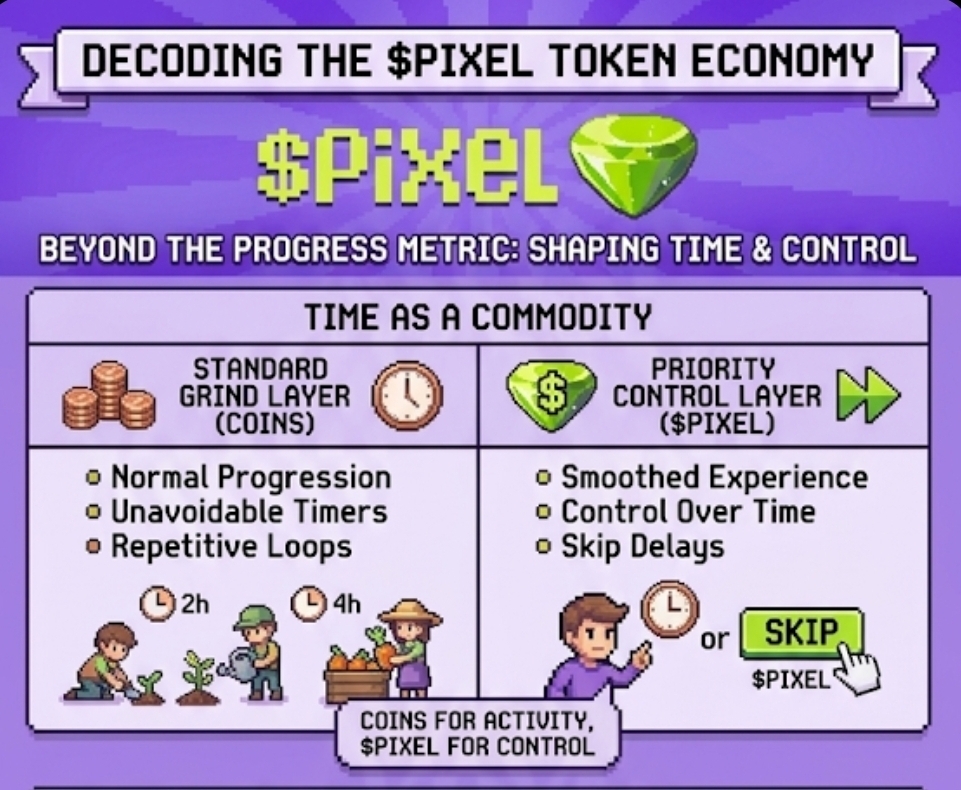
What players seem to react to isn’t what they’re getting. It’s how long everything takes to happen.
That sounds obvious, but it shifts the whole lens. Most GameFi tokens try to sell progress. Better tools, faster yields, higher output. Pixels technically does that too, but the pressure point isn’t the reward. It’s the delay wrapped around the reward. Growth timers, energy limits, small pauses everywhere. Individually they’re harmless. Together, they stack into something heavier than they look.
And that’s where $PIXEL quietly enters.
I don’t think it’s being used as a currency in the traditional sense. It feels closer to a permission layer for time. You’re not really buying items when you use it. You’re deciding that waiting is no longer worth it. Or maybe that repeating the same loop again isn’t worth the energy. That decision shows up more often than I expected.
I’ve seen players who don’t care much about optimizing output, but still reach for $PIXEL just to smooth things out. Not to win. Just to avoid friction. That’s a different kind of demand. Less visible. Harder to measure. But it repeats.
There’s also this split inside the system that I think gets overlooked. Coins handle most of the basic activity. They keep everything moving, keep the world alive. You can stay in that layer for a long time. Nothing forces you out. But the moment you want control, not just participation, you drift toward $PIXEL. That boundary feels intentional.
It reminds me a bit of how some platforms separate free access from priority access. Same system, different experience depending on how much control you want over time. Pixels doesn’t say it directly, but it behaves like that.
What’s interesting is how this changes the usual “adoption” conversation. People keep asking whether more players will come in, whether user numbers will grow, whether the token can hold value based on expansion. I’m not sure that’s the main lever here. The more I look at it, the more it feels like repetition matters more than growth.
If players keep encountering small delays that feel worth skipping, demand can exist even without huge inflows. Not explosive demand. Just steady, recurring decisions to compress time. That’s not something you see clearly on a chart.
But it’s fragile.
If the game becomes too efficient, if waiting stops being noticeable, then Pixel loses its role. There’s nothing left to compress. On the other hand, if the delays start feeling artificial, like they’re only there to push spending, players notice that too. And they don’t usually stay quiet about it.
So the system ends up walking a thin line. Friction has to feel natural. Almost invisible. Like part of the environment, not something imposed. That’s harder than it sounds. Especially at scale.
I also think the market is still reading this the wrong way. Most analysis I’ve seen focuses on supply, unlock schedules, maybe user counts. Those are easier to track. Cleaner. But they miss the behavioral layer. The quiet decisions players make dozens of times without thinking. Skip this. Speed that up. Avoid repeating this loop again.
That’s where the token actually lives.
And it’s not guaranteed that players will keep choosing that path. Sometimes people prefer the grind. Or they just leave instead of paying to make things smoother. I’ve done that myself in other games. Closed the app instead of speeding things up. That option always exists.
So I’m not fully convinced this model holds long term. But I also don’t think it’s being priced correctly right now.
Pixels doesn’t really sell progress. It shapes how time feels inside the system. Slower here, faster there, optional in some places. Pixel just sits at the point where that feeling can be changed. Whether that turns into durable demand or just a temporary habit probably depends on how subtle they can keep it.
And subtle systems are easy to underestimate.
#Pixel #pixel $PIXEL @Pixels