

Key Highlights
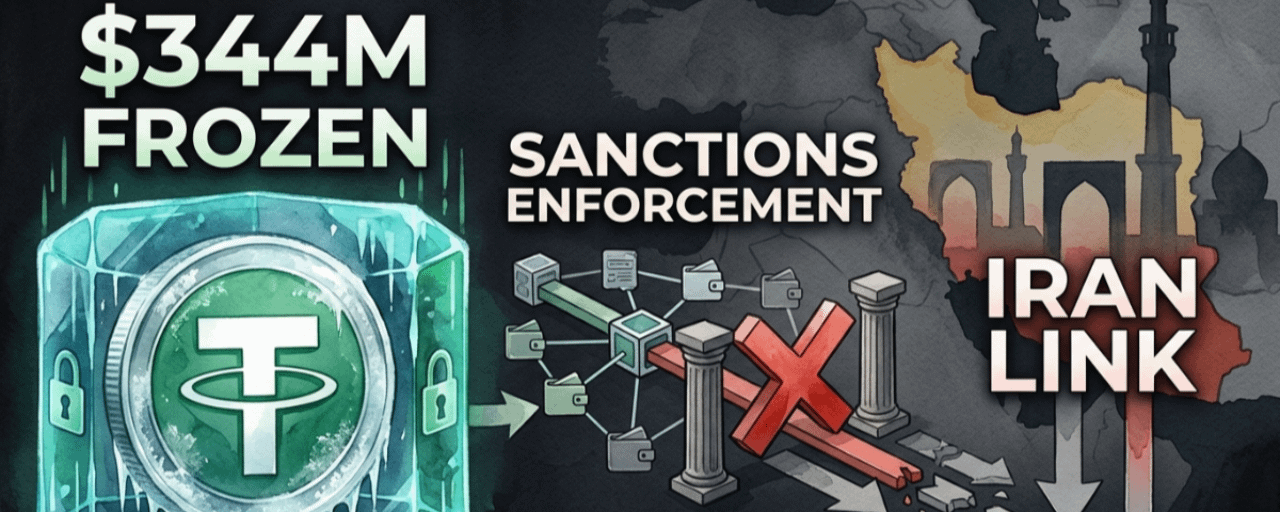
The Trump administration, in coordination with Tether and OFAC, froze $344 million in USDT stablecoins linked to Iran across two Tron blockchain addresses.
One address held approximately $213 million and the other $131 million.
Tether acted on information from U.S. authorities regarding suspected sanctions evasion and illicit activity connected to the Iranian regime.
Treasury Secretary Scott Bessent emphasized: “We will follow the money that Tehran is desperately attempting to move outside of the country and target all financial lifelines tied to the regime.”
In a significant escalation of economic pressure on Iran, the Trump administration has announced the freezing of approximately $344 million in Tether’s USDT stablecoin, funds that U.S. officials say are directly linked to the Iranian regime. The move, coordinated with Tether and the Office of Foreign Assets Control (OFAC), highlights the growing role of cryptocurrency in global sanctions enforcement—and reignites debates about decentralization in the crypto industry.
According to the latest report, Treasury Secretary Scott Bessent stated that the U.S. is sanctioning multiple crypto wallets connected to Tehran. In an official statement, Bessent declared: “We will follow the money that Tehran is desperately attempting to move outside of the country and target all financial lifelines tied to the regime.”
How the Freeze Unfold
On April 23, 2026, Tether—the issuer of the world’s largest stablecoin, USDT—announced it had frozen more than $344 million across two addresses on the Tron blockchain. The action was taken “in coordination with OFAC and U.S. law enforcement” after authorities provided information about activity tied to unlawful conduct, including suspected sanctions evasion. finance.yahoo.com +1Blockchain analytics later identified the two blacklisted Tron addresses:
One holding roughly $213 million
The other containing about $131 million
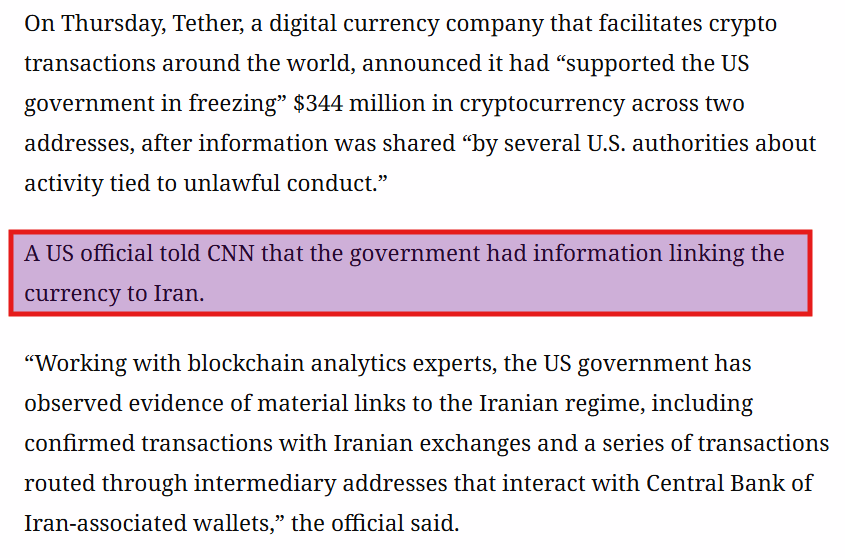
A U.S. official told CNN that the assets showed “material links to the Iranian regime,” including confirmed transactions with Iranian exchanges and interactions with wallets associated with the Central Bank of Iran. Chainalysis, a leading blockchain intelligence firm, noted that the wallets had historically moved large sums in patterns consistent with known Iranian Revolutionary Guard Corps (IRGC) activity.
 Source: cnn
Tether has a long history of cooperating with global law enforcement. The company has frozen over $1.8 billion in USDT since 2020 and works with more than 340 agencies across 65 countries. This latest action ranks among its largest single freezes to date.
Geopolitical Context:
Heavily sanctioned for decades, Iran has increasingly turned to cryptocurrency to bypass traditional banking restrictions. Crypto holdings in Iran reached $7.8 billion in 2025, according to Chainalysis, with the IRGC controlling a significant portion. Tehran uses digital assets to stabilize its rial, facilitate trade, and fund operations amid international isolation.
The timing of the freeze is notable. It comes as a fragile ceasefire holds following recent conflicts, with diplomatic efforts to end the war stalled. The Trump administration has ramped up sanctions to cut off Tehran’s financial lifelines, viewing crypto as a key vector for evasion. Experts like Daniel Tannebaum of the Atlantic Council describe the $344 million seizure as “meaningful” but note that Iran’s sophisticated adaptation strategies—often involving third-country actors like China—limit its overall impact.
Implications for Crypto: Decentralization Under Scrutiny
The incident has sparked intense discussion in crypto communities. While USDT is promoted as a borderless, efficient stablecoin, its centralized issuer (Tether) retains the technical ability to blacklist and freeze addresses on command.
Critics on X pointed out the irony with many users questioning whether stablecoins truly offer the financial sovereignty Bitcoin and other non-custodial assets promise.
However, the freeze underscores a key reality: much of the crypto ecosystem still relies on centralized intermediaries. Unlike Bitcoin, which operates on a fully decentralized network with no single point of control, USDT—and many other stablecoins—can be frozen at the issuer level. This event serves as a reminder that “not your keys, not your crypto” applies with extra force to custodial or issuer-controlled assets.
What’s Next?
The Iranian mission to the United Nations declined to comment. It remains unclear whether this freeze will materially affect Tehran’s war efforts or negotiation stance, given the scale of Iran’s overall economy and oil revenues.For the crypto industry, this is another chapter in the ongoing tension between innovation and regulation.
As governments worldwide enhance their blockchain surveillance capabilities, issuers like Tether will likely face increasing pressure to balance user privacy with compliance demands.
FAQ Section
How much USDT was frozen and on which network?
Tether froze more than $344 million in USDT across two addresses on the Tron blockchain. One wallet held ~$213M and the other ~$131M.
Disclaimer: The views and analysis presented in this article are for informational purposes only and reflect the author’s perspective, not financial advice. Technical patterns and indicators discussed are subject to market volatility and may or may not yield the anticipated results. Investors are advised to exercise caution, conduct independent research, and make decisions aligned with their individual risk tolerance.