most people (and honestly me at first) talk about pixels like it’s “a farming game with a token.” you plant, harvest, craft, sell, earn $pixels, maybe buy some assets, and ronin makes it cheap so it doesn’t feel painful. that’s the surface story, but it’s not the part that keeps sticking in my head. the part that keeps sticking is how carefully the system tries to control what gets produced, at what rate, and who ends up holding the token when the day’s done.
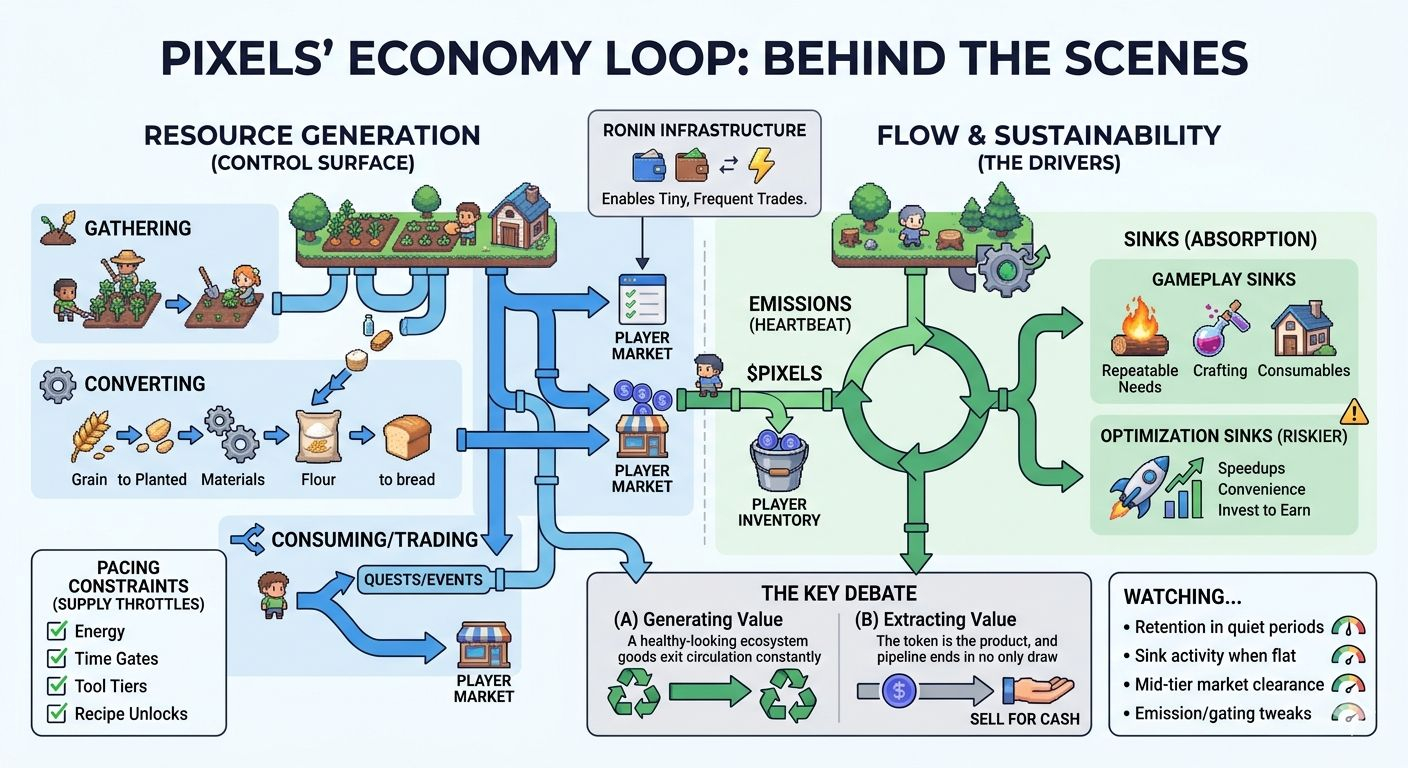
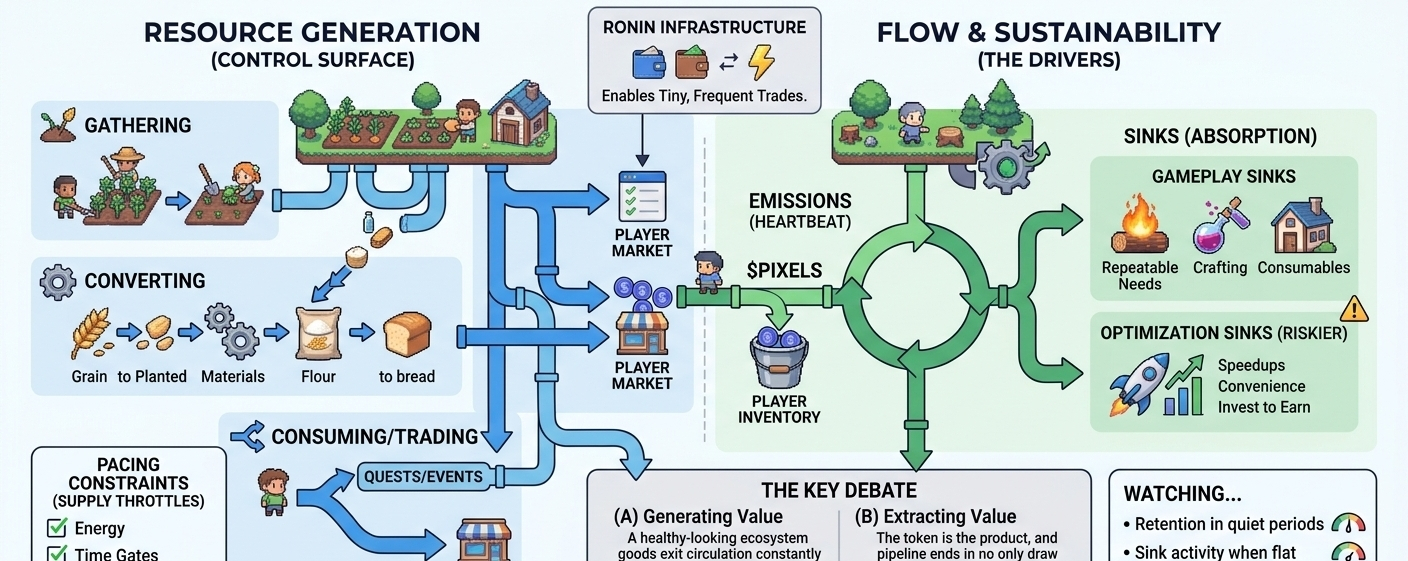
resource generation feels like the first control surface. the loop is straightforward: farming/gathering creates base mats, then crafting converts mats into higher-tier goods, and those goods either get consumed (quests/progression) or sold (player market). i keep using one boring example because it exposes the whole structure: grow a crop → process it into an ingredient → craft a consumable → sell it because someone else needs it to clear a quest step or unlock the next recipe. if that demand is steady, you can get real specialization and trade. if demand is mostly “because this week’s quest/event says so,” then it’s less a market and more a rotating instruction set.
what stands out is how much of the “economy” is actually enforced by pacing constraints: energy, time gates, tool tiers, recipe unlocks, and whatever access bottlenecks exist. those are not just balance knobs; they’re supply throttles. without them, players would converge on the highest-margin chain and turn the market into a landfill of undercut listings. with them, pixels can keep supply uneven and keep certain goods scarce-ish. i’m just not sure yet if that translates into long-term depth, or if it means the economy needs constant steering to avoid becoming solved.
then there’s $pixels flow, which is where the whole thing either closes into a loop or leaks outward. emissions are clearly the heartbeat: do activities, get $pixels, feel progress. but emissions are also inflation pressure by default, so sinks matter more than the headline reward rates. and here’s the part i’m thinking about: sinks can look “strong” on a whiteboard and still fail in practice if they’re confidence-based.
i mentally split sinks into:
- gameplay sinks: you spend because you actually want to do the thing (crafting that’s fun, consumables that matter, repeatable needs that burn resources).
- optimization sinks: you spend because it’s supposed to increase your earning/progression efficiency (speedups, convenience, “invest to earn more”).
optimization sinks scare me a bit because they’re pro-cyclical. when the token is exciting and player sentiment is up, people reinvest and sinks look healthy. when the token is flat and the market is saturated, players stop spending and start extracting, and the sink turns into a suggestion. the tricky balance is that making sinks mandatory enough to matter can also make the game feel like it’s charging rent, which is a retention killer in its own way.
infrastructure-wise, ronin feels like the practical backbone that makes pixels’ market behavior possible at all. low fees and decent wallet UX mean the game can support lots of small, frequent transactions: buying inputs, listing stacks of materials, moving assets around, settling sales. pixels isn’t an economy of occasional big trades; it’s lots of tiny trades. ronin makes that viable. but ronin also changes the behavioral baseline: players there are used to markets. profitable loops get found quickly, and if a crafting path has an outsized reward-to-input ratio, it gets crowded and compressed fast. scalability isn’t just “can the chain handle it,” it’s “can the economy withstand being min-maxed continuously.”
so the sustainability question i keep circling is: are players generating value or just extracting it? the “generating” version requires steady consumption (items actually leaving circulation), specialization that persists beyond a single event, and sinks that don’t depend on hype. the “extracting” version is when the token is the product, and items/quests are just the machinery that schedules distribution.
and yeah, a lot depends on continuous user growth even if nobody says it. new players absorb supply, buy starter goods/assets, and keep markets liquid. if growth plateaus, you find out whether demand is intrinsic or just onboarding + event scheduling.
watching:
- retention in quiet periods (no big events, token not moving)
- whether $pixels sinks stay active when reinvesting isn’t obviously “worth it”
- market clearance for mid-tier crafted goods (do they sell, or just get listed?)
- frequency of emission/gating tweaks (normal balancing vs constant leak-plugging)
i don’t have a clean conclusion yet. pixels feels well-managed, but i’m still trying to see if it can survive a long flat stretch where the token is boring and growth slows. if that happens, who’s the buyer of last resort: other players with real needs, or nobody?