Market's been quiet this week. The kind of quiet where you start poking at things you normally wouldn't.
So I ended up spending more time than intended looking at @Pixels $PIXEL and the Ronin ecosystem around it.
I wasn't looking for a trade. I was trying to understand why this particular token keeps showing up in conversations about Web3 gaming durability. Most gaming tokens come up once and disappear. This one keeps getting mentioned.
And I think I finally see it. Or at least I see something I didn't see before.
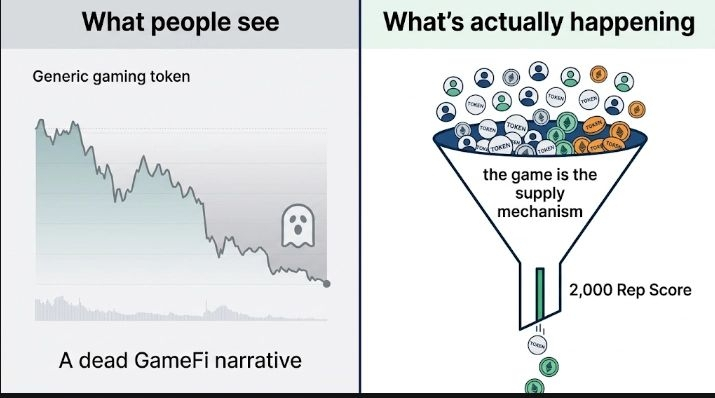
Here's what most people do when they look at $PIXEL: they open a price chart, check the market cap it's sitting around $5 6 million right now, down hard from an ATH of just over a dollar
and they write it off as another deflated play to earn relic. GameFi's been underwater for most of 2026. The narrative is dead, they say. Move on.
But here's the thing that stopped me. I went one layer deeper and looked at how the token actually moves inside the game. Not the price. The mechanics.
There's a Reputation Score system in Pixels that determines what you can do with $PIXEL on chain. You need 2,000 points before you can withdraw anything to your wallet. Players below that threshold which is most of them, especially newer ones are fully active in the game, spending, farming, participating in events, generating volume. But they can't exit on chain. They're in the loop, not through it.
That isn't just an anti bot filter. That's a structural supply cap enforced through gameplay.
I thought about this for a while. Then I looked at deposit versus withdrawal data for the ecosystem. In May 2025 and this was apparently a notable moment they flagged themselves
the game hit a milestone where deposits outpaced withdrawals for the first time. More #pixel flowing in than out. That's not a marketing story. That's a mechanics story.
The game is literally designed to pull more tokens in than it lets out and it uses Reputation a gameplay metric to enforce it.
So when people say "gameplay choices drive token value," they usually mean something vague about engagement. What's actually happening here is more specific: the game loop determines your withdrawal access.
Your farming hours, quests, guild participation all of that feeds a score that decides whether you're a net buyer or a net seller of PIXEL. Most active players are net buyers for a long time before they become net sellers.
That's a different kind of token design. It's not promising you rewards for playing. It's structuring the player base so that the biggest segment free to play, still building rep generates consistent inbound demand while being gated from consistent outbound pressure. Mechanically, it looks more like a supply control system than a game economy.
But here's the part I keep coming back to and can't fully resolve.
There's a 91.18 million pixel unlock scheduled for May 19th about 25 days from now. That's ecosystem, team, advisor and seed tranches across several vesting lines landing at once.
Total circulating right now is about 770 million against a 5 billion max supply. So when that unlock hits, external holders who aren't inside the Reputation gate can sell freely. And they will, if the broader market stays soft.
The game's internal mechanics can suppress sell pressure from players. They cannot suppress sell pressure from investors and early allocators exiting into liquidity. Those are two completely different seller populations, and the Reputation system only controls one of them.
That gap is what I'm still sitting with.
I thought this was a story about a well designed token economy. It might still be. But it's also a story about whether in game mechanics can actually offset structured unlock pressure at the cap table level. In a low volume market, probably not. In a recovering one, maybe. The answer probably depends on timing more than design.