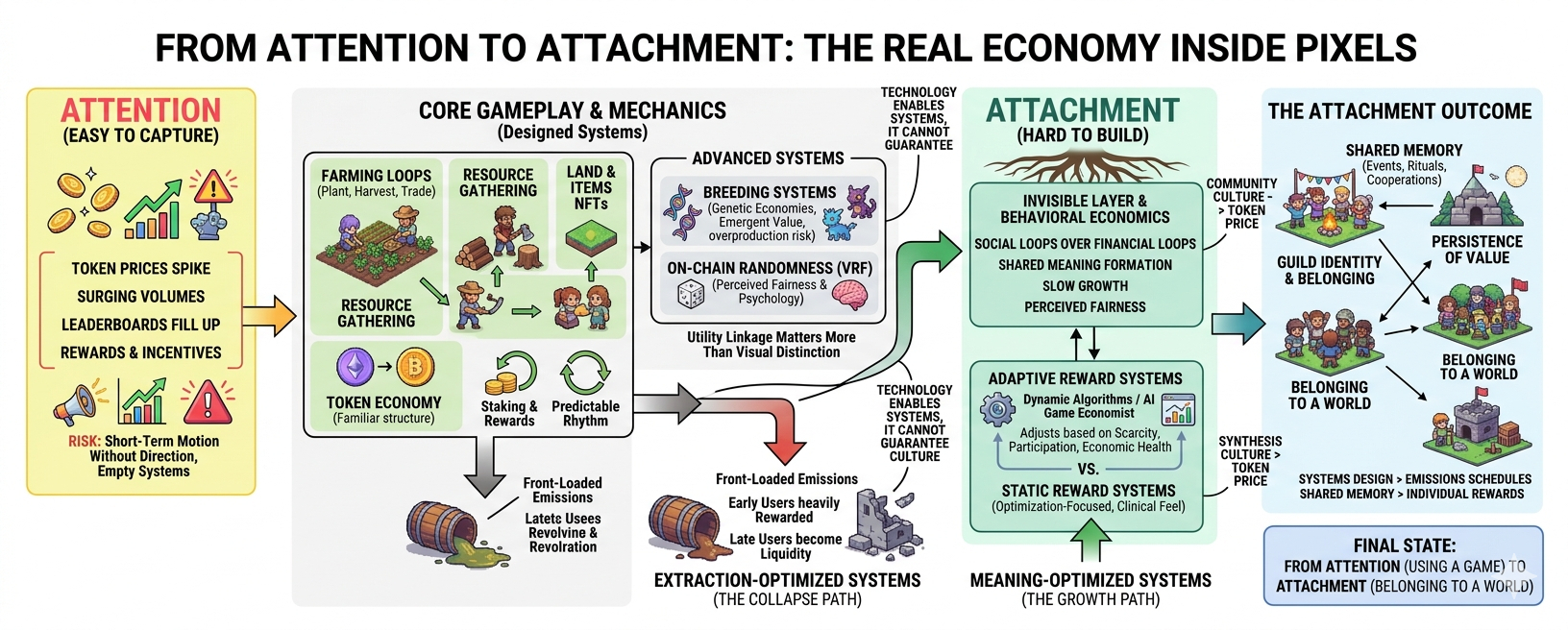
I have been around crypto long enough to stop being impressed by numbers alone. Token prices spike, volumes surge, leaderboards fill up, and yet a few weeks later the same systems feel empty. What used to look like momentum reveals itself as motion without direction. The common belief is that rewards drive engagement, but what I have seen over multiple cycles suggests something quieter and less comfortable. Rewards can attract attention, but they rarely build attachment.
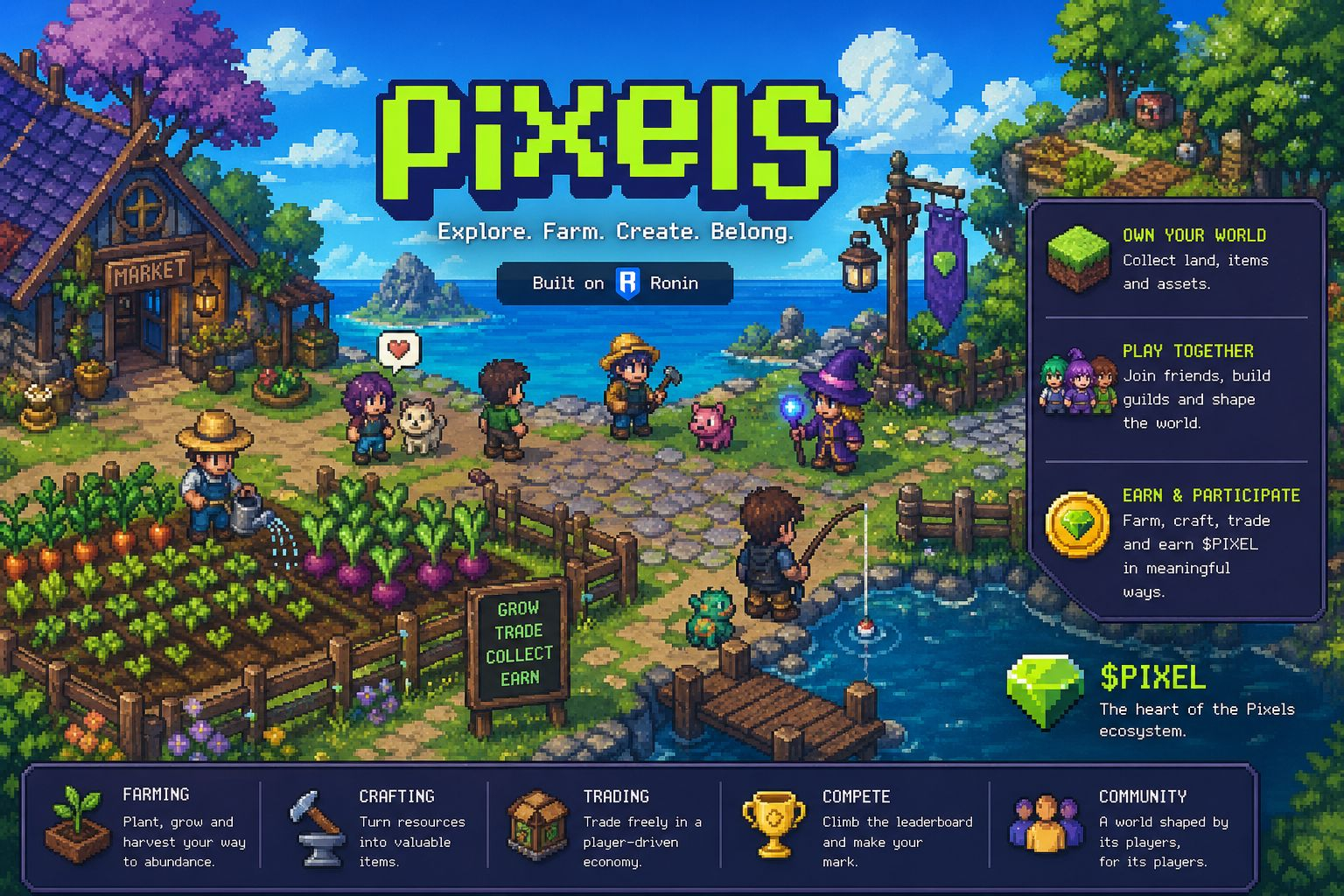
That is where something like Pixels begins to feel different, or at least more interesting to examine. Not because it avoids incentives, but because it hints at a broader system where incentives are only one layer. Built on Ronin Network, Pixels sits in a familiar category on the surface. Farming loops, resource gathering, NFTs, token rewards. None of this is new. But what interests me more is how these pieces interact rather than what they are individually.
The thesis that keeps emerging for me is simple. Community culture matters more than token price. Systems design matters more than emissions schedules. Social loops matter more than financial loops. This is not something projects usually declare. It is something you notice when you spend time inside them, watching how players behave when no one is announcing a new reward campaign.
At the visible layer, Pixels looks like any other Web3 game trying to balance economy and gameplay. There are tokens moving through the system, NFTs representing land and items, and a set of farming mechanics that anchor daily activity. Staking and rewards create a predictable rhythm. Players plant, harvest, trade, repeat. The structure is legible, almost comforting in its familiarity.
But the invisible layer is where things become harder to measure and more important to understand. Why do players return when rewards are not exceptional. Why do certain communities cluster around specific areas of the map. Why do some players build identities around their land or their role in the ecosystem. These are not outcomes of tokenomics alone. They emerge from social behavior, from the slow formation of shared meaning.
Most Web3 projects fail because they optimize too aggressively for extraction. They design systems where value is pulled out faster than it is created. Emissions are front loaded. Early users are rewarded heavily. Late users become liquidity. It works for a moment, and then it collapses under its own incentives. The part people miss is that extraction is easy to design but meaning is not.
Pixels, at least in its current form, seems to lean toward a different balance. Not perfectly, and not without risk, but there is an attempt to let the world breathe. NFTs are not just static assets but parts of a broader loop. Traits and rarity exist, but their value is tied to how they function within the system rather than pure speculation. Utility linkage matters more than visual distinction.
There are also underlying questions about fairness and randomness. On chain randomness systems, often implemented through mechanisms like verifiable random functions, try to ensure outcomes are not manipulated. But fairness is not just technical. It is perceived. If players feel outcomes are predictable or biased, trust erodes quickly. That is where system design meets psychology.
Breeding systems and genetic economies introduce another layer of complexity. They promise emergent value, where combinations of traits produce new forms of utility. In theory, this creates a living economy. In practice, it often leads to overproduction and value dilution. The challenge is not creating new assets but maintaining their meaning over time. Ownership alone is not enough. Ownership without persistence of value becomes a burden rather than a benefit.
When you shift into behavioral economics, the picture becomes clearer. Incentives shape behavior in ways that are often unintended. Static reward systems encourage optimization. Players find the most efficient path and repeat it until the system breaks or the rewards diminish. This leads to a kind of mechanical engagement that looks active but feels hollow.
Adaptive reward systems, whether driven by dynamic algorithms or something closer to an AI game economist, offer a different path. Instead of fixed outputs, the system responds to player behavior. Rewards adjust based on participation patterns, scarcity, and broader economic health. This is not about adding complexity for its own sake. It is about aligning incentives with long term engagement rather than short term extraction.
But even this introduces tension. Over optimization can strip away the sense of play. If every action is measured and adjusted, the system can start to feel clinical. Players are not just participants, they become variables. That is where the balance between efficiency and meaning becomes fragile.
From a macro perspective, Web3 games increasingly resemble digital economies more than traditional games. In some cases, they look like ad networks where attention is monetized and redistributed. In others, they function as platform ecosystems where creators, players, and investors intersect. Pixels sits somewhere in between, acting not just as a game but as a kind of infrastructure layer for social interaction and value exchange.
The convergence with traditional gaming is inevitable. Not because blockchain is inherently superior, but because both sides are moving toward similar goals. Persistent worlds, player driven economies, and long term engagement loops. The difference is that Web3 makes ownership explicit, while traditional systems keep it abstract.
What I find more compelling, though, is the cultural layer. Shared memory matters more than individual rewards. Players remember events, interactions, small moments of cooperation or competition. Guilds form not just for efficiency but for identity. Rituals emerge, whether it is daily farming routines or community driven events. This is the difference between using a game and belonging to a world.
Attention is easy to capture. Attachment is not. Economy can be designed. Culture has to grow.
Pixels is not a solved system. It carries the same risks as any Web3 project. Reward structures can still be gamed. Value can still be extracted faster than it is created. Players can still optimize the fun out of the experience. The presence of better design does not eliminate these pressures. It only changes how they manifest.
The outcome remains uncertain. And that is probably the most honest place to end. The real challenge is not technical implementation or token design. It is human behavior. How people respond to incentives, how they form communities, how they assign meaning to digital spaces.
Technology can enable systems. It cannot guarantee culture.
That is where it gets interesting.