
It Doesn’t Look Like Much—At First
There’s a moment, when you first open Pixels, where you might almost underestimate it.
The visuals are simple. Soft colors, blocky characters, farmland stretching out in neat little squares. It feels familiar in a comforting way—like something you’ve played before, maybe years ago. You plant crops, walk around, talk to a few NPCs. Nothing too complicated.
And yet… give it an hour.
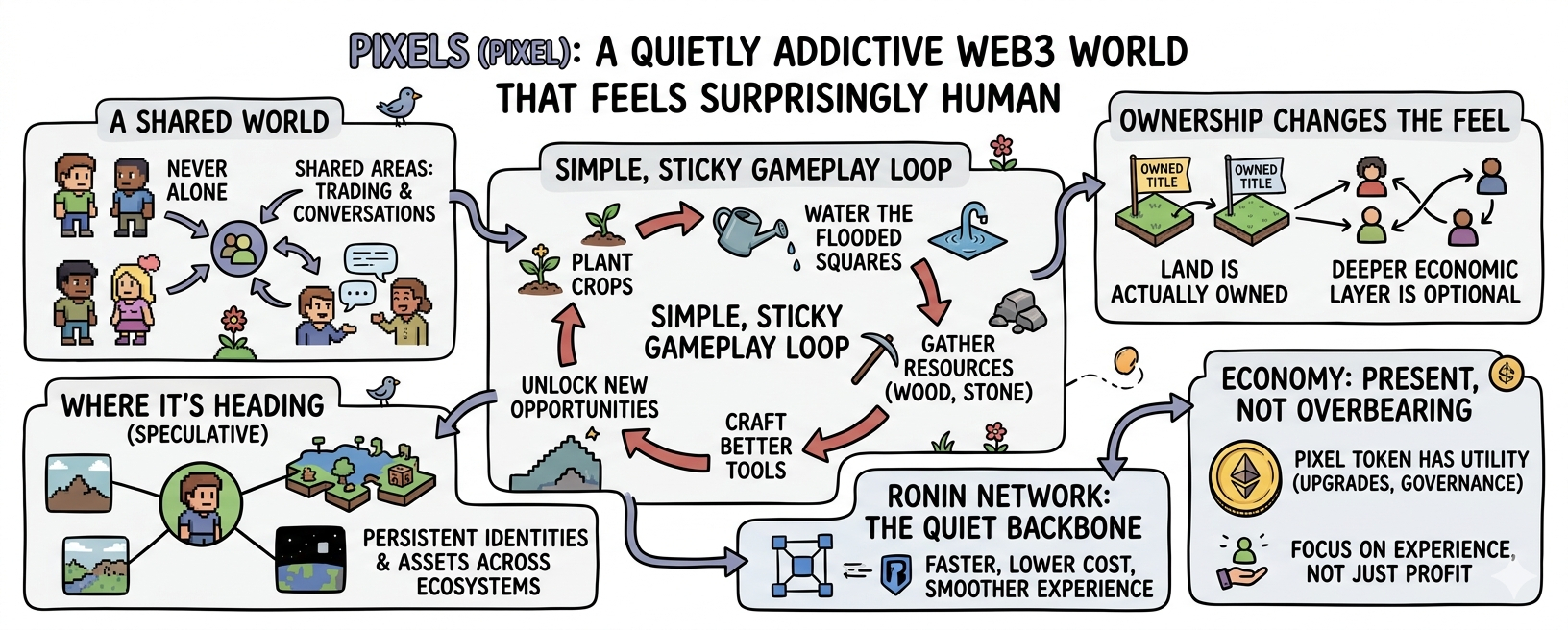
What starts as a casual farming loop slowly begins to reveal something deeper. Not in a dramatic, “big reveal” kind of way, but in small, layered realizations. You notice other players moving through the world. You realize the land has value. You start to see how everything—resources, time, interaction—feeds into something larger.
Pixels isn’t trying to impress you immediately. It grows on you. And that’s part of its charm.
A World That Feels Shared, Not Just Played
One thing that stands out pretty quickly is that this isn’t a lonely experience.
Even though you begin with your own little space—your crops, your tasks—you’re never really alone. Other players pass by. Some stop. Some don’t. There’s a quiet sense that everyone is doing their own thing, but still part of the same world.
It changes the atmosphere in a subtle way.
In many farming games, everything revolves around you. Your farm is the center of the universe. In Pixels, your farm feels more like… a piece of a bigger puzzle. Not insignificant, just not isolated.
You might run into someone harvesting resources in the same area. Or see a group gathered in a town hub, trading items or just lingering for no obvious reason. It’s not forced socialization. It just… happens.
And oddly, that makes it feel more real.The Gameplay: Simple on the Surface, Sticky Over Time
If you strip it down, Pixels is built on very straightforward mechanics:
You plant crops.
You water them.
You gather wood, stone, and other materials.
You craft things.
You complete tasks.
That’s it. Nothing revolutionary.
But here’s the thing—these systems are tied together in a way that keeps pulling you forward.
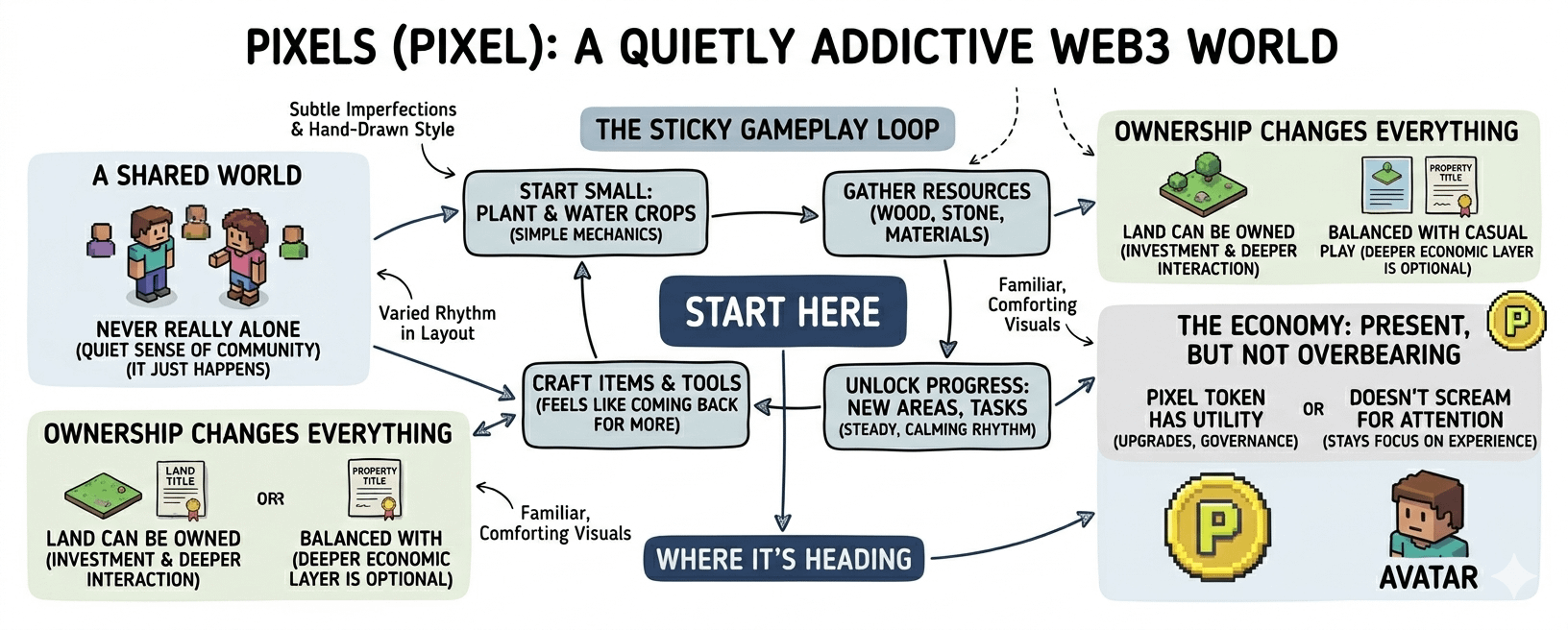
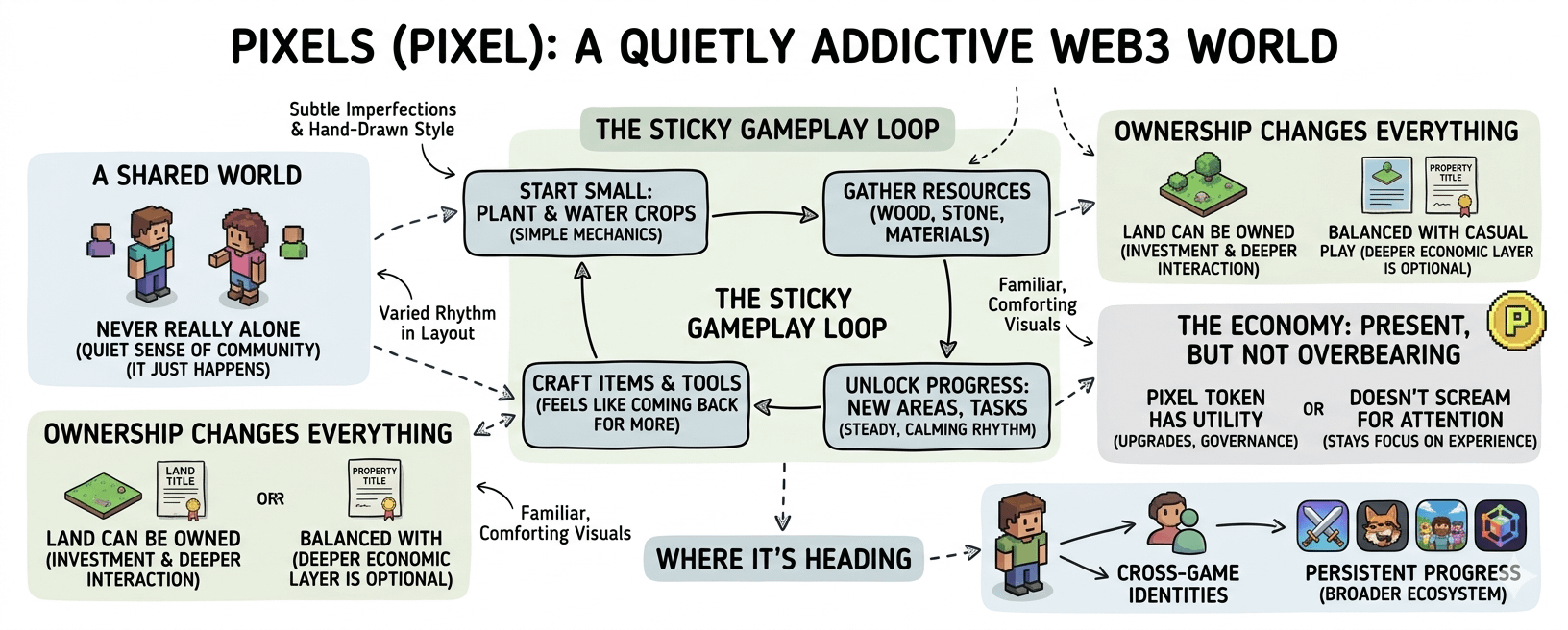
You don’t just farm because it’s there. You farm because you need resources. You need resources because you want better tools. Better tools help you progress faster. Progress unlocks new areas, new tasks, new opportunities.
It becomes a loop. Not an exhausting one—but a steady, almost calming rhythm.
There’s always something small to do next. And for a lot of people, that’s enough to keep coming back.
Ownership Changes the Feel of Everything
This is where Pixels quietly steps into Web3 territory.In traditional games, everything you build—your farm, your items, your progress—exists within the game’s boundaries. It belongs to the system.
Pixels shifts that idea.
Land, in particular, can be owned. Not just “used” or “unlocked,” but actually owned in a way that carries value outside the game itself. That alone changes how people interact with it.
If you own land, you’re not just decorating a space. You’re investing in it. You think differently about how you use it, how you expand it, even how others might interact with it.
But what’s interesting is that the game doesn’t force this on you.
You can still play casually. You can farm, explore, and progress without worrying about ownership at all. The deeper economic layer is there if you want it—but it doesn’t dominate the experience.
That balance feels intentional. And honestly, it’s refreshing.The Economy: Present, But Not Overbearing
Let’s talk about the PIXEL token for a second.
In many blockchain-based games, the economy becomes the game. Everything revolves around earning, trading, optimizing for profit. It can start to feel less like playing and more like… managing a system.
Pixels takes a slightly different approach.
Yes, there’s a token. Yes, it has utility—things like upgrades, governance, and certain in-game actions. But it doesn’t scream for your attention every five minutes.
You can spend hours in the game without thinking about it at all.
And that’s important.
Because it keeps the focus where it probably should be: on the experience itself.
The Social Layer (That Sneaks Up on You)
At some point, you realize you’re not just playing the game—you’re existing in it alongside others.
There are shared areas where people gather. Informal trading happens. Conversations pop up. Sometimes you help someone. Sometimes someone helps you.
It’s not structured like a traditional MMO where you’re constantly pushed into teams or missions. It’s looser than that. More organic.
You might log in just to check your crops…
And end up spending time chatting or wandering around instead.
That kind of interaction isn’t easy to design. But Pixels manages to create the conditions for it without forcing it.
Ronin Network: The Quiet BackboneBehind the scenes, Pixels runs on the Ronin Network—a blockchain built specifically for games.
Now, most players won’t think about this much. And honestly, they don’t need to.
What matters is what it enables:
Faster interactions.
Lower costs.
smoother experience overall.
Earlier Web3 games often struggled here. Things felt clunky. Slow. Expensive to interact with. That friction pushed people away.
Pixels, by comparison, feels… normal. Which is probably the highest compliment you can give a system like this.
Where It’s Heading: Something Bigger Than a Farming Game
This is where things get a bit more speculative—but also more interesting.
Pixels doesn’t seem content staying just a farming simulator. There’s a growing sense that it’s evolving into a broader ecosystem.
The idea is simple, but ambitious:
Your progress, your assets, your identity in Pixels might eventually carry over into other experiences.
Different games. Different environments. Same underlying ownership.
If that works—and that’s still a big “if”—it could change how people think about time spent in games. It wouldn’t just be temporary progress locked into a single title. It would be something more persistent.
But again, Pixels doesn’t rush this. It builds slowly.Few Honest Thoughts
It’s not perfect.
The gameplay can get repetitive if you’re not the kind of person who enjoys slow progression. Some systems still feel like they’re being figured out. And like any evolving game, there’s always a bit of uncertainty about where it’s heading.
But maybe that’s part of what makes it interesting.
It doesn’t feel finished. It feels in progress.
OAnd that gives players a sense—real or not—that they’re part of shaping it.Conclusion: Small Pixels, Big Ideas
What makes Pixels stand out isn’t any single feature.
It’s the way everything comes together quietly.
simple farming loop.
shared world.
layer of ownership that doesn’t overwhelm.
social environment that feels natural.None of these things are entirely new on their own. But combined, they create something that feels… different.
Not revolutionary in a loud, attention-grabbing way.
Just quietly different.And sometimes, that’s exactly what sticks.
