Been staring at this Pixels situation for the last few hours, trying to figure out if they’re actually fixing the sink or just rearranging deck chairs on the Titanic. The price action is toast, same as every other gaming token from that era, but the development side? Not dead yet. That’s what makes me pause.
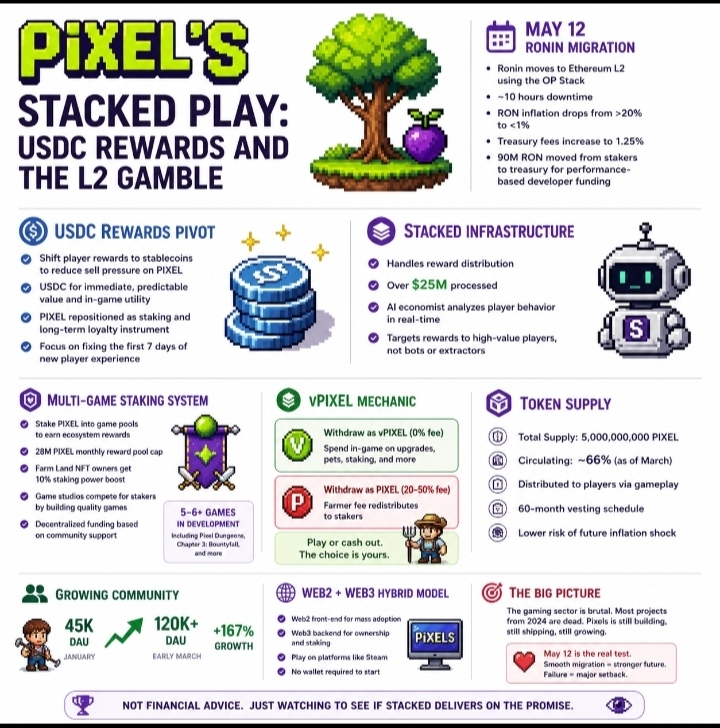
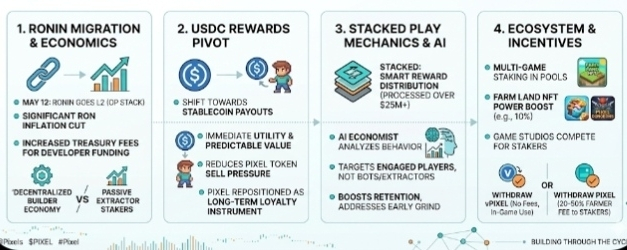
The big news that dropped recently is the Ronin migration happening May 12 . That’s not just some technical upgrade you ignore. Ronin is moving from being a sidechain to a proper Ethereum Layer 2 using the OP Stack. For Pixels, this means about ten hours of downtime when the mainnet goes offline. Games might be unavailable during that window. Annoying, sure, but the economics underneath are shifting hard. RON inflation is dropping from over twenty percent to under one percent . Treasury fees are increasing to one point two five percent. And ninety million RON that used to go to stakers is moving to the treasury to fund developers based on performance, not just passive holding.
That last part matters for Pixels because the chain is finally admitting their old model didn’t work. Too much inflation, too much extraction. Now they’re forcing a builder economy. If you’re building a game on Ronin, you might actually get support instead of just competing with stakers dumping their yields.
But what’s really caught my eye is the USDC rewards pivot they talked about in the February AMA . The team is moving a chunk of player rewards toward stablecoins. Why? To stop the constant sell pressure on PIXEL. Think about it. If you’re a player grinding quests and getting paid in a token that’s down ninety eight percent, you’re dumping that the second you get it. That’s just rational behavior. But if you’re getting USDC for your daily chores? You might hold it. Or spend it in-game. Either way, the sell wall gets thinner.
The plan is two-track. Immediate utility and predictable value via USDC payouts. PIXEL gets repositioned as a staking and long term loyalty instrument, not just a reward token you flip for rent money . They’re targeting the first seven days of the new player experience, which they admit is a grind right now. Reputation requirements are too harsh. People quit before they even understand the loop. Fix that, pay them in stable value, and maybe retention looks different.
There’s this infrastructure thing they built called Stacked. Honestly, I slept on it until I saw the numbers. Stacked is handling the reward distribution, and it’s already processed over twenty five million dollars . It’s got an AI economist that analyzes player behavior in real time. Who’s about to churn? What actions actually predict long term retention? Then it drops rewards on the people who matter, not the bots and the extractors. Most play to earn died because the rewards got gamed by scripts. This is supposed to fix that.
The multi-game staking system is rolling out too . You stake PIXEL into different game pools and earn a cut of the monthly ecosystem rewards. Right now that pool is capped at twenty eight million PIXEL per month. If you own Farm Land NFT, you get a ten percent staking power boost. The idea is that game studios have to build quality stuff to attract stakers. Decentralized funding instead of just handing out grants that get mismanaged. They’ve got five or six other games in development under the ecosystem. Pixel Dungeons is one of them. Chapter 3 Bountyfall added team competitions and sabotage mechanics.
The PIXEL mechanic is weird but makes sense if you think about it. You can withdraw rewards as PIXEL with zero fees, but you can only spend it inside the game on upgrades, pets, or staking . If you want direct PIXEL to sell on an exchange, you pay a twenty to fifty percent farmer fee that gets redistributed to stakers. That fee is brutal, but that’s the point. It forces a choice. Do you want to play or do you want to cash out? The game needs people who want to play.
The token supply situation is worth noting. Total supply capped at five billion. About sixty six percent of that is already in circulation as of March . Most of it was distributed to actual players through gameplay, not just investors sitting on unlocks. That means less risk of a massive inflation shock later. The vesting schedule is spread over sixty months. No sudden supply dumps.
The founder Luke talked about how internal AI tooling has made the team way more productive . His take is that just building a game isn’t enough anymore. You need a moat. Data advantages. Network effects. He thinks Stacked could be that moat because it separates the rewarded play from the core game. That means Pixels could sit on platforms like Steam where direct Web3 stuff isn’t allowed inside the game client. Hybrid model. Web2 front end. Web3 backend. You don’t need to know what a wallet is to plant some Popberries. But if you want to own your stuff, the option is there.
Daily active users grew from forty five thousand in January to over one hundred twenty thousand in early March . That’s a hundred sixty seven percent increase. In a market where most crypto games are shutting down. The Forgotten Runiverse on Ronin closed. Xociety on Sui is done. The space is brutal right now. So Pixels still having growing activity means something. Not sure exactly what, but something.
The team did address the Web2 integration concerns head on in the AMA. People worried they’re abandoning Web3 entirely. Their response was clear. The foundation remains on chain. Ownership and staking mechanisms stay intact. They’re just abstracting the complexity away for people who don’t care about crypto . That’s probably the only way mass adoption happens anyway.
Not gonna pretend I know where this goes. The token is down the same ninety eight percent as AXS and IMX and everything else that was hot in 2024. The whole gaming sector got wrecked. But the difference between Pixels and the dead projects is that this team is still building. Still shipping new mechanics. Still trying to figure out sustainable play to earn when almost everyone else failed.
May 12 is the real test. The Ronin migration happens, and if it goes smooth, that’s one less thing to worry about. If it breaks, we’ll see how fast they recover. Either way, I’m watching. Not buying. Not selling. Just watching to see if this Stacked thing actually delivers on the promise or if it’s just another layer of complexity on top of a broken model. $APE