
I’ll be honest—I didn’t go into Pixels expecting much.
It looked like one of those simple farming games you open out of curiosity and forget a day later. Bright colors, slow gameplay, familiar mechanics. I’ve seen enough of those to know how they usually go. But for some reason, I didn’t drop it as quickly as I thought I would. Not because it surprised me in a big way, but because something about it felt… intentional. Almost like it was holding something back.
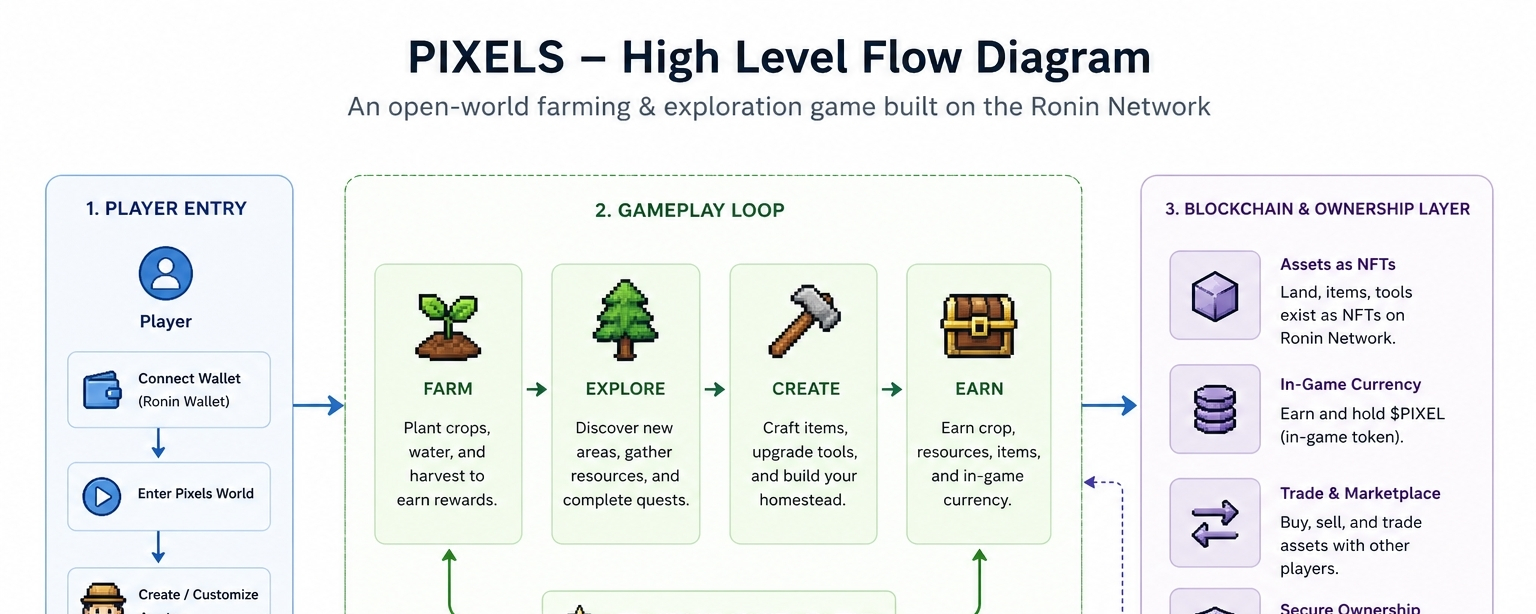
On the surface, it’s exactly what it looks like. You plant crops, collect resources, walk around, do small tasks, and slowly build your progress. It’s repetitive, yes—but in a calm, almost comforting way. There’s no rush, no pressure. You just keep going, little by little. And honestly, that simplicity might be why it works at all.
But then there’s this other layer underneath.
Pixels runs on the Ronin Network, which basically means that some of the things you earn in the game—like land or items—aren’t just stuck inside it. They’re technically yours. You can move them, trade them, or hold onto them outside the game. That idea isn’t new if you’ve been around Web3 stuff, but here’s what stood out to me: the game doesn’t constantly remind you of it.
And that’s rare.
Most blockchain games I’ve come across feel like they’re trying too hard to prove something. They push tokens in your face, talk about earnings, make everything feel like an opportunity. Sometimes it doesn’t even feel like you’re playing a game—it feels like you’re managing a small economy.
Pixels doesn’t do that. Or at least, not in an obvious way.
You can play it for quite a while without thinking about ownership at all. You’re just farming, exploring, doing your thing. And then, slowly, you start realizing—wait, this stuff actually belongs to me? Not in a dramatic way. Just quietly, in the background.
That made me pause more than I expected.
Because maybe the real question isn’t whether people want ownership. Everyone says they do. The more interesting question is: does ownership still feel meaningful when it’s not constantly being advertised to you?
Pixels feels like it’s testing that. Not loudly, not aggressively—just by letting the idea sit there and seeing if players naturally start to care about it over time.
I’m still not sure what the answer is.
The more I thought about it, the more it felt like this isn’t just about games. It’s about how we spend time online in general. In most digital spaces, you put in hours, you build something—progress, identity, even relationships—but none of it really leaves that space. It stays locked there.
Pixels hints at something slightly different. Not a complete shift, but a small step. The idea that maybe what you build could exist beyond the system itself. That your time might carry some kind of continuity.
But I don’t want to overstate it either.
Ownership only matters if it actually means something. If there’s no real use or demand for what you own, then it becomes more of a concept than a reality. And there’s always that risk here. Just because something is “yours” doesn’t automatically make it valuable or even useful.
And then there’s the gameplay itself. It’s peaceful, yes—but also repetitive. That can be relaxing for a while, but I do wonder how long that feeling lasts. Without something deeper pulling you in—whether it’s community, creativity, or purpose—it could start to feel empty.
There’s also a subtle tension I kept noticing. Even if the game doesn’t push financial thinking, the fact that assets can be traded is always there in the background. And once something has value, even quietly, it changes how people behave. You start thinking differently. Maybe not right away, but eventually.
Still, I can’t dismiss what Pixels is doing.
It doesn’t feel like it’s trying to impress anyone. It’s not loud or overly ambitious in how it presents itself. If anything, it feels patient. Like it’s okay with people not fully understanding it at first.
After spending time with it, I don’t come away thinking this is some kind of breakthrough. That would feel forced. But I do think it’s asking a better question than most games in this space.
Not “how do we make money from players?”
Not even “how do we give players ownership?”
But something simpler, and maybe harder:
what happens if ownership is just… there, quietly, while people play?
I don’t know if Pixels answers that yet. But I found myself thinking about it long after I stopped playing. And honestly, that alone feels worth something.