

I didn’t expect much when I first wandered into Pixels. Another Web3 game, I thought—probably more noise than substance, more talk about tokens than actual play. But something about the quiet rhythm of it pulled me in before I had time to judge it properly.
At first, it felt almost too simple. You plant crops, you move around, you gather things. Nothing groundbreaking on the surface. But then I noticed how I wasn’t rushing. I wasn’t trying to optimize every second or chase some leaderboard. I was just… there. Walking around, figuring things out slowly, like the game wasn’t asking anything from me except attention.
And that’s where it got interesting.
Most games, especially ones tied to blockchain, feel like they’re constantly nudging you—earn this, grind that, don’t fall behind. Pixels doesn’t completely escape that, but it softens it. The farming loop, the exploration, the small interactions—it all creates this strange sense of calm. It’s not empty, just… unpressured.
I kept thinking about why that felt so rare.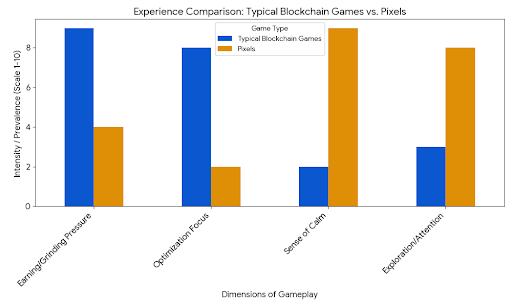
Maybe it’s because the idea of ownership in Web3 games usually overshadows everything else. You’re supposed to care about assets, tokens, economies. But while playing Pixels, I found myself caring more about where I placed my crops than what they were worth. That shift felt subtle, but kind of important.
Still, I couldn’t ignore the skepticism sitting in the back of my mind.
Is this calmness intentional, or is it just early-stage simplicity? Will it eventually turn into another optimization treadmill once systems deepen and economies mature? I don’t know. And I think that uncertainty is part of the experience too. You’re not just playing the game—you’re watching it become something.
There’s also something oddly human about how the world feels. Not because it’s realistic—it isn’t—but because it leaves space. Space to wander, to pause, to do nothing for a moment without feeling like you’re wasting time. That’s rare in digital spaces now. Everything usually demands engagement, retention, efficiency.
Pixels doesn’t fully demand that. At least not yet.
And maybe that’s why I keep coming back to it, even when I’m not entirely sure what I’m working toward. It’s not about a grand goal or some big payoff. It’s more like checking in on a place that slowly grows familiar.
I don’t think it’s perfect. Parts of it feel unfinished, and the Web3 layer still raises questions for me—about sustainability, about accessibility, about whether this model really adds something meaningful long term. Those doubts don’t go away just because the game feels relaxing.
But at the same time, I can’t deny that it made me slow down in a way most games don’t.
And maybe that’s enough, at least for now.
I’m still not fully convinced by the bigger promises around it. But I am curious. And that curiosity feels more honest than hype.