
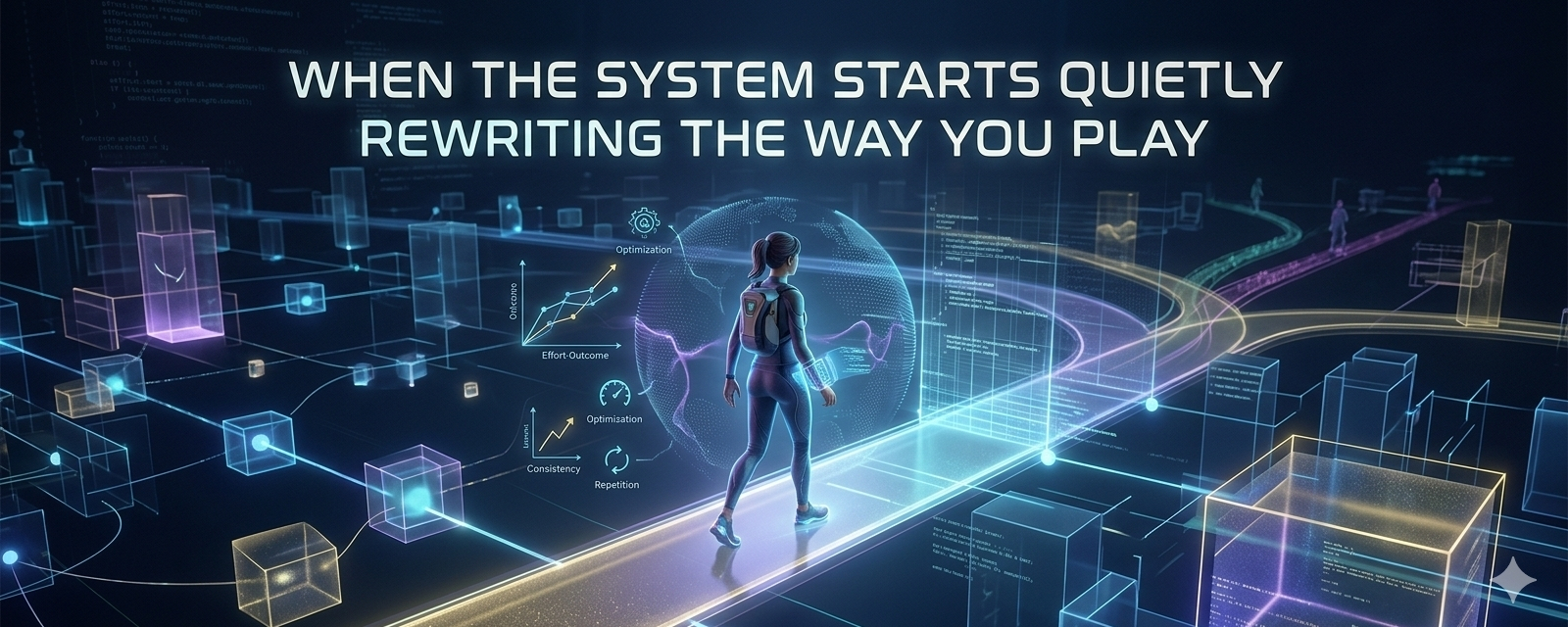
@Pixels There was a time when I believed I could clearly tell when I was doing things “right” inside a system. In most games, that moment comes naturally—effort aligns with outcome, and the loop feels stable enough to trust. But here, that clarity never fully settled. Some sessions felt smooth and predictable, while others carried a strange kind of friction, even though I was doing the same things in the same way. Nothing looked broken on the surface, yet the results didn’t always reflect the effort in a way I could explain. It wasn’t failure, it was something more subtle—an inconsistency that didn’t quite reveal its source.
Like most people, I assumed the issue was mine to solve. That’s almost instinctive in GameFi environments. When outcomes don’t match expectations, the natural response is to refine, optimize, and push harder. So I leaned into that mindset. I cleaned up my loops, reduced wasted movement, and approached everything with more structure. For a while, it worked. It felt like I had finally aligned myself with how the system wanted to be played. But that sense of control didn’t last. The same patterns that once felt reliable started drifting again, and the gap between effort and outcome quietly returned.
What made it more confusing was noticing that other players didn’t seem to face the same resistance. Some moved with less structure, less visible optimization, yet progressed with a kind of smooth consistency. Not necessarily faster, but with fewer disruptions. That was the moment where efficiency stopped feeling like the full answer. It was still important, but clearly not the only factor shaping results.
That shift in perspective changes how you see something like Pixels. It stops feeling like a traditional game and starts resembling something closer to an evolving system—one that reacts rather than simply rewards. It doesn’t just measure what you do, but how you do it over time. Patterns begin to matter more than isolated actions. Consistency, timing, and even subtle variations in behavior start influencing outcomes in ways that aren’t immediately visible.
The longer you stay inside it, the harder it becomes to ignore that rewards don’t scale in a straight line. Sometimes they feel compressed, other times stretched, and occasionally they don’t align with expectations at all. It doesn’t come across as randomness. It feels more like quiet adjustment, as if the system is constantly rebalancing itself in response to how people interact with it. At the same time, progression isn’t frictionless. Every layer—crafting, upgrades, land usage, participation—gradually pulls value out of circulation. You don’t always see it happening, but you feel it in how your decisions become more measured over time.
As the broader economy around PIXEL continues to evolve, behavior itself starts playing a bigger role in maintaining balance. If everything worked in a simple, linear way, it would be easy to exploit or drain. So instead, the system seems to lean on participation patterns as a form of control. Not just how much activity exists, but what kind of activity persists. That’s where things become more complex, because it means outcomes are no longer just about effort—they’re about alignment with something that isn’t directly explained.
What stands out the most is how subtle all of this feels. There’s no clear signal telling you that something has changed. No announcement that the rules are different. Yet over time, players who appear similar on the surface begin to experience different trajectories. That quiet divergence is what makes it interesting. The system doesn’t tell you why it’s happening—it simply reflects it through results.
But even that state doesn’t feel permanent. Once people begin to recognize patterns, they try to replicate them. And once something becomes widely replicated, it loses its edge. That creates an ongoing tension between genuine participation and optimized imitation. It’s not a problem that gets solved—it’s a cycle that keeps reshaping itself.
Eventually, the focus shifts away from rewards entirely. What starts to matter more is whether the system can keep people engaged over time. Because no matter how well something is designed, it only works if players continue to return. That’s where everything seems to converge—not in a single action or transaction, but in the decision to come back again and again.
At that point, the loop stops feeling like a loop. It feels more like something that observes, adapts, and gradually reshapes how you move within it. It’s no longer just a game, and it’s not purely an economy either. It feels like a system that learns which behaviors are worth sustaining, and then reinforces them quietly through outcomes instead of direct instruction.
Whether that kind of design holds up at scale is still uncertain. Systems and players evolve together, constantly influencing each other in ways that are hard to predict. There’s no clean boundary where intention becomes clear. For now, it feels like the design is still moving ahead of full understanding.
And maybe that uncertainty isn’t a flaw. Maybe it’s the point.
Because in the end, it’s not really about maximizing rewards.
It’s about recognizing what the system chooses to keep—and deciding whether you want to keep moving with it.
