
There’s something disarming about Pixels. You log in, tend your land, trade, explore—and it genuinely feels like your world. Not rented, not controlled, but yours. That’s the promise that pulls people in. But the deeper I sat with it, the more I realized that feeling rests on something far more fragile than it appears.
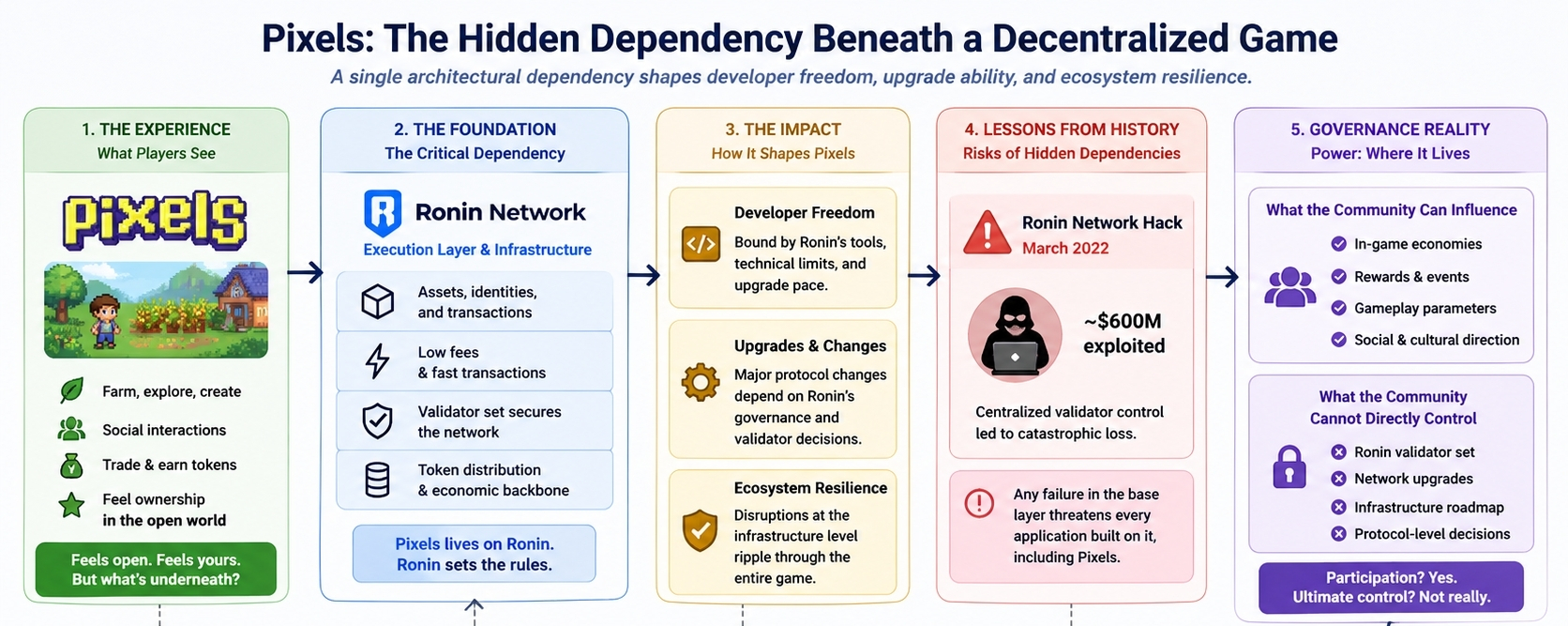
Everything inside Pixels—your assets, your progress, your identity—lives on the Ronin Network. It’s efficient, smooth, almost invisible in how it works. But that invisibility is exactly what makes it easy to forget how much depends on it. This isn’t just a technical choice; it’s the foundation of the entire experience. And that foundation is closely tied to Sky Mavis.
At first, that doesn’t feel like a problem. You’re not thinking about validators or network design while planting crops or trading items. But it starts to matter when you ask a simple question: how much of this world can actually change because of its players?
Developers building inside Pixels are creative, no doubt. But they’re still working within the boundaries of Ronin—its tools, its rules, its pace of evolution. If the network doesn’t support something, or if changes take time, the game quietly inherits those limits. It’s not a hard wall, more like a soft boundary you don’t notice until you try to push it.
And history hasn’t been entirely kind to that kind of setup. The Ronin Network Hack showed just how much can hinge on a small number of moving parts. When those parts fail, it’s not just infrastructure that breaks—it’s trust. And everything built on top feels that ripple.
Pixels does try to give power back to its players. There are tokens, economies, participation—it feels alive because people shape it every day. But most of that influence exists on the surface. The deeper layers—the ones that decide how the system evolves, who secures it, how it adapts—aren’t as open. They’re quieter, more controlled, and harder for the average player to reach.
That’s where the illusion starts to crack, just a little. You realize you’re shaping a world, yes—but within a structure you didn’t choose and can’t fully control.
And it leaves you with a question that doesn’t go away: if something truly important had to change, would the community be the one to decide it—or just the one to live with it?