
I’m watching how simple systems attract trust.
Plant. Harvest. Craft.
Looks harmless.
Almost too harmless.
I keep focusing on what happens when a loop feels calm but still holds scarcity inside it.
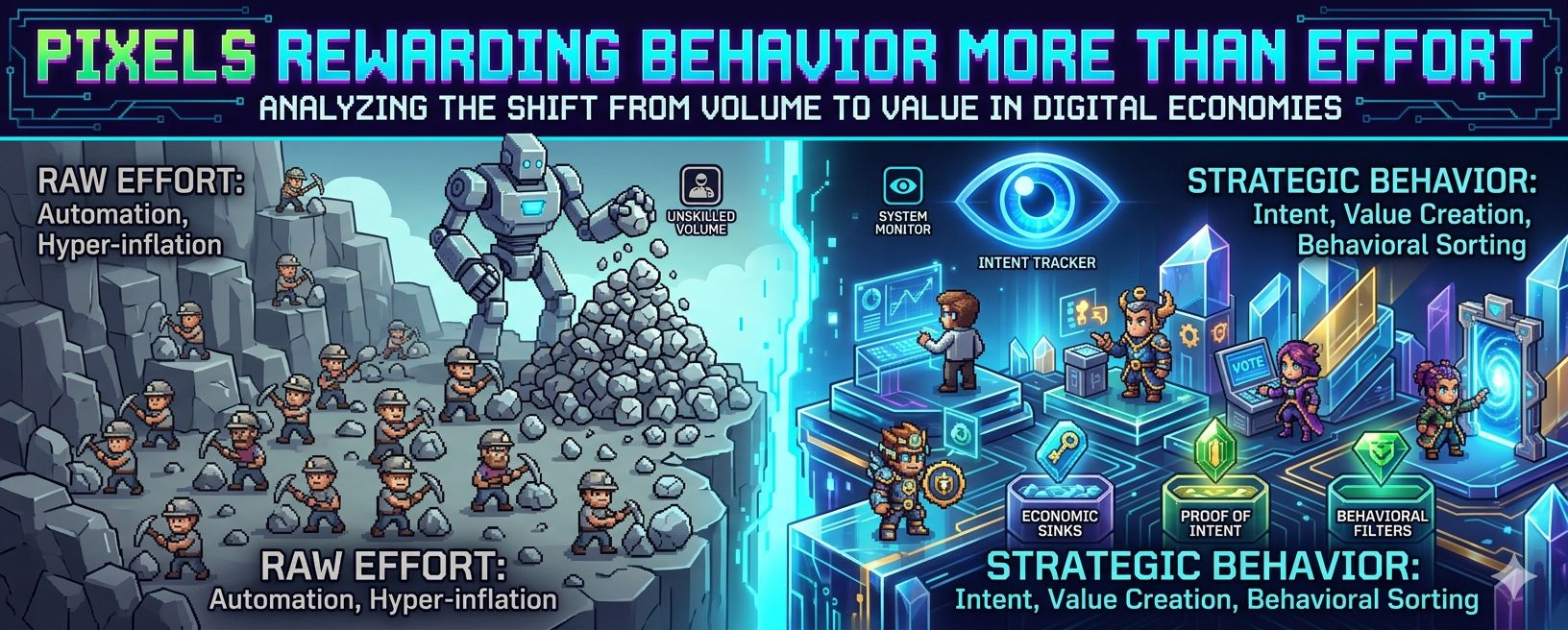
Because in Ronin Network through Pixels, effort doesn’t always seem to map cleanly to reward.
That keeps bothering me.
You can grind.
You can optimize.
You can stay active for hours.
And still the value doesn’t appear to flow only toward whoever works most.
More like it moves toward whoever aligns with friction.
That feels different.
I’ve been noticing energy systems.
Land access.
Craft dependencies.
Resource bottlenecks.
Not as game features.
As pressure points.
And pressure points usually reveal incentive design.
Not progression.
Design.
Because if a player hits a slowdown, the question isn’t “can they keep farming.”
It becomes—
do they wait
do they trade
do they spend
do they speculate
That’s where behavior gets exposed.
And maybe measured.
Not raw effort.
Response to constraint.
I keep looking at $PIXEL there.
Not just as currency.
More like a valve.
Opens where progression tightens.
Shows up where time becomes expensive.
That’s not unusual in GameFi.
But what feels strange is how softly it happens.
No obvious push.
No aggressive monetization signal.
Just friction appearing.
Quietly.
And players adjusting around it.
That adjustment may be where value is really produced.
Not crops.
Not resources.
Behavior.
Patterns.
Repeated choices under small pressure.
I keep wondering if systems like this reward labor less than they reward predictability.
Reliable loops.
Consistent returns.
Habitual participation.
Maybe that’s why “doing more” can sometimes feel weaker than “doing the right repetitive thing.”
Not effort dominance.
Pattern dominance.
And if that’s true, then incentives may be shaping players more than players shape the economy.
That reverses the story.
Most people look at tokens and ask where utility is.
I keep asking where dependency forms.
Different question.
Because utility can be narrative.
Dependency tends to be structural.
And structures crack under pressure.
What happens if token demand outruns in-game value?
What happens if land concentration grows?
What happens if casual players stop feeding the resource base?
That’s where these systems usually reveal themselves.
Not in expansion.
In stress.
I’m looking there.
Because farming games always look abundant until scarcity starts stacking.
Then behavior changes fast.
Cooperation becomes extraction.
Optimization becomes competition.
Play starts looking like work.
Sometimes work starts looking like arbitrage.
And the social layer—
that interests me too.
Because social systems can stabilize economies.
Or hide weakness.
Depends whether relationships create value…
or just retain users.
Not the same thing.
I’m not convinced Pixels is solving that.
But I keep noticing it may be testing it.
Quietly.
Through loops that look softer than they are.
And I can’t tell whether $PIXEL supports the game…
or whether the game increasingly supports $PIXEL.
That distinction matters.
Maybe a lot.
Because one is economy serving play.
The other is play serving economy.
Not this.
More like that.
And maybe the biggest question isn’t whether rewards are fair.
Maybe it’s whether the system is interpreting behavior in ways players don’t fully see.
That possibility keeps lingering.
Because if incentives are really shaping responses at that level…
then what looks like casual farming may be something more behavioral underneath.
Or maybe I’m overreading ordinary game loops.
Could be that too.
Still.
I keep watching where friction appears.
Because that’s usually where the truth leaks first.
And I’m not sure yet what leaks out here.
