
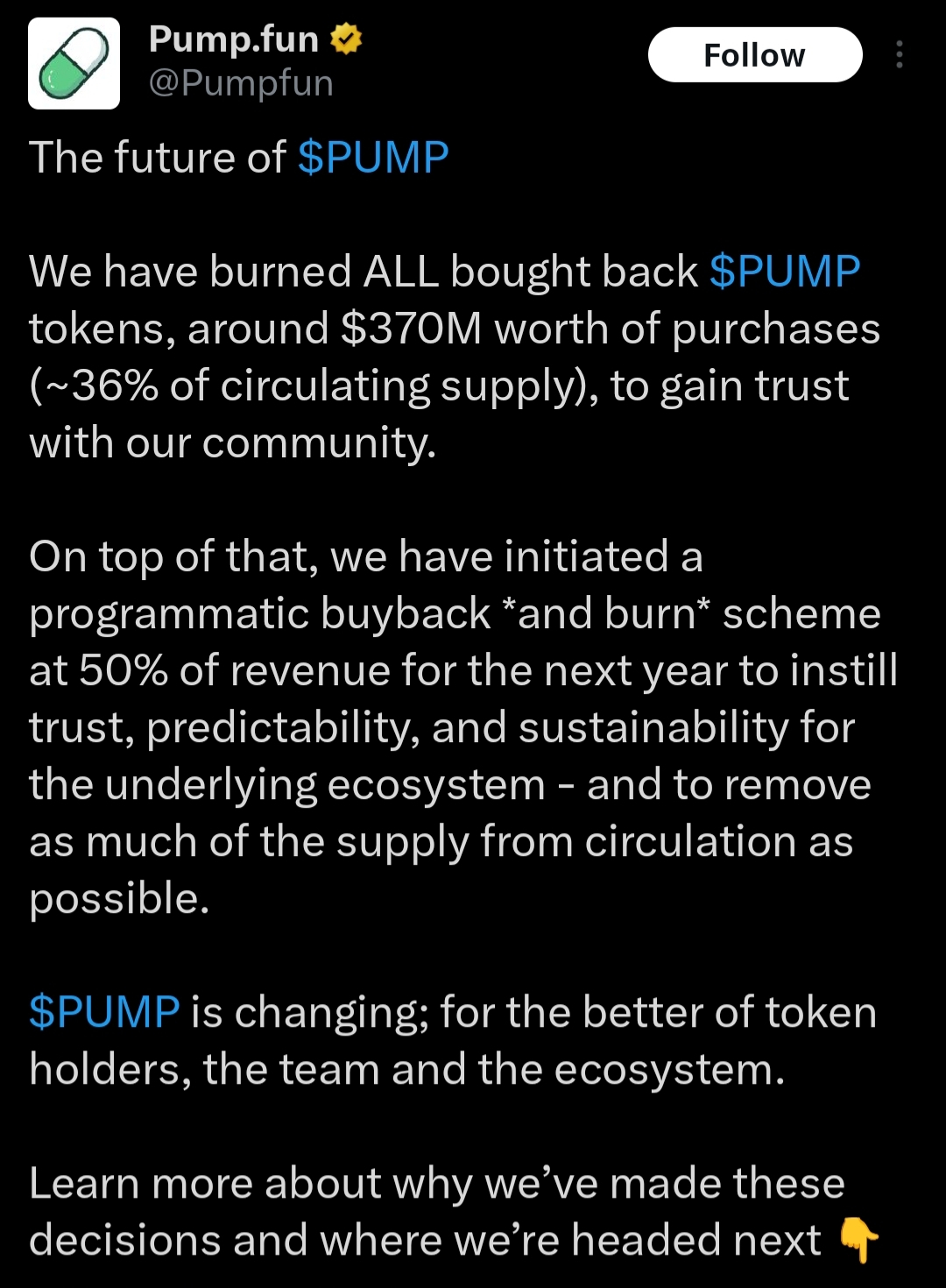
Isn't Really About Scarcity. It's About Trust. So Pump.fun pulled the trigger yesterday. Around $370 million worth of PUMP , roughly 36% of circulating supply, gone in two on-chain transactions at 20:52 UTC. Those weren't fresh tokens being torched either. The team had been quietly accumulating them for nine months by routing 100% of platform revenue into open market buybacks, and every single one of those repurchased coins has now been permanently destroyed.On paper that's one of the largest supply reductions any major crypto project has executed this cycle. So why did PUMP only pop about 10% on the news before retracing most of it? That's the part I think people are missing.Here's what I keep coming back to. If burning 36% of supply was the magic bullet, the chart would look very different right now. The fact that price went from around $0.00184 to flirt with $0.0019 and then cooled tells me the market had already priced in the buyback machine. $PUMP Traders watched 100% of revenue funnel into PUMP for nine months and the token still bled out. Supply pressure wasn't the problem. Belief was.That's why the bigger announcement isn't the burn itself. It's the irreversible locked smart contract that now directs 50% of net revenue from the bonding curve, PumpSwap, and Terminal into automated buy-and-burn for the next twelve months. The keyword there is irreversible. The team can't change their mind, can't redirect funds elsewhere, can't let the program quietly fade if memecoin season cools off. That's the credibility patch. Co-founder Alon Cohen basically said as much when he framed this as a turning point and admitted that 50% of the business they're building toward will dwarf 100% of what they have today.
 Now the trading logic that I think most takes are missing. The cut from 100% to 50% revenue allocation is actually the most underrated piece of this whole thing. Pure buyback economics were starving the company of reinvestment capital. You can't hire, can't ship product, can't expand the ecosystem if every dollar gets immediately converted to token pressure. The new split lets them build a real business while still committing meaningful flow into $PUMP. Long term, a healthy platform with a smaller buyback is worth more than a shrinking platform with a maxed-out one.What I'm watching from here.Memecoin season is the real catalyst. Pump.fun's revenue is downstream of degen activity on Solana. If launches and trading volumes pick up, that 50% allocation becomes serious size very fast. Lifetime platform revenue has already crossed $1 billion, so the math at full throttle is meaningful.$PUMP If Solana memecoin volume cools, the buyback contract still runs, just on smaller flows.The supply overhang isn't fully gone either. Burning 36% sounds enormous but unlocks, team allocations, and future emissions still matter for float math. I want to see the updated post-burn tokenomics breakdown before assuming dilution risk is solved.Sentiment is fragile and short term overbought. PUMP just snapped an eight-day downtrend and broke a falling wedge, which is technically constructive, but the structure is still recovering from months of distrust. I'd rather see a clean retest of the breakout zone than chase the first move into resistance near $0.00193.My honest read is this is the right move executed slightly late. The team finally addressed the actual problem, which was never supply, it was whether anyone trusted the buyback would keep happening. Locking it into a smart contract was the only credible answer left on the table. Whether that translates into sustained price action depends entirely on whether Solana's memecoin engine keeps printing fees through 2026.Not financial advice, just how I'm reading the setup.
$PUMP #pump #LearnWithFatima #market #Market_Update #BinanceSquareFamily