
I still remember the first time I actually used instead of just reading about it. It wasn’t some big investment move. I was just trying to send a small amount of ETH and the gas fee felt confusing. A bit frustrating, honestly. That moment stuck with me more than any chart ever did. Because it made me realize this thing isn’t just an idea it’s a living system with trade-offs you can actually feel.
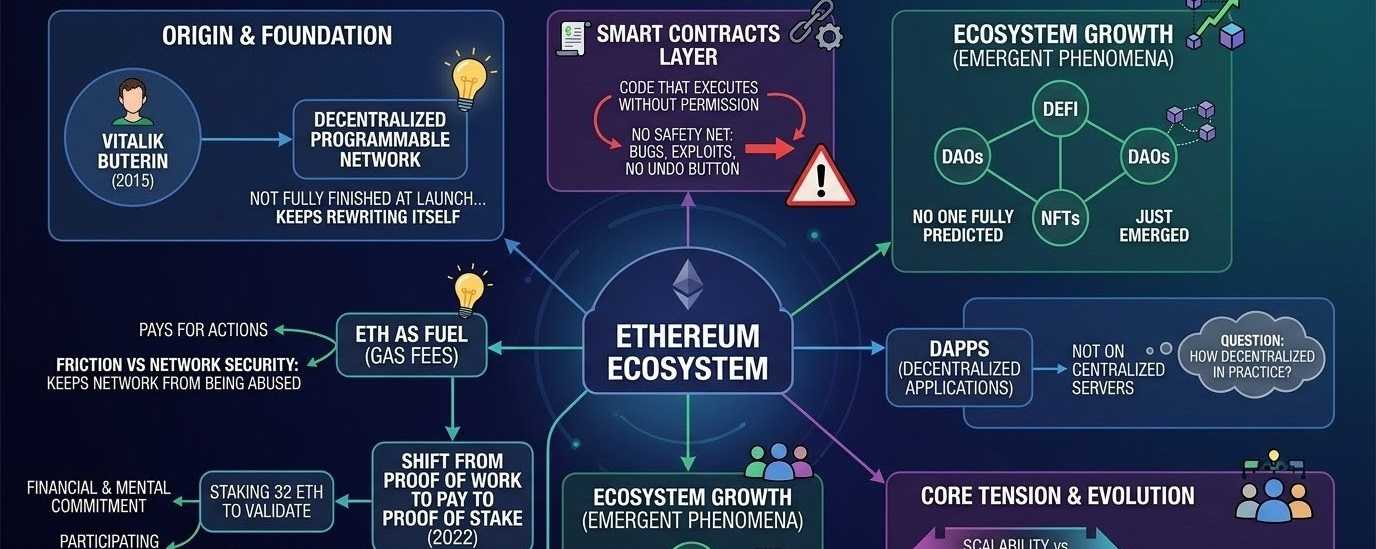
Most people hear that created Ethereum back in 2015 and think of it as just another origin story. But when you spend time around the ecosystem, it starts to feel less like a single invention and more like something that keeps rewriting itself. Almost like it wasn’t fully “finished” at launch — and maybe it still isn’t.
What always stood out to me is how Ethereum isn’t just about sending money. It’s more like a platform where money is just one layer. Underneath that, there’s this whole world of smart contracts quietly running. Code that executes without asking anyone for permission. That idea felt strange at first. I remember wondering… if no one is in control, who’s responsible when something goes wrong?
And things do go wrong sometimes. Bugs, exploits, weird edge cases. That’s the part people don’t always talk about when they describe decentralization. It’s powerful, sure. But it also removes the safety net we’re used to. No customer support. No undo button. Just code and consequences.
At the same time, that openness is what made Ethereum feel different from everything else. Anyone can build on it. No approvals. No gatekeepers. I’ve seen small developers create things that suddenly gain traction overnight. It doesn’t always last, but that unpredictability is part of the appeal. It feels… alive.
I think that’s why DApps became such a big part of the conversation. Not because they’re perfect, but because they represent this idea that applications don’t have to sit on centralized servers anymore. They can exist on a network that no single entity owns. Though sometimes I wonder how decentralized they really are in practice.
Then there’s ETH itself. It’s easy to think of it as just another token, but it’s more like fuel for the entire system. Every action costs something. Every interaction leaves a trace in the form of gas fees. I used to see that as a downside. Now I’m not so sure. It creates friction, yes, but maybe that friction is what keeps the network from being abused.
The shift from Proof of Work to Proof of Stake in 2022 felt like a turning point. I remember the debates leading up to it. Energy consumption, security, decentralization — everyone had an opinion. When it finally happened, it almost felt… quiet. Like something huge changed, but the world didn’t fully react the way I expected.
Staking 32 ETH to become a validator sounds simple on paper. In reality, it’s a big commitment. Not just financially, but mentally too. You’re locking yourself into the network’s future. That idea is kind of fascinating. You’re not just holding an asset — you’re participating in its operation.
Still, I can’t help but question whether this model concentrates power in subtle ways. If only those with enough ETH can validate, does that shift influence over time? Maybe I’m overthinking it, but these things don’t feel entirely settled yet.
The Shanghai upgrade added another layer to that conversation. Suddenly, staked ETH wasn’t locked forever. People could withdraw. That changed the psychology of staking in a big way. It made the system feel more flexible, less rigid. But it also introduced new dynamics — liquidity, movement, potential sell pressure.
What’s interesting is how Ethereum keeps evolving without losing its core identity. Or at least, that’s how it feels right now. It adapts, upgrades, shifts direction — but the idea of a decentralized, programmable network stays intact. Even when the details change.
Sometimes I think about how much of Ethereum’s growth came from things no one fully predicted. NFTs, DeFi, DAOs — none of these felt inevitable in the early days. They just… emerged. That makes me wonder what’s next, and whether we’ll even recognize it when it starts.
There’s also this quiet tension in the background. Between scalability and decentralization. Between usability and purity. Every improvement seems to come with a trade-off. And the community doesn’t always agree on which direction is right.
I’ve noticed that the more time I spend around Ethereum, the less certain I feel about absolute answers. It’s not a simple story of success or failure. It’s something in between. A system still figuring itself out, shaped by the people using it.
And maybe that’s the part that keeps me paying attention. Not because everything is clear, but because it isn’t. Because there are still open questions. Still things that don’t quite make sense yet.
I guess if there’s one thing I’ve taken away from all of this, it