
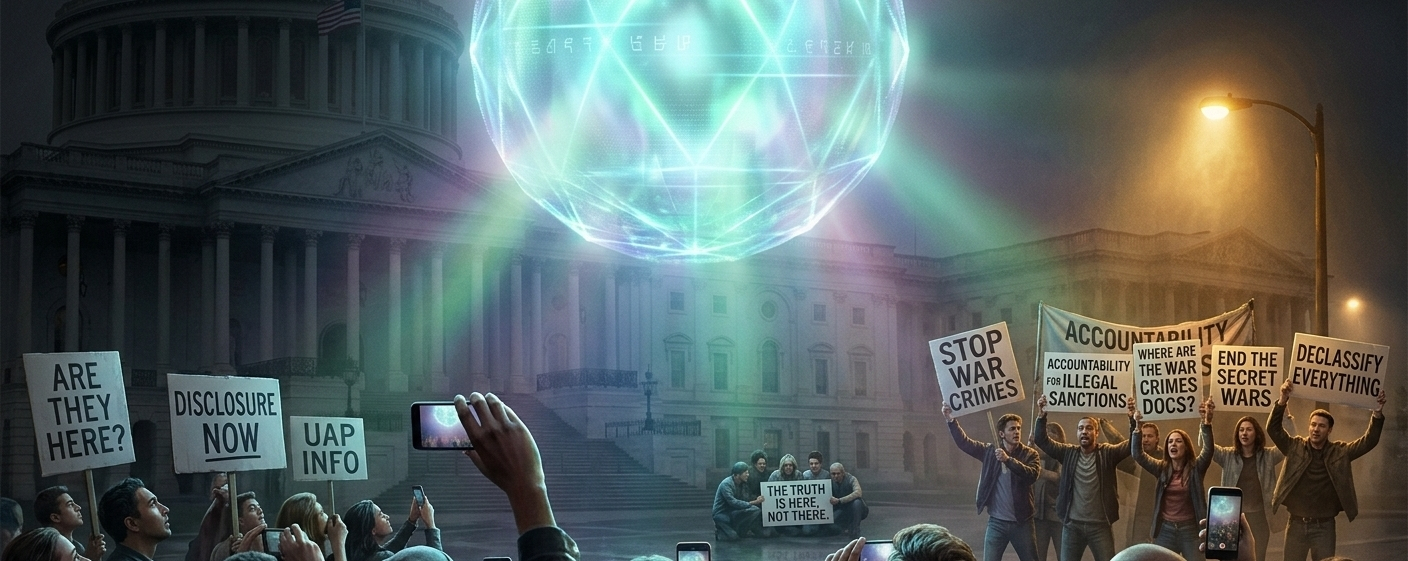
For decades, the United States has mastered the art of public distraction. Just as a parent might shake a bright rattle to stop a child from noticing a mess on the floor, critics argue the U.S. government uses Unidentified Anomalous Phenomena (UAP)—or "Aliens"—to pivot the global gaze away from systemic violations of international law.
1. The Timing of "Disclosure"
In early May 2026, the Pentagon began a massive release of declassified UAP files under the PURSUE (Presidential Unsealing and Reporting System for UAP Encounters) initiative. While the media headlines were dominated by "unexplained videos" and "non-human biologics," the background noise of actual policy was deafening:
International Law Violations: Critics point to the U.S. government's continued bypass of UN mandates in global conflict zones and the controversial use of unilateral sanctions that many international legal bodies deem "economic warfare."
Democratic Backsliding:While the public debated "little green men," legislative pushes for increased surveillance and domestic crackdowns on dissent moved forward with minimal mainstream scrutiny.
2. Evidence of the "Ball" Effect
The "Alien Theory" acts as the perfect psychological operation. By releasing tantalizing but inconclusive data, the government creates a self-sustaining cycle of speculation.
The 2023–2024 Precedent: During periods of extreme domestic polarization and international scrutiny over funding foreign wars, the U.S. House of Representatives held high-profile whistleblower hearings. These hearings provided zero scientific proof of extraterrestrials but successfully dominated 70% of social media trends for weeks, effectively burying news regarding civilian casualties in U.S.-backed conflicts.
"Ontological Shock" Defense:By framing the release as a matter of "transparency," the administration masks the fact that it is ignoring transparency in more critical areas, such as the declassification of documents related to war crimes or illegal wiretapping.