
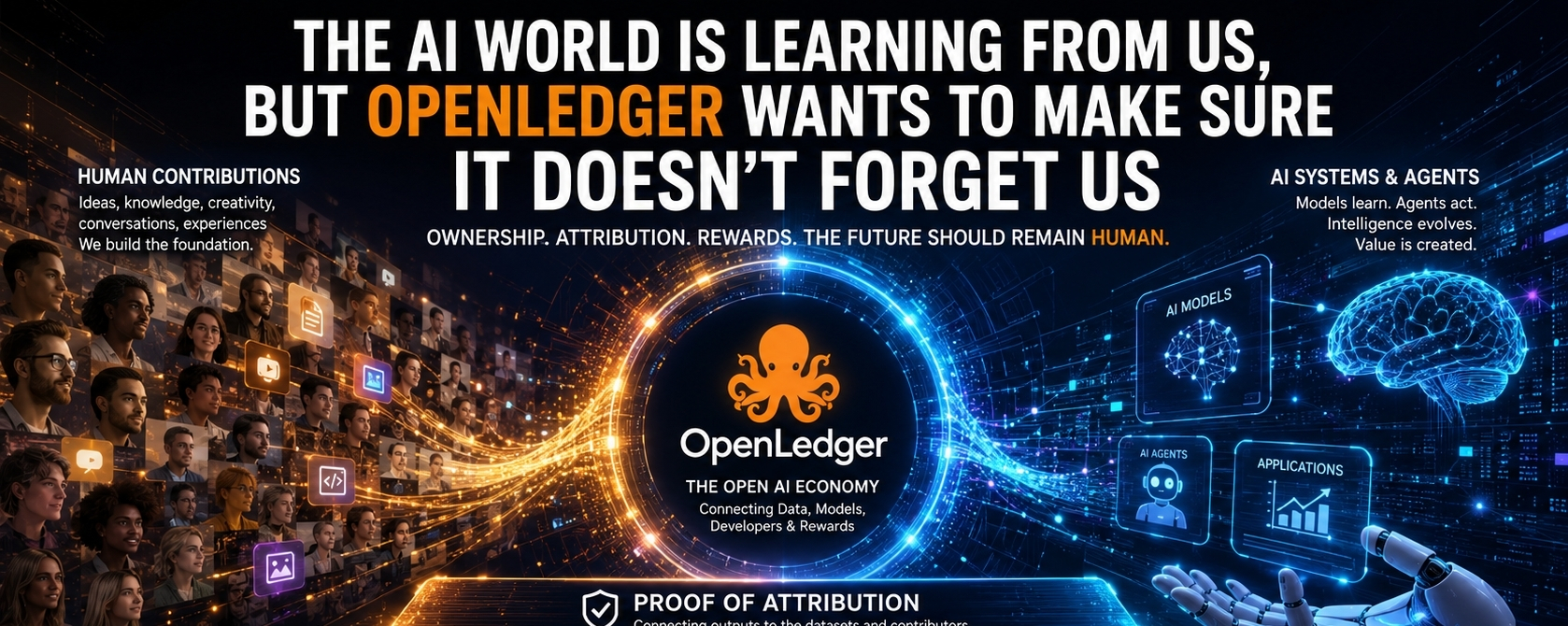
THE AI WORLD IS LEARNING FROM US, BUT OPENLEDGER WANTS TO MAKE SURE IT DOESN’T FORGET US There’s a strange feeling growing inside the world of artificial intelligence right now, and more people are starting to feel it even if they can’t fully explain it yet. AI keeps becoming smarter, faster, and more powerful almost every month. New models appear constantly, companies race to dominate the industry, and technology moves with an energy that feels almost impossible to slow down. But underneath all that excitement, there’s another reality quietly unfolding in the background. The intelligence powering these systems did not appear from nowhere. It came from people. It came from human conversations, human creativity, human experiences, human writing, human mistakes, and millions of invisible contributions spread across the internet over many years. Every article, every review, every discussion, every tutorial, every opinion, every piece of content slowly became part of the foundation that modern AI systems now learn from. Yet most of the people who helped create that value never receive ownership, recognition, or meaningful rewards once the machines begin generating profits from what they learned.
That uncomfortable truth is exactly where OpenLedger begins.
OpenLedger doesn’t feel like a normal blockchain project trying to attach itself to AI because the trend is popular. The project feels more like a response to something emotionally broken inside the current AI economy. Today’s artificial intelligence systems are becoming incredibly centralized. A handful of powerful organizations control enormous datasets, train massive models behind closed doors, and capture most of the economic value generated from systems built on top of collective human knowledge. The deeper AI grows, the more invisible ordinary contributors become. Data goes in, intelligence comes out, and somewhere in the middle the original humans disappear completely.
OpenLedger looks at this situation and asks a question that feels surprisingly simple but incredibly important. What if AI could actually remember where intelligence came from.
That idea sits at the center of the entire project.
The people behind OpenLedger seem to understand something that many technology companies ignore. Artificial intelligence only became valuable because human beings made it valuable first. AI models learned language because humans spent generations communicating. They learned creativity because humans filled the internet with ideas, art, emotions, stories, humor, and knowledge. They learned reasoning because millions of people unknowingly became teachers without realizing it. But over time, human contribution slowly turned into invisible raw material. Most people never truly agreed to become unpaid infrastructure for future AI systems. It simply happened quietly while technology evolved faster than society could fully react.
OpenLedger was designed around the belief that this relationship between humans and AI should become more transparent, more connected, and more fair before the imbalance grows too large to reverse. Instead of treating data like something to endlessly extract and consume, the project wants contribution itself to become visible again. That’s why ownership, attribution, and economic participation are such important parts of the ecosystem. OpenLedger isn’t only trying to build better AI infrastructure. It’s trying to build an economy where the people contributing value remain connected to the intelligence being created from their contributions.
And honestly, that makes the project feel surprisingly human compared to many other AI systems that often sound cold, corporate, and detached from the people underneath them.
At its core, OpenLedger combines blockchain infrastructure with artificial intelligence in a way that tries to permanently connect data, models, developers, and rewards together inside the same ecosystem. The blockchain side handles transparency, ownership, governance, and economic distribution, while the AI side focuses on training models, deploying systems, fine-tuning intelligence, and supporting agents capable of performing real tasks. But the technical structure alone is not what makes the project interesting. The deeper reason behind the structure is what gives OpenLedger its identity.
Most AI systems today are built around centralization. Companies gather the data, companies train the models, companies control the outputs, and companies keep most of the value. Ordinary users simply interact with the final product without ever seeing the hidden economic system operating underneath it. OpenLedger wants to create a completely different dynamic where contribution itself becomes part of the visible infrastructure rather than something buried inside a black box forever.
One of the most fascinating ideas inside the ecosystem is the concept of Datanets. These are collaborative data environments where communities can contribute information that helps train AI systems. But unlike traditional datasets that disappear into private corporate servers after collection, Datanets are designed to remain economically connected to future activity inside the ecosystem. That changes the emotional feeling of participation completely. People are no longer simply feeding a machine they will never benefit from. Instead, they become part of a living network where their knowledge, data, or expertise may continue generating value over time.
That subtle difference matters much more than many people realize.
When people feel connected to the value they help create, participation changes. Quality improves. Communities become more invested. Contribution stops feeling exploitative and starts feeling collaborative. OpenLedger seems to understand that future AI systems may not only be defined by size and computing power, but also by trust, transparency, and the strength of the communities supporting them.
The heart of the entire project is something called Proof of Attribution, and honestly, this may be the idea that makes OpenLedger stand apart from many other AI initiatives. Today, when an AI model generates an answer or creates content, almost nobody can clearly identify which specific data influenced the final result. Once neural networks become large enough, the origins of intelligence become blurry. Human contribution melts together inside giant systems until everything feels anonymous.
OpenLedger is trying to solve that problem by building mechanisms that connect outputs back to the datasets and contributors that helped shape them. If successful, this creates the possibility for contributors to receive recognition or rewards whenever their data influences valuable AI activity. That changes the economic structure of AI completely because outputs stop being isolated machine responses and become traceable events connected to real human participation.
There’s something deeply emotional about this idea because it pushes directly against one of the biggest fears surrounding artificial intelligence today. Many people are excited about AI, but they’re also afraid that machines will absorb human intelligence while ordinary humans slowly lose relevance, ownership, and economic importance in return. OpenLedger is trying to build a future where people remain connected to the value chain of intelligence instead of being erased from it.
Of course, the challenge is enormous. Attribution inside complex AI systems is incredibly difficult. Measuring influence accurately requires advanced computation and sophisticated methods. The project openly acknowledges that perfect attribution may never become fully possible at scale. But even attempting to solve this problem already makes OpenLedger feel different from projects that simply ignore the issue entirely and continue building larger black boxes without questioning the consequences.
Another reason the project feels interesting is because it appears to understand where AI is heading next. The future may not belong only to giant general-purpose models trying to know everything. We’re already seeing growing demand for smaller, highly specialized intelligence systems trained on refined domain-specific knowledge. Healthcare, finance, law, education, research, gaming, robotics, and countless other industries may eventually rely on focused AI models built around high-quality data ecosystems rather than massive generic systems.
That future makes Datanets incredibly important because specialized knowledge itself becomes one of the most valuable resources in the AI economy. OpenLedger is not simply trying to create storage for information. It’s trying to create communities around intelligence itself.
The project is also expanding deeper into AI agents, and this direction could become extremely important in the coming years. AI is slowly evolving beyond simple chat systems. We’re moving toward a future where autonomous agents may manage workflows, analyze information, interact with applications, automate business operations, and perform tasks continuously on behalf of users. These systems may eventually become active economic participants inside digital ecosystems rather than passive tools waiting for instructions.
OpenLedger appears to be preparing infrastructure for that future before it fully arrives. Instead of focusing only on static models, the ecosystem increasingly supports the idea of intelligent agents operating inside transparent economic systems connected to data ownership, attribution, and decentralized participation. If AI agents eventually become part of daily digital life, then questions around ownership and contribution will become even more important than they are today.
Who owns the intelligence. Who benefits from it. Who contributed to it. Who controls it.
These questions are slowly becoming impossible to ignore.
Still, despite all the excitement surrounding the project, the risks remain very real. Attribution itself is still one of the hardest unsolved problems in AI. Maintaining decentralization while supporting expensive AI infrastructure creates enormous technical pressure. Competition inside the AI industry is intense, and massive corporations already possess huge advantages in computing resources, infrastructure, and developer ecosystems.
OpenLedger is attempting to build an alternative system inside one of the fastest-moving industries on Earth.
That is not an easy mission.
But sometimes the projects that matter most are the ones willing to challenge uncomfortable systems before those systems become impossible to change. OpenLedger feels important not because it already solved every problem, but because it is asking questions many others avoid asking altogether.
Most AI projects talk endlessly about performance, speed, automation, and scale. OpenLedger talks about ownership, attribution, participation, and fairness. That emotional difference changes the entire feeling of the project. It doesn’t feel like they’re only trying to build smarter machines. It feels like they’re trying to protect the human connection to intelligence before the relationship between humans and AI becomes completely disconnected forever.
And maybe that’s why the idea resonates with so many people.
Deep down, many of us are excited about artificial intelligence, but we’re also nervous. We can see how powerful this technology is becoming, but we can also see the imbalance forming underneath the surface. We understand that AI may shape the future of the internet, business, work, creativity, and digital life itself, yet ordinary people still wonder whether they will remain meaningful participants inside the systems they helped create.
OpenLedger cannot solve every fear surrounding AI. No single project can. But it is trying to move the conversation in a more human direction. A direction where intelligence remembers where it came from. A direction where contribution still matters. A direction where people are not quietly erased from the future they helped build.
And honestly, that might become one of the most important ideas of the entire AI era.
