
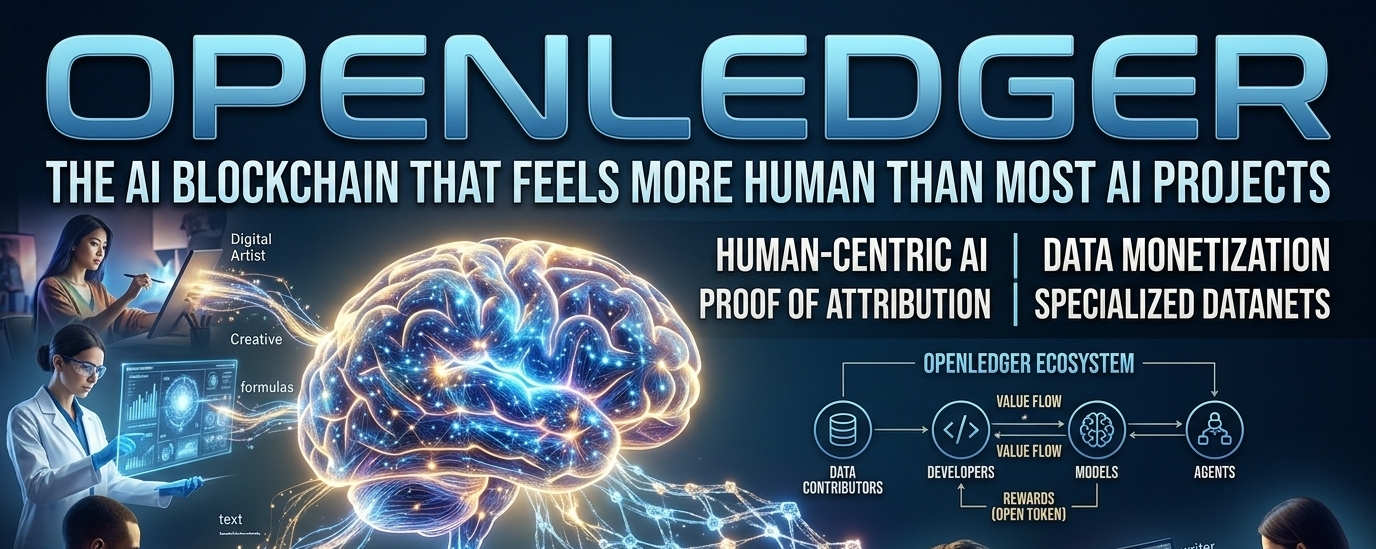
OPENLEDGER THE AI BLOCKCHAIN THAT FEELS MORE HUMAN THAN MOST AI PROJECTS Artificial intelligence is becoming part of everyday life so quickly that sometimes it feels like the world barely has time to understand what is happening before the next breakthrough arrives. One month people are amazed that AI can answer questions, and a few months later those same systems are writing code, creating videos, analyzing research, automating businesses, and slowly entering industries that once depended completely on human expertise. Everywhere you look there’s another company talking about smarter models, larger datasets, faster systems, and a future powered by machine intelligence.
But underneath all the excitement, there’s a question that quietly stays in the background.
Who is actually teaching these machines?
Because when you strip away all the marketing and technical language, the truth becomes very simple. AI learns from people. It learns from human writing, human conversations, human emotions, human creativity, human experiences, and the endless amount of information shared online every single day. Every article someone writes, every tutorial uploaded to the internet, every opinion shared publicly, every discussion inside forums and communities slowly becomes part of the massive stream of knowledge feeding modern artificial intelligence.
And honestly, that’s where things start feeling a little uncomfortable.
The companies building AI systems are becoming more valuable every year, while the people whose knowledge helped shape those systems usually receive nothing back. Their ideas, experiences, and contributions disappear into giant black-box models that continue growing more powerful without ever acknowledging where the intelligence originally came from.
That feeling is exactly what makes OpenLedger interesting.
OpenLedger is not trying to present itself like another loud AI project promising to change the world overnight. The deeper idea behind it feels much more personal and much more connected to the people behind the technology. At its core, OpenLedger is built around a belief that sounds almost obvious once you hear it properly: if AI is learning from humans, then humans should not become invisible inside the process.
That single idea shapes almost everything the project is trying to build.
OpenLedger describes itself as an AI blockchain focused on monetizing data, models, and agents, but the real story underneath those words is about ownership, attribution, and fairness. The project is trying to create a system where people who contribute valuable knowledge can actually remain connected to the value their contributions create later. Instead of information disappearing permanently into centralized AI systems, OpenLedger wants contribution to stay visible.
And maybe that matters more now than ever before.
For years the internet quietly trained people to give away value for free. Social media platforms became massive because users created content. Search engines became smarter because people uploaded information every day. Recommendation algorithms improved because billions of humans continuously interacted online. Now AI is accelerating that entire process to another level because intelligence itself is becoming one of the most valuable resources in the digital economy.
OpenLedger seems to recognize something many people are only beginning to realize. If artificial intelligence keeps growing without systems for attribution and ownership, then the imbalance between platforms and contributors could become enormous.
That is why the project talks so much about something called “Payable AI.”
The phrase sounds technical at first, but the meaning behind it is actually very human. OpenLedger wants AI systems to recognize where value comes from. Instead of treating human knowledge like invisible fuel for giant machine-learning systems, the network tries to build a structure where contributions can be tracked and rewarded over time.
In simple words, OpenLedger believes people should not disappear from the story while AI becomes more intelligent.
That idea becomes even clearer once you look at how the project is designed. One of the most important parts of the ecosystem is something called Datanets. These are decentralized data networks focused on specialized information and domain-specific intelligence. Instead of believing one giant universal AI model can understand everything deeply, OpenLedger leans toward the idea that the future will depend heavily on specialized systems trained on high-quality focused knowledge.
And honestly, that makes a lot of sense.
A general AI model might know a little about almost everything, but industries like healthcare, law, science, finance, research, and engineering require deep expertise that often lives inside smaller communities and specialized environments. The best information usually isn’t freely floating around the internet. It exists inside companies, professional groups, research communities, and people with years of real-world experience.
The problem is that nobody wants to give away valuable knowledge without trust or incentives.
OpenLedger is trying to solve that problem by creating systems where contributors can benefit from the value their data creates. Instead of simply extracting information from people, the network attempts to turn contribution itself into part of the economy.
That changes the relationship between humans and AI in a very important way.
Most AI systems today feel distant from the people helping train them. You ask a model a question and receive an answer, but you never really see the invisible human knowledge underneath it. OpenLedger is trying to build something where those invisible layers become visible again.
This is where the project’s idea of Proof of Attribution becomes one of its most important features.
Traditional AI systems usually cannot explain where specific knowledge came from after training. Information gets compressed into models until the original sources become almost impossible to identify. OpenLedger wants to build attribution directly into the network itself so datasets, models, and outputs maintain traceable relationships with contributors.
It’s an ambitious idea, but it’s also one of the few AI narratives that actually feels focused on people instead of just machines.
The project also seems to understand that the future of AI is moving far beyond simple chatbots. AI agents are beginning to emerge across the industry, and that shift could become massive over the next several years. These systems are slowly evolving from tools that only answer questions into autonomous digital entities capable of executing actions, managing workflows, interacting with applications, and operating independently inside online environments.
That future creates incredible opportunities, but it also creates serious risks.
If AI systems eventually begin participating in economies, managing digital assets, or making decisions autonomously, then transparency becomes extremely important. OpenLedger’s blockchain structure appears designed to prepare for that future by creating systems where actions, contributions, and interactions remain verifiable instead of hidden.
The OPEN token exists as part of this larger ecosystem. It is designed to support transactions, inference activity, contributor rewards, staking, and participation across the network. The idea is that the ecosystem becomes stronger as more developers, contributors, datasets, and AI systems interact together.
But even with all the vision behind the project, OpenLedger still faces difficult challenges like every ambitious technology does.
Building technology is hard, but building trust is even harder.
The success of a system like this depends heavily on whether contributors actually believe attribution will remain fair, whether high-quality data continues entering the network, whether developers build useful tools on top of the infrastructure, and whether the economic model remains sustainable over time. AI systems require enormous resources. Specialized datasets are difficult to maintain. Token economies can become unstable very quickly if communities lose confidence.
And beyond all the technical challenges, there is another problem that feels even bigger.
Most people still do not fully understand how much of modern AI already comes directly from human knowledge. They see the outputs, but they rarely think about the millions of invisible contributions underneath the surface. OpenLedger is trying to make that invisible layer impossible to ignore.
That’s probably why the project feels emotionally different from many other AI narratives.
It’s not only talking about smarter technology. It’s talking about human value inside technological systems. It’s asking whether the future of intelligence should only belong to giant centralized platforms or whether the people helping create that intelligence should remain part of the economy too.
And honestly, that question is only going to become more important with time.
Because AI is no longer some distant futuristic concept. It is becoming infrastructure for the modern world. The systems being built today will eventually influence communication, business, research, education, creativity, finance, and the way people interact with information itself.
OpenLedger is trying to build a future where humans are still visible inside that process.
Maybe the project succeeds completely. Maybe it evolves into something very different over time. Maybe the industry itself changes faster than anyone expects. But the reason people keep paying attention to ideas like OpenLedger is because the feeling behind them already makes sense.
People do not only want more intelligent machines.
They also want a future where the humans teaching those machines are not forgotten along the way.
