
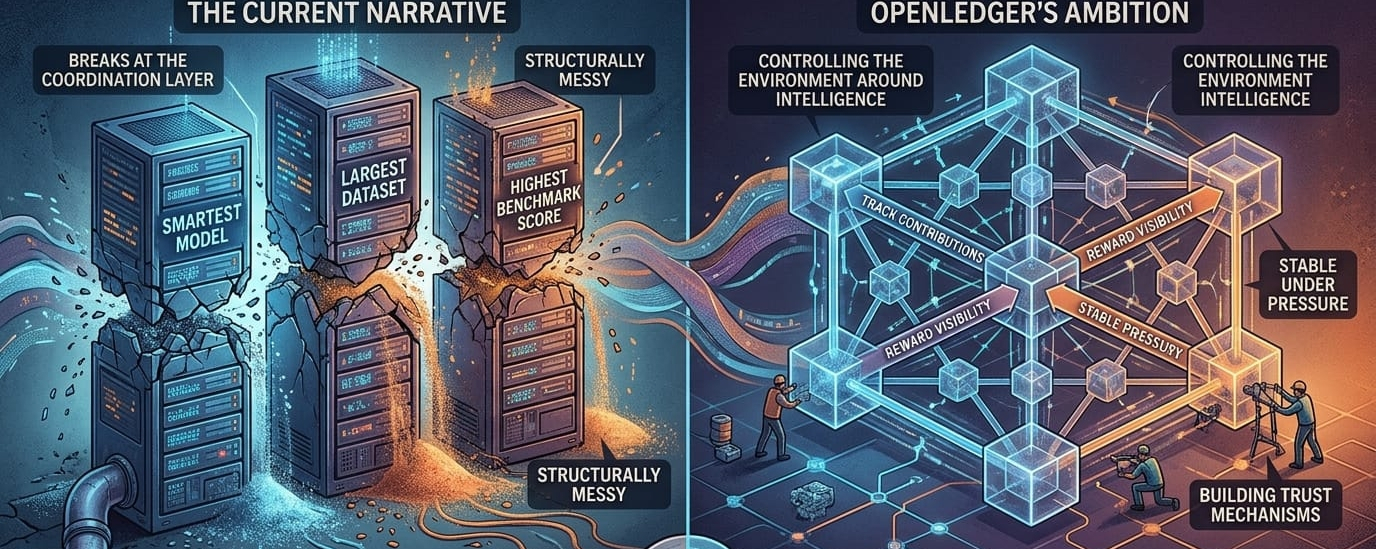
I’mwaiting.I’mwatching.I’mlooking.I’vebeenseeingthesamequestiononloop:Okay,buthowmuchcanitreallyhandle?Ifollowthenumbers,butIalsofollowthesilences thepausesbetweenblocks,thelittleRPChesitations,themomenttradersstartretryingandpretendit’snormal.Ifocusonwhatstayssteadywhenit’smessy,notwhatlooksprettywhenit’squiet.
OpenLedger has been sitting in the back of my mind longer than I expected. Not because of the AI narrative. I’ve heard too many polished AI narratives already. Most of them disappear the second real usage arrives. What keeps pulling me back here is something smaller and harder to explain. It’s the feeling that this chain is trying to solve a problem most networks quietly avoid talking about: what happens when machines start competing economically at a speed humans can barely track anymore.
I don’t mean futuristic robot fantasies. I mean the simple reality that more automated systems are starting to hit blockchains every month. Bots already dominate liquidity. Arbitrage already moves faster than human reaction. Liquidations already happen before most people even realize the market moved. OpenLedger feels like a chain being built with that uncomfortable truth already accepted instead of politely ignored.
And honestly, that changes the emotional texture of watching it.
When I monitor older networks during heavy activity, there’s still a human rhythm underneath everything. You can almost feel traders reacting. Here, the activity sometimes feels colder. Sharper. Like systems negotiating with systems while humans stand a few seconds behind trying to interpret the aftermath. That’s why I keep staring at the infrastructure instead of the branding. Because once automated demand becomes real, infrastructure weaknesses stop being technical footnotes. They become survival problems.
The strange thing is how quickly confidence disappears when a chain hesitates at the wrong moment.
A half-second delay doesn’t sound important until you’re trying to close a position during volatility and your wallet hangs just long enough to make you wonder whether the transaction even exists. That feeling matters. People talk about throughput like it’s math, but most users experience chains emotionally first. They experience certainty or uncertainty. Calm or panic. Trust or hesitation.
I’ve watched OpenLedger during bursts where everything looked smooth from a distance, but if you stayed close enough to the flow you could feel the tension underneath. RPC requests slowing unevenly. Bots resubmitting transactions aggressively. Wallet balances taking an extra refresh to settle. Explorers briefly disagreeing with indexers. Tiny fractures appearing around the edges while the chain itself technically kept producing blocks.
That’s the part nobody includes in the highlight clips.
Because real throughput isn’t one clean number. It’s not a screenshot. It’s not a benchmark posted during perfect conditions. Real throughput is what survives once the network becomes emotionally hostile. Once fear enters. Once greed enters. Once too many actors want the same state access at the same time and nobody is willing to wait politely.
DeFi exposes this better than anything else ever could.
The moment markets turn violent, every beautiful architecture diagram suddenly collides with human behavior. Liquidators hammer the same accounts. Bots chase identical price gaps. Oracle updates hit and trigger chain reactions across lending systems. Transactions start colliding because economic gravity pulls everyone toward the exact same opportunities. Parallel execution sounds elegant until everybody wants the same door at once.
That’s where I think OpenLedger becomes interesting.
The chain doesn’t feel designed around fantasy-level assumptions where activity spreads evenly across the network forever. It feels like it expects concentrated pressure. The execution model seems built around keeping coordination fast enough that AI-related economic activity can move continuously without the entire system choking on synchronization delays. But there’s a cost to building for speed like this. There always is.
Low latency changes behavior all the way down the stack.
Validators naturally drift toward better-connected infrastructure. Operators with stronger networking routes gain advantages. Geographic clustering becomes tempting because milliseconds suddenly matter economically. The network becomes faster, but also more dependent on tighter operational environments. I don’t think people fully appreciate how emotional that tradeoff becomes once real money starts flowing through the system.
Because decentralization is easy to celebrate when nothing stressful is happening.
The real question comes later, during the ugly moments. During outages. During sudden volatility. During the hours where everyone refreshes the same dashboard over and over pretending not to panic. That’s when you find out whether a network was truly resilient or just optimized beautifully for normal conditions.
I’ve been through enough market cycles to recognize the emotional pattern. Every chain looks invincible during calm growth periods. Then one sharp event arrives and suddenly users discover the difference between theoretical capacity and lived capacity. The failures almost never begin at consensus itself. They begin at the edges where humans actually touch the system.
Endpoints stop responding consistently. Wallets feel uncertain. Indexers drift behind. Bridges freeze into awkward limbo. People retry transactions because silence feels worse than failure.
That last part matters more than most engineers admit.
Silence destroys trust faster than errors do.
If a transaction fails clearly, people adapt. If a network becomes ambiguous, people spiral. They start clicking repeatedly. Bots increase retry frequency. Traffic multiplies itself artificially. One small layer of uncertainty creates waves of additional pressure everywhere else.
Watching OpenLedger lately, I don’t see collapse. I see tension. And weirdly, I trust tension more than perfection. Perfect-looking chains make me nervous now because real systems are messy. Real systems reveal strain before they reveal failure. OpenLedger still shows its seams. You can still observe where contention builds. You can still notice where infrastructure starts breathing harder under pressure.
There’s honesty in that.
The AI marketplace angle also creates a deeper problem most people haven’t emotionally processed yet. If valuable agents and datasets actually live here long term, then the chain won’t just host transactions. It’ll host competition over intelligence itself. Popular models become economic choke points. High-demand datasets become hotspots. Access rights become contested state. Suddenly network performance isn’t just about moving tokens anymore. It’s about whether automated economies can coordinate without drowning themselves in retries and latency wars.
That future sounds exciting until you imagine what it feels like during stress.
Because machines don’t get tired. Bots don’t hesitate. Automated systems don’t sleep during volatility.
If OpenLedger succeeds, the chain eventually stops dealing primarily with human pacing and starts dealing with machine pacing. That’s a completely different psychological environment for infrastructure.
And maybe that’s why I keep watching it late at night when the dashboards quiet down a little. I’m trying to understand whether the network feels alive or merely optimized. There’s a difference. Optimized systems look impressive in controlled conditions. Alive systems recover when reality becomes chaotic.
Over the next few weeks I’ll be paying attention to things most people probably won’t screenshot. I want to see whether RPC reliability stays emotionally stable during sudden bursts instead of slowly degrading into uncertainty. I want to watch how quickly indexers recover after heavy contention because recovery speed tells the truth about operational maturity. And I want to see whether validator performance starts depending too heavily on a smaller circle of highly optimized operators, because that changes the social shape of the network even if the technical metrics still look strong.
The signal that would actually change my trust isn’t another polished performance thread. I want to watch OpenLedger survive one genuinely ugly market event where fear enters the system hard and fast, where users scramble simultaneously, where bots flood the same state pathways, where everyone wants certainty immediately—and I want the network to remain understandable through all of it.
Not perfect. Not magical. Just stable enough that people don’t lose their nerve when things get loud.
That’s the moment a blockchain stops feeling experimental to me.
That’s the moment it starts feeling real.