
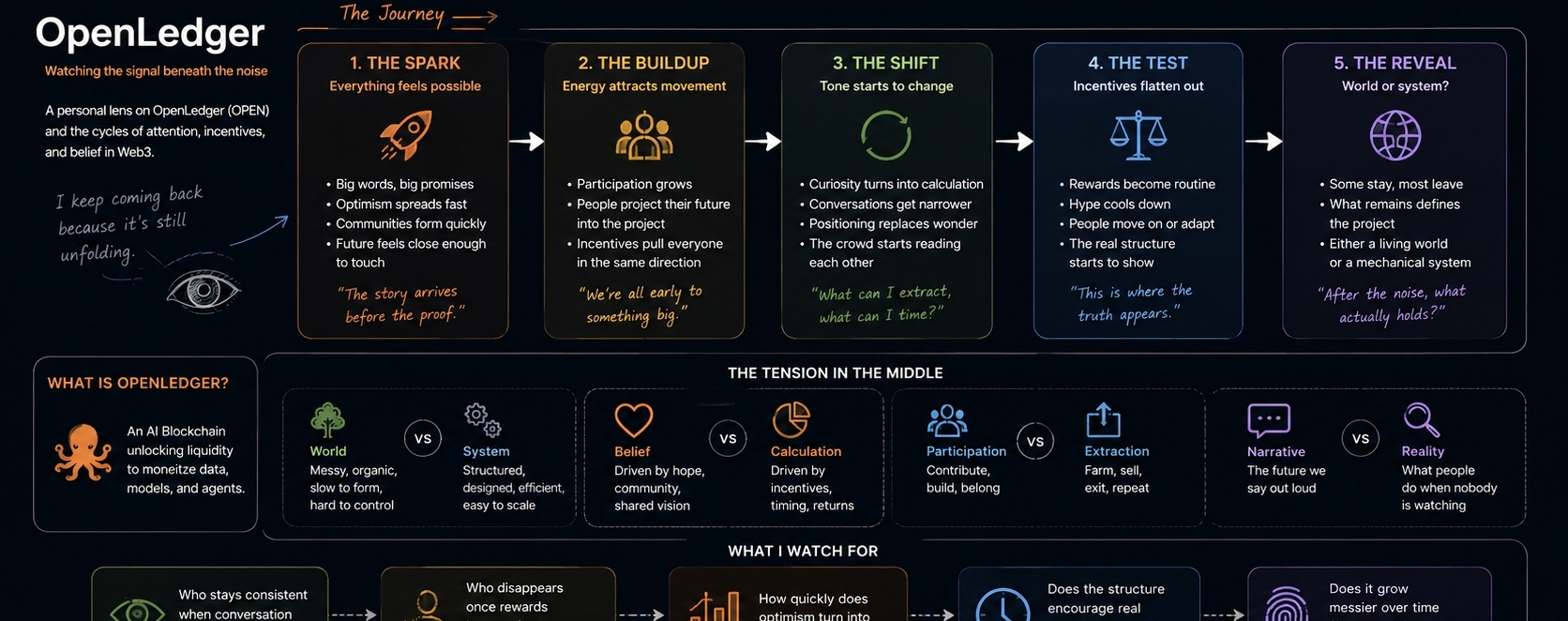
I keep finding myself back around OpenLedger late at night, usually when everything else has gone quiet. No charts open. No spaces running in the background. Just reading through things slowly, almost trying to catch what remains when the performance drops away for a minute.
That’s the part I care about now.
Not the launch energy. Not the confident posts. Not the way every new project in crypto arrives sounding like the future already signed its approval somewhere behind the scenes. I think I’ve watched too many cycles for that to work on me the same way anymore.
OpenLedger feels interesting to me because I still can’t tell what it becomes once people stop trying so hard to believe in it.
And maybe that sounds harsher than I mean it to. I’m not even cynical about it. Just careful. There’s a difference.
In the beginning, everything in this space feels bigger than it really is. People speak in this inflated language because excitement spreads faster when nobody slows down long enough to examine the edges. AI, agents, liquidity, ownership — the words carry their own gravity now. You barely even have to explain them anymore. The atmosphere does most of the work. Everyone already knows how to react when certain narratives appear together.
I notice how quickly people attach themselves to possibility here. Especially when it still feels undefined.
That’s probably why projects like OpenLedger pull attention so easily. They leave enough empty space for people to project their own version of the future onto them. Some people see infrastructure. Some see opportunity. Some just see momentum forming and don’t want to miss the early part of it. In crypto those things often blur together until nobody can really separate belief from positioning anymore.
I’ve seen communities form around that blur before.
At first it always feels alive. Fast conversations. Constant movement. Everybody speaking like they’re already inside something important. But time changes the emotional texture of these spaces. It always does. A few months later the tone becomes quieter, more transactional somehow. The same people who once talked about vision start talking about timing. You stop hearing curiosity and start hearing calculation.
Not openly. Just underneath everything.
And I think that’s the part outsiders never fully understand about Web3 culture, especially around gaming and AI ecosystems. Most people arrive wanting to believe they’re entering a world, but eventually they start interacting with it like a system. Rewards teach behavior faster than ideals do. Once incentives become visible, people adapt themselves around them almost automatically.
You can actually feel the shift happen if you stay around long enough.
That’s why I pay attention to what happens after the excitement settles. Anybody can build momentum during the loud phase. The hard part starts later, when participation becomes repetitive. When logging in feels ordinary. When rewards flatten out. When there’s no social advantage left in pretending you’re deeply early to something.
That’s when projects show their real shape.
Some spaces still feel human after that point. Messy, uneven, slower maybe, but real in a strange way. Others start feeling mechanical almost immediately, like the entire environment only existed to keep activity circulating long enough to sustain itself.
I still don’t know where OpenLedger lands.
Sometimes it feels like there’s a genuine attempt underneath all the market language. Other times it feels too aware of how crypto attention works, too optimized around narratives people are already emotionally prepared to respond to. Maybe that’s unavoidable now. Every project competes for attention against thousands of others. Eventually they all learn how to speak in ways that trigger recognition before understanding.
And honestly, maybe users do the same thing.
People move through this space carrying exhaustion they rarely admit out loud. Everybody wants to find the thing that lasts longer than a cycle, but everybody also behaves like the cycle might end tomorrow. So communities develop this strange tension where nobody fully settles in. One eye is always looking toward the exit, even while they talk about building.
I catch myself doing it too sometimes.
Watching sentiment.
Watching volume.
Watching whether people still sound sincere once the market gets colder.
Because sincerity is fragile in crypto. It disappears faster than people expect once numbers stop moving.
Still, OpenLedger keeps pulling my attention back in small ways. Not because I’m convinced. More because I feel like the project hasn’t fully revealed what kind of place it wants to become yet. Right now it still exists in that uncertain middle state where ambition, speculation, experimentation, and performance all overlap together.
And those spaces are always the hardest to read clearly while you’re still inside them.
So I keep watching quietly from the edges a little. Watching who stays. Watching who changes tone. Watching whether people continue showing up once there’s less reason to perform belief publicly.
Maybe that’s unfair. Maybe every ecosystem deserves more patience than that.
But I’ve been here long enough to know that the real story usually starts after the noise fades, after the timelines move on, after everyone stops trying to force certainty into something that hasn’t earned it yet.
I don’t think OpenLedger has reached that moment yet.
I think it’s still becoming whatever it’s going to be. And right now I’m mostly just sitting with that feeling, somewhere between curiosity and hesitation, waiting to see what remains once the movement around it slows enough for the outline underneath to finally hold still for a second.