
I was down a rabbit hole in Chrome, digging into how people actually monetize AI agent automation. After a few random clicks, I split off into a new tab and found myself scanning a blog post. That is when the name OpenLedger popped up.
My immediate thought? Just another blockchain project slapping an AI label on itself to look cutting-edge. It was a clean first impression, but standard enough that I almost closed the tab and forgot about it.
Then I started reading how Octoclaw changed the feel of the whole thing. Not the slogans. The behavior. Agents did not just seem to be using data. They seemed to be entering a system where the data they touched could matter again later, in a way that was harder to erase than I expected.
That part felt slightly off to me at first. Not broken. Just uneven. Two agent runs could look almost identical from a distance, yet one seemed to carry a heavier trail behind it. The difference did not read like skill, and it didn’t feel like luck either. It felt quieter than both.
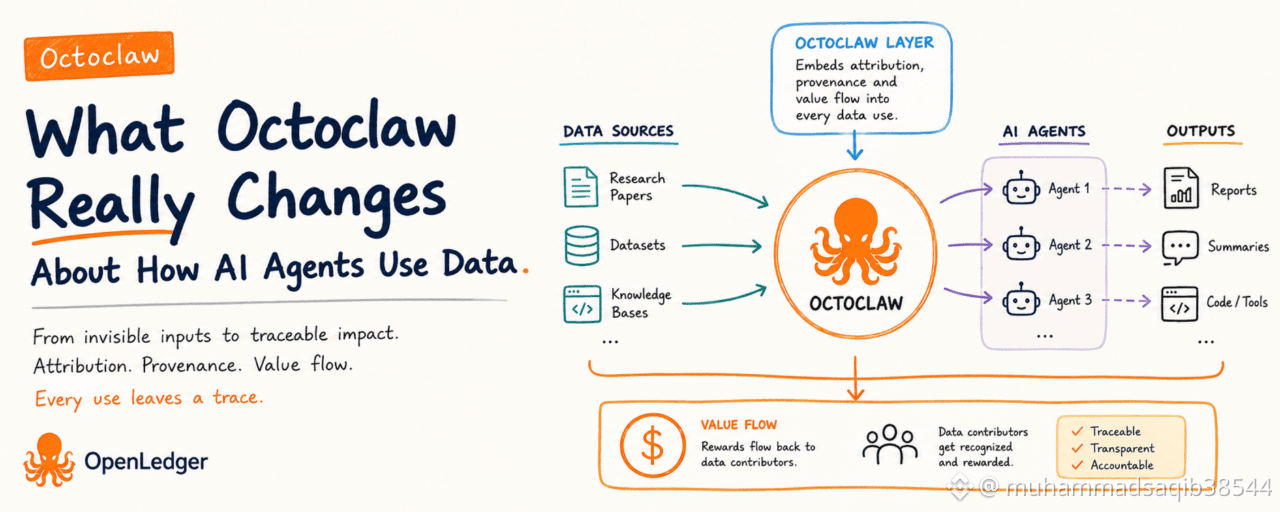
That’s where OpenLedger started looking different to me. Octoclaw is not just a way for agents to reach for information. It makes the act of using data sit inside attribution, provenance, and eventual value flow. That is the part I had to keep circling back to.
Once I saw that, the network stopped feeling like a simple AI layer. It started to feel like a place where usage itself becomes legible. Not every use, maybe. Not perfectly. But enough that the old habit of treating data as free, anonymous fuel begins to look unfinished.
That matters because AI agents do not behave like neat software modules. They sample, retrieve, branch, revisit, and sometimes return to the same source in slightly different forms. If OpenLedger can keep those paths tied to the data that shaped them, then the agent is no longer just producing output. It is leaving a record of dependence.
I’m not fully convinced yet that the market understands how different that is. A lot of projects say they want better AI infrastructure, but that often means faster access or cleaner hosting. This feels more invasive than that. It asks what should happen after the model has used something, and who should still be visible when the output starts moving around.
That is why Octoclaw does not read to me like a tool bolted onto a blockchain. It feels closer to a rule about how information is allowed to travel. The agent can act, but the path of that action can remain attached to the source. I’m not sure if that is the final form of the idea or just the first version of it, but it changes the tone immediately.
The closest analogy I can find is a freight terminal. Not the truck itself. Not the road. The terminal. Every box matters there because the manifest matters. Who sent it, who handled it, where it passed through, what was inside, what got claimed at the end. The value is not only in movement. It is in the record that makes movement accountable.
OpenLedger starts to feel like that to me, except the cargo is data and the handlers are agents. The system is not only asking what the model can do. It is asking what kind of trace the model leaves behind when it does it. That distinction sounds small until you sit with it for a while. Then it gets uncomfortable.
Because attribution is not a neutral thing once it starts influencing rewards. If data contributors can be linked to downstream use, the whole system gets more honest in one way and more strategic in another. I can imagine people optimizing for what is easiest to trace instead of what is actually useful. I can also imagine sources getting crowded out if they are important but messy. That tension feels real.
Still, I can’t ignore the other risk either. The more autonomous the agent layer gets, the harder it may be to know which input really mattered. One retrieval leads to another. One tool call folds into the next. By the time the output appears, the original contribution may still exist, but it may have been diluted into a chain of behavior that is harder to price cleanly. I’m not fully convinced any system will solve that neatly.
And maybe that is the point. Octoclaw does not seem to promise perfect clarity. It seems to push AI agents into a world where data use can no longer hide behind convenience. That alone changes the way I read the network. It is not just about making agents smarter. It is about making their dependence harder to deny.
That shift matters more to me than the usual language around infrastructure. I’ve seen enough projects blur the line between access and ownership to know how quickly the story gets vague. Here the story feels tighter, but also more demanding. If OpenLedger works the way it appears to, then the real question is not what the agent said. It is what it borrowed and whether that borrowing still has a trace.
The trace is the thing I keep watching. #OpenLedger $OPEN @OpenLedger