
Most people still talk about AI like it is a pure horsepower race.
More parameters. More compute. More throughput. More scale.
That framework made sense when the market was mostly obsessed with capability. Whoever could generate the best output, fastest and cheapest, seemed most likely to win. But that is only one part of the story. Once AI moves from demos into real workflows, another force starts mattering more: legitimacy.
Not whether the model is smart.
Whether it is allowed.
That distinction is easy to miss at first because both ideas look similar from far away. A model that writes better, predicts better, or summarizes better appears more valuable. But in enterprise systems, value is not only created by performance. It is created by permission structures that determine whether performance can actually be used.
That is where OpenLedger becomes interesting.
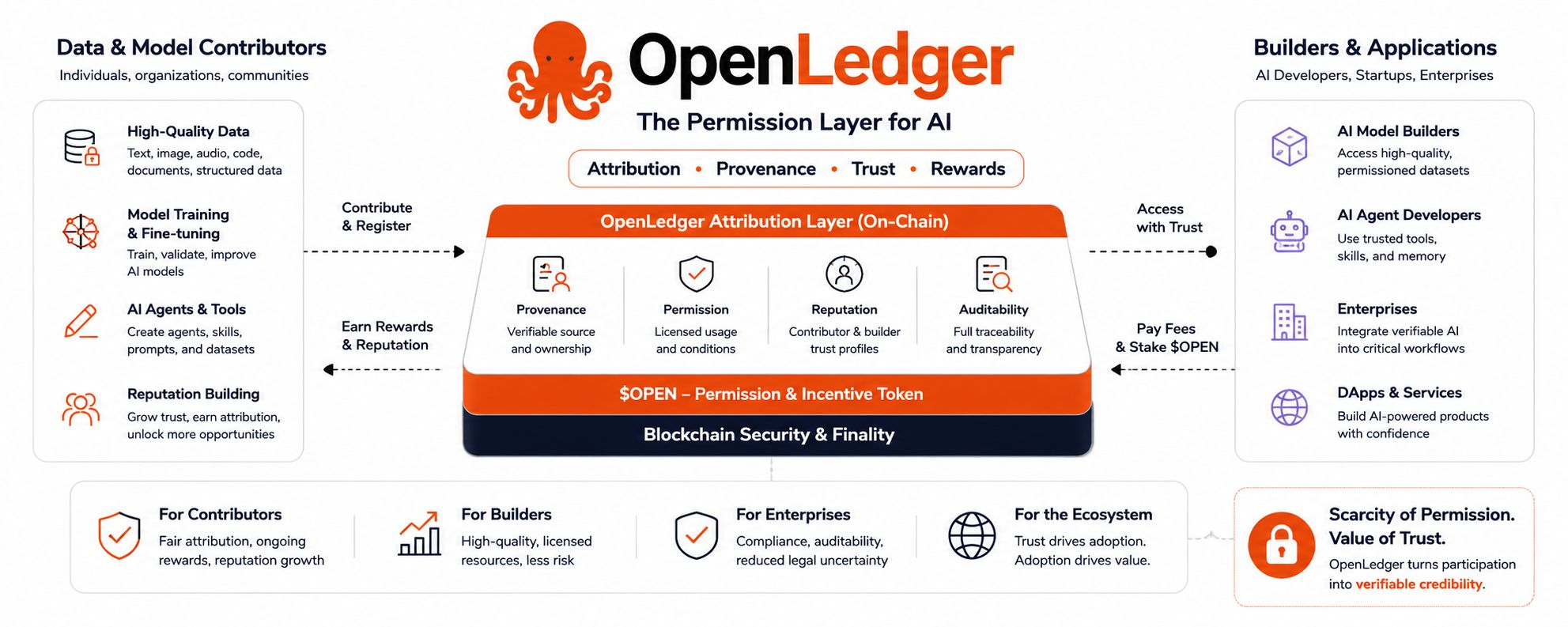
At first glance, it looks like another AI coordination layer. Contributors supply data, builders consume it, incentives keep the system moving, and a token ties it together. That is a familiar crypto story: create a market, bootstrap activity, reward participation, hope usage turns into value.
But there is a deeper possibility hiding underneath that surface.
OpenLedger may not be building a marketplace for AI assets.
It may be building a market for trust.
And trust is a much scarcer commodity than intelligence.
Anyone can scrape data. Anyone can fine-tune a model. Anyone can assemble an agent and call it decentralized, autonomous, or intelligent. What becomes difficult is proving that the underlying inputs are legitimate enough to survive real scrutiny. In consumer AI, that may not matter much. If a chatbot is slightly wrong, users shrug. If an image generator produces nonsense, people laugh and move on.
But enterprise AI does not get that luxury.
If AI touches underwriting, compliance, payments, procurement, legal review, healthcare documentation, or internal decision systems, the questions change completely. Who supplied the data? Was it licensed? Can provenance be traced? Can a result be audited? Who is liable when the system acts on something false, harmful, or unauthorized?
At that point, the product is no longer just intelligence.
It is permissioned intelligence.
That is a very different category.
The market tends to underestimate this because permission does not sound exciting. It does not feel like disruption. It does not produce the same flashy narrative as a model leap or a new agent demo. But permission is often where durable infrastructure value accumulates. It is the layer that decides what can pass through, what gets blocked, what gets validated, and what earns access to sensitive workflows.
In that sense, OpenLedger may matter less as a place where people exchange data and more as a system that assigns economic credibility to participation.
That idea has large implications.
Because if a network can verify provenance, trace contribution, and attach reputation or rights to inputs, then it is not just coordinating a market. It is creating a standard for acceptable AI behavior. And standards are powerful because they reduce uncertainty. They make companies more willing to adopt. They make regulators less nervous. They make legal teams less resistant. They make operations easier to defend.
That is often where the real money sits.
Not in novelty.
In reduced friction.
Still, there is a catch. Trusted systems can become gatekeeping systems very quickly. Once access becomes valuable, someone has to define the rules. Who qualifies as trusted? Who gets excluded? Who audits the auditors? Who controls reputation? Can the system be manipulated by insiders, sybil behavior, or token-weighted governance? These are not edge cases. They are the pressure points that decide whether a permission layer becomes infrastructure or just another bottleneck dressed up as innovation.
And that is why the token question matters so much.
A protocol can be useful without the token capturing that usefulness.
Crypto has repeated this mistake many times. A project can solve a real problem, attract developers, and still fail to translate that adoption into durable token value. Utility and token economics are related, but they are not the same thing. The market often prices the story before it understands the mechanics.
So the better question is not whether OpenLedger can win as an AI marketplace.
That framing is too small.
The better question is whether the next phase of AI makes trustworthy participation more valuable than raw model performance. If so, then the most important infrastructure will not be the system that produces the smartest answer. It will be the system that determines which answers are allowed to matter.
And that kind of system can become deeply sticky.
Because once organizations rely on trusted access, they rarely want to rebuild it. They do not just buy a tool. They buy a framework for reducing risk. They buy a layer of accountability. They buy a way to turn unknown inputs into usable ones.
That is the real prize.
Not intelligence alone.
Legible intelligence.
Permissioned intelligence.
The kind that can survive contact with the real world.