
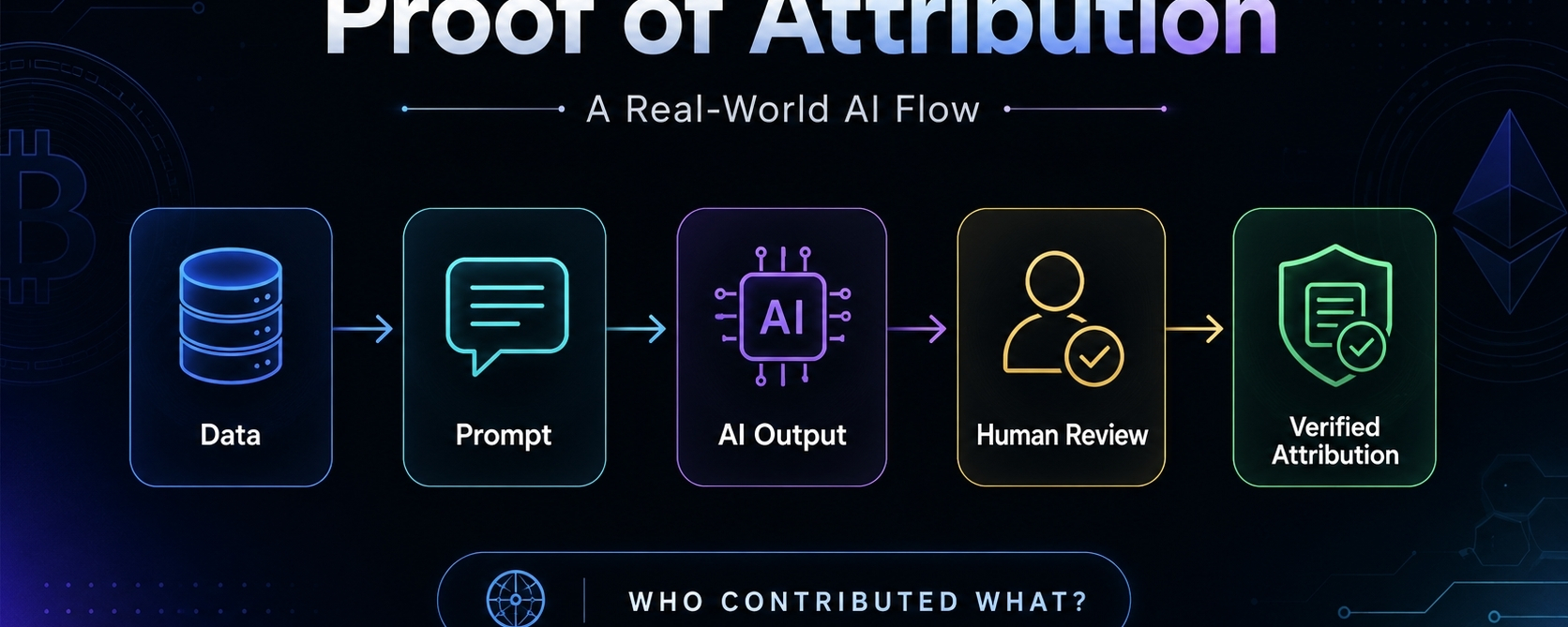
Sometimes I wonder if the next big problem in crypto will not be speed, fees, or even regulation. It might be something much simpler and much harder at the same time knowing who actually contributed what.
We already live in a world where content moves faster than memory. A chart gets posted, a thread gets copied, an AI image goes viral, a trading idea spreads across five platforms, and within a few hours nobody really knows where it started. In crypto, that feels normal. Maybe too normal. And that is where the idea of proof of attribution starts to matter.
At its simplest, proof of attribution is about creating a reliable way to show that a person, wallet, model, creator, or contributor was connected to a specific piece of work, action, or output. Not just someone saying, “Trust me, I made this.” More like a record that can be checked later.
I’ve noticed that people often understand this better when we take it out of theory and put it into a real example. So imagine a crypto research community where members use AI tools to help generate market summaries. Someone feeds the AI a mix of on chain data, social sentiment, funding rates, and exchange flows, then the AI produces a short report about why traders are becoming cautious around a certain market setup.
Now here is the tricky part. Who deserves credit for that report?
Is it the person who gathered the data? The person who wrote the prompt? The AI model that shaped the language? The community analyst who reviewed and corrected it? Or the platform where the final post was published?
That question sounds small at first, but it gets bigger the longer you sit with it. In crypto, reputation is capital. People follow analysts because they trust their judgment. Builders earn attention because they ship consistently. Traders gain influence when their calls are thoughtful, even when they are not always right. If AI starts helping with more of this work, attribution becomes messy very quickly.
From my perspective, proof of attribution is not about removing AI from the process. That would be unrealistic. AI is already part of how people research, write, code, summarize, translate, and brainstorm. The real issue is transparency. If a post was created using AI, edited by a human, and backed by public blockchain data, it would be useful to know that chain of contribution.
Think about a simple scenario. A user creates an AI assisted report about a sudden rise in stablecoin inflows to exchanges. They attach the original data sources, record the wallet that submitted the post, and include a timestamp showing when the analysis was created. Later, if the report spreads across social media, anyone can trace it back to the original contributor and see what information was used.
That does not magically prove the analysis was correct. It only proves where it came from and what helped create it. And honestly, that alone is valuable.
Crypto users already understand this idea more than most people realize. When we check a transaction hash, we are not asking for a story. We are asking for a record. Did the transaction happen? When did it happen? Which addresses were involved? Proof of attribution applies a similar mindset to content, contribution, and creation.
One thing that stood out to me is how relevant this becomes in AI generated media. Imagine an AI tool creates a market chart, but the chart is based on outdated data. Someone reposts it without context, traders react to it, and suddenly misinformation spreads. If there were attribution records attached to that output, users could check when the chart was made, what data was used, and who published it first.
That kind of record would not stop people from making mistakes, but it could slow down confusion.
It feels like crypto has always been obsessed with ownership, but attribution is slightly different. Ownership asks, “Who controls this asset?” Attribution asks, “Who contributed to this thing?” In a world of memes, research, code, AI outputs, governance proposals, and community work, that second question is becoming harder to ignore.
There is also a fairness angle here. In many online communities, the loudest account often gets more credit than the original thinker. Someone posts a good idea quietly, another account repackages it with better formatting, and suddenly the second version becomes the one everyone remembers. Proof of attribution could help make original contribution easier to recognize.
Of course, this is not simple. People can still fake context, recycle ideas, or create low quality content with perfect timestamps. A record does not equal truth. That part matters. Proof of attribution should not become another shiny label people blindly trust. It should be treated as one signal among many, like wallet history, public reputation, source quality, and community review.
What’s interesting is that AI makes this both harder and more necessary. Harder because content can now be produced at ridiculous speed. More necessary because when everything is easy to generate, the source of an idea starts to matter more. The question becomes less “Can someone produce content?” and more “Can we understand the path behind it?”
For builders, this could open up new tools around creator identity, AI transparency, research trails, and contribution tracking. For traders, it could help filter noise from actual analysis. For everyday users, it could make the information flow feel a little less chaotic.
I do not think proof of attribution will solve trust by itself. Crypto has learned that no single tool fixes human behavior. But it could give us better receipts. Better context. Better ways to separate original work from copied noise, and thoughtful AI assisted analysis from random generated content.
Maybe that is the real point. As AI becomes more normal in crypto, the goal should not be pretending humans and machines are separate worlds. They are already blending. The better question is whether we can build systems that show how ideas, data, and contributions move through that blend.