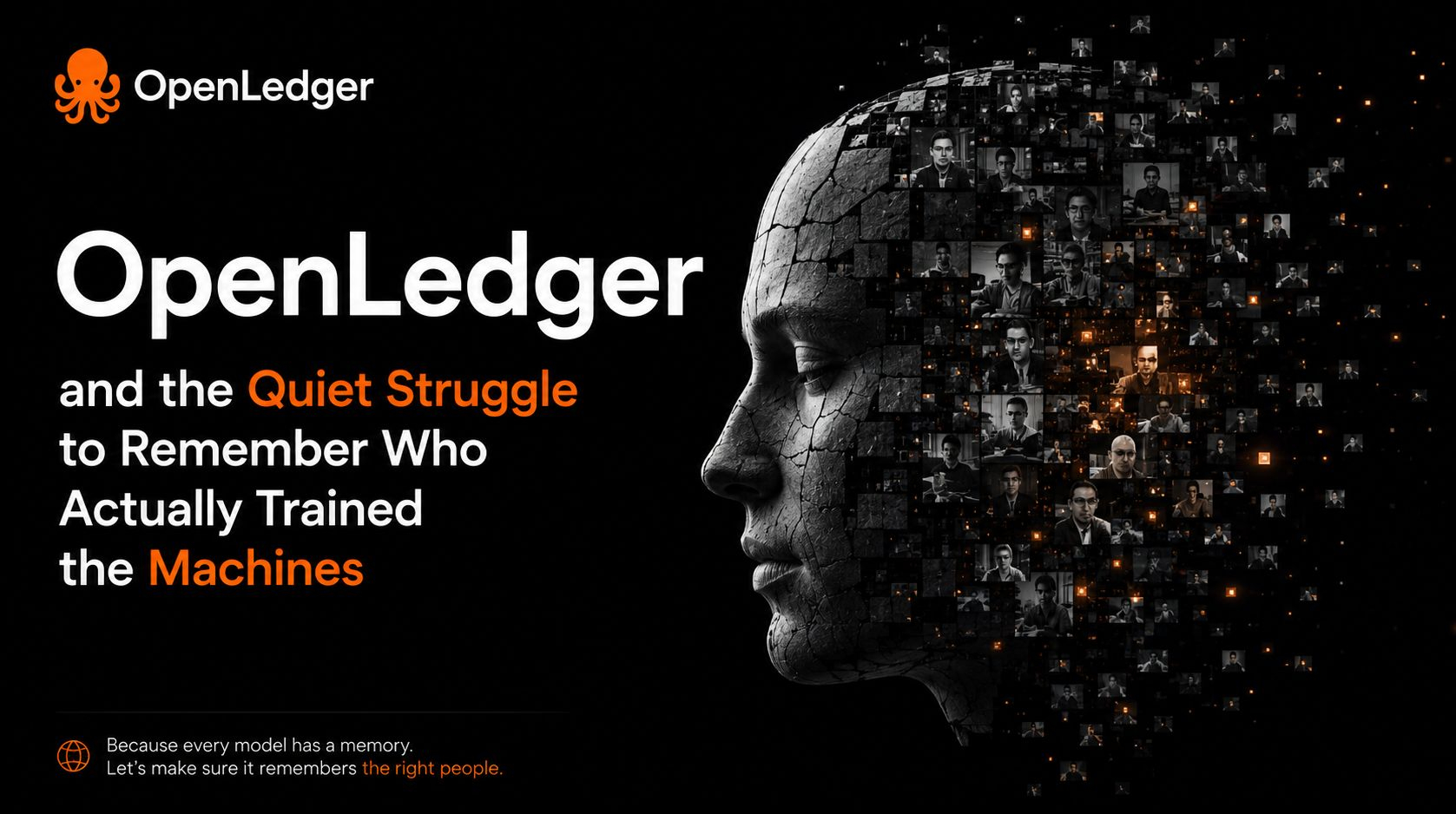
I was digging into OpenLedger late at night, half tired, half curious, and at first I thought I already understood the idea. Data goes in. Models use it. Contributors get rewarded. Simple. But after sitting with it for a while, it started feeling less simple. OpenLedger is not just trying to pay people for data. It is trying to answer a harder question: when human knowledge gets absorbed into AI, does anyone remember where the value came from?
That thought stayed with me. Because once data enters a model, it stops looking like “your” data or “my” data. It mixes with everything else. It becomes part of something larger, harder to trace, harder to separate. And yet OpenLedger is trying to keep some kind of memory alive inside that mess. Not perfect memory, maybe. But enough to say: this contribution mattered.
People don’t only want rewards. They want recognition. They want to feel like their work did not disappear into a machine that later gets monetized by someone else. The token may be what everyone talks about, but underneath that there is a very human feeling: I gave something valuable, and I don’t want to be erased.
Still, incentives are never clean. The moment people know attribution can be rewarded, behavior changes. Some will contribute because they care about the system. Some will contribute because they see an opportunity. Some will try to understand what kind of data gets rewarded most. Slowly, the question may shift from “is this useful?” to “will this pay?” That tiny shift can change the whole culture of a protocol.
And this is where I stay skeptical. A system can work technically and still fail socially. OpenLedger can build attribution, rewards, models, dashboards, and all the right-looking pieces. But people still have to believe the system is fair. They have to trust how value is measured. They have to believe the rewards are connected to real demand, not just internal circulation.
Because activity can be misleading. A protocol can look alive because people are uploading, earning, staking, posting, and trading. But movement is not always health. Sometimes it is just incentives keeping everyone in motion.
The real question is what remains when incentives cool down. Do high-quality contributors stay? Do real buyers show up? Does the data actually improve useful AI systems? Or does the whole thing become another loop where people earn from each other until the belief gets tired?
That is the tension I keep seeing in OpenLedger. The problem it points to is real. AI is using human knowledge at scale, and most of that value flows upward without much memory of who helped create it. OpenLedger is trying to build a system where contribution does not vanish so easily.
But the survival of that system depends on more than code. It depends on trust, demand, patience, and whether people still believe the rewards mean something when the noise fades.
Maybe OpenLedger becomes a real coordination layer for AI data. Maybe it proves that attribution can turn invisible human work into something measurable and valuable. Or maybe it discovers what many protocols discover too late: that measuring value is easier than creating lasting demand for it.
I’m still not sure. But the deeper I looked, the less it felt like another AI token story, and the more it felt like a quiet question sitting underneath the whole market: when machines learn from people, who gets remembered?
@OpenLedger #OpenLedger #OpenLedger # $OPEN