
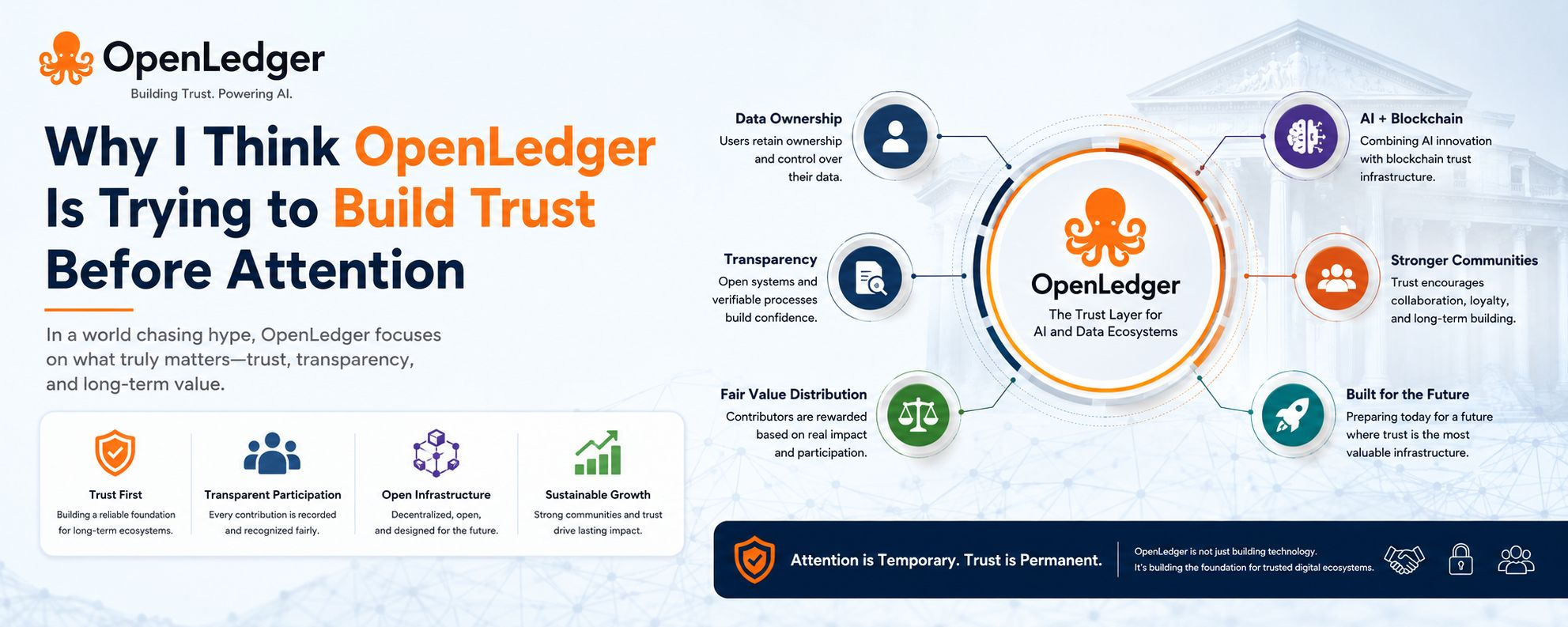
One thing I have noticed in crypto is that many projects focus on visibility first and trust later. They try to become popular quickly, attract huge attention, and create nonstop excitement around the ecosystem. But personally, I think long-term technology projects work differently.
Strong systems usually build trust first.
This is one reason why OpenLedger keeps becoming more interesting to me the more I study it carefully. The project does not feel designed only for fast reactions or temporary trends. Instead, it feels more focused on creating a structure people may eventually rely on over time.
That difference matters a lot from my perspective.
Right now, most digital systems already struggle with trust problems. Users question how their data is used. They question transparency. They question ownership. At the same time, AI systems are growing larger every year, which makes these concerns even more important.
Personally, I think future technology platforms will need stronger trust structures than current systems.
This is where OpenLedger feels different to me compared to many projects connected to AI discussions. Instead of only focusing on expansion, the project appears more focused on creating a system where contribution, participation, and ecosystem activity feel more transparent and balanced.
I think that direction is important.
Most users do not immediately notice trust infrastructure because it operates quietly in the background. People usually focus on visible products, fast growth, and market excitement. But long-term ecosystems often survive because of invisible trust systems supporting everything underneath.
That is why I believe OpenLedger may be positioning itself differently from many short-term projects.
I also think trust changes how communities behave inside digital ecosystems. When users trust a system, participation becomes more natural. People contribute more comfortably. Builders stay longer. Ecosystems develop stronger connections over time.
Without trust, growth becomes temporary.
This is something I rarely see discussed deeply in crypto conversations because most discussions focus on trends, numbers, and short-term attention cycles. But personally, I think trust may become one of the most valuable parts of future AI ecosystems.
OpenLedger gives me the impression of a project trying to prepare for that future reality early.
Another thing I keep thinking about is how AI systems are becoming more integrated into everyday digital life. As this continues, people will probably care more about transparency and contribution value instead of simply accepting closed systems without questions.
I believe projects that understand this shift early may eventually hold stronger long-term relevance.
What interests me about OpenLedger is not only the technology side. It is the psychological side of participation. Systems become healthier when users feel the ecosystem operates fairly and transparently. That feeling creates stronger long-term engagement naturally.
Personally, I think many platforms underestimate how important this human side really is.
Modern internet systems often prioritize expansion speed over ecosystem quality. But projects focused on sustainable participation usually need stronger trust layers to survive long term. That process may look slower from the outside, but it often creates more stability underneath.
This is why I think OpenLedger feels more infrastructure-focused than attention-focused.
I also believe trust becomes even more important in AI-related ecosystems because AI already creates uncertainty for many people. Users want to understand how systems work, how value moves, and how participation matters inside the ecosystem itself.
Projects that ignore these concerns may struggle later as technology becomes more advanced.
From my perspective, OpenLedger seems more aligned with building long-term confidence instead of chasing short-term reactions. That may not always create immediate excitement, but I think it creates stronger positioning over time.
Another reason this topic stands out to me is because trust cannot be forced through marketing alone. Real trust usually develops slowly through consistency, structure, and ecosystem behavior. It takes time before people genuinely believe in a system.
Personally, I think this slower process may actually benefit projects trying to become part of future digital infrastructure.
OpenLedger gives me the feeling of a project trying to build that type of foundation quietly instead of depending only on visibility.
Of course, long-term success will still depend on execution, participation, and ecosystem growth. Every project must eventually prove its value through real adoption. But I think the direction behind a project matters just as much as short-term performance.
And honestly, one reason I keep watching OpenLedger closely is because it feels more connected to the future need for trusted digital ecosystems instead of temporary market attention.
In crypto, attention moves fast.
But trust usually lasts much longer.
