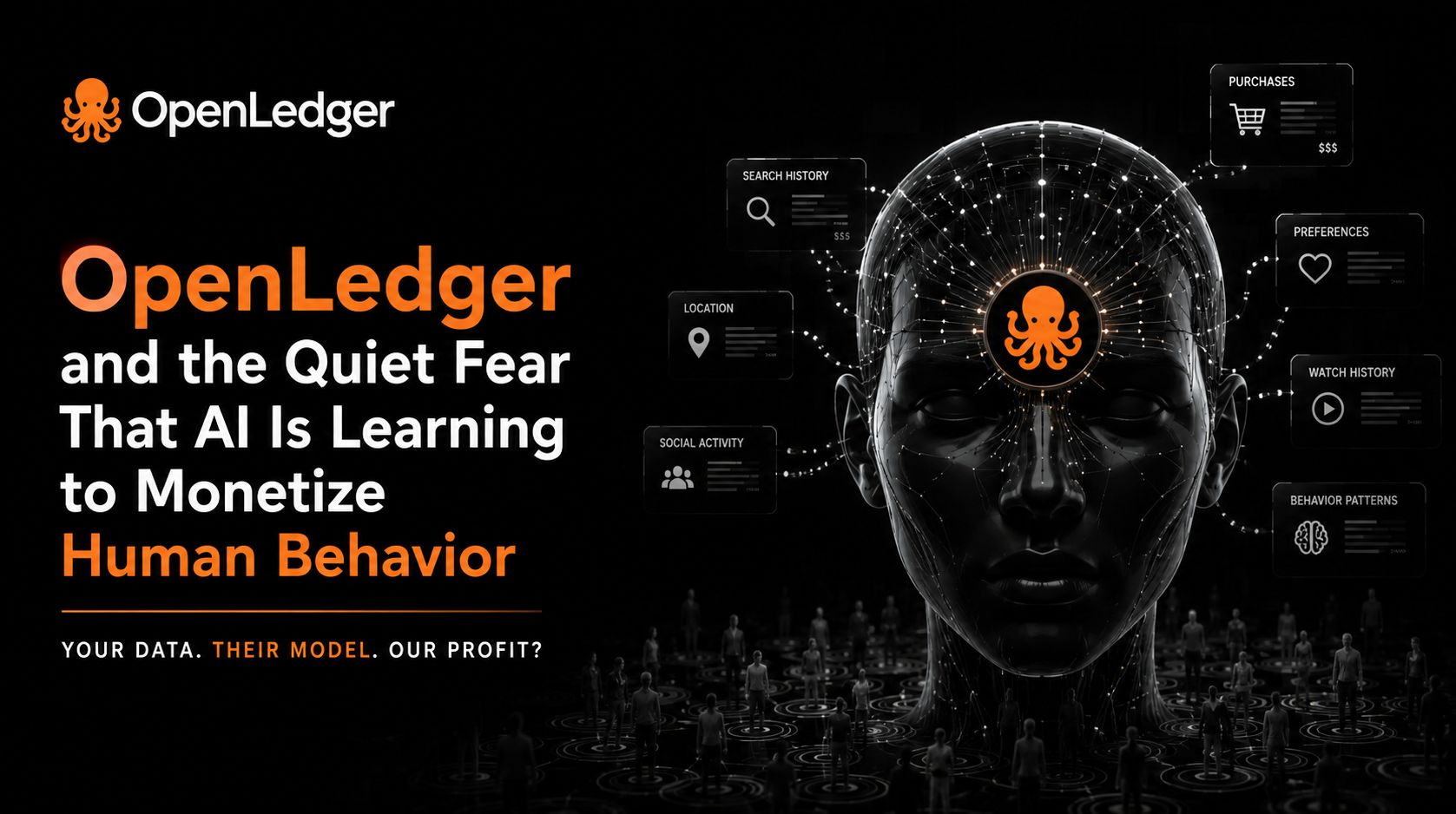
I first looked at OpenLedger like I look at most AI-crypto projects now, with one eye half open and the other already tired.
But it stayed with me.
Not because the idea is loud, but because the problem underneath it feels strangely familiar. AI is feeding on human work, human behavior, human patterns, human mistakes, human taste. Most of that value disappears into systems people will never see. OpenLedger seems to be asking a simple but uncomfortable question: what if the people and data behind intelligence were not treated like background noise?
That sounds fair. Almost obvious.
But nothing stays obvious once incentives enter the room.
If people know their data, models, or contributions can be tracked and rewarded, they start behaving differently. They don’t only contribute. They calculate. They repeat what pays. They shape themselves around the system. A contribution becomes less like sharing and more like placing something on a shelf, waiting to see if the market notices.
That is where OpenLedger becomes interesting to me. Not as a clean solution, but as a mirror.
Because AI may need attribution. It may need provenance. It may need a way to show where value came from before everything gets absorbed into some giant invisible machine. But attribution also changes the people being attributed. It turns invisible labor into visible inventory. And once something becomes inventory, people start treating it like yield.
This is the quiet risk.
A protocol can work technically and still struggle socially. Metrics can rise while real demand remains thin. Contributors can look active while mostly chasing rewards. A community can sound committed while secretly waiting for price to confirm belief. Crypto has seen this pattern too many times: motion mistaken for adoption, incentives mistaken for loyalty, dashboards mistaken for life.
Maybe OpenLedger escapes that. Maybe it really does become useful outside its own economy. Maybe builders, agents, models, and data contributors actually need this kind of accounting layer badly enough for demand to survive when rewards cool down.
I want to believe that possibility.
But I don’t want to pretend belief is evidence.
Decentralization does not remove trust. It just moves trust into new places: validators, governance, token design, reward formulas, the honesty of contributors, the patience of users, the market’s willingness to keep caring. That does not make the system fake. It makes it human.
And maybe that is the real story here.
OpenLedger is not only about AI infrastructure. It is about whether the next intelligence economy can avoid becoming another extraction layer dressed up as ownership. It is about whether people are actually being paid for value, or simply being pulled into a new loop where participation feels like ownership until incentives fade.
I don’t have a clean conclusion.
I just keep thinking about all the invisible work AI is built on, and how strange it would be if the first real attempt to recognize it also taught people how to package themselves for extraction.
@OpenLedger #OpenLedger #OpenLedger # $OPEN