
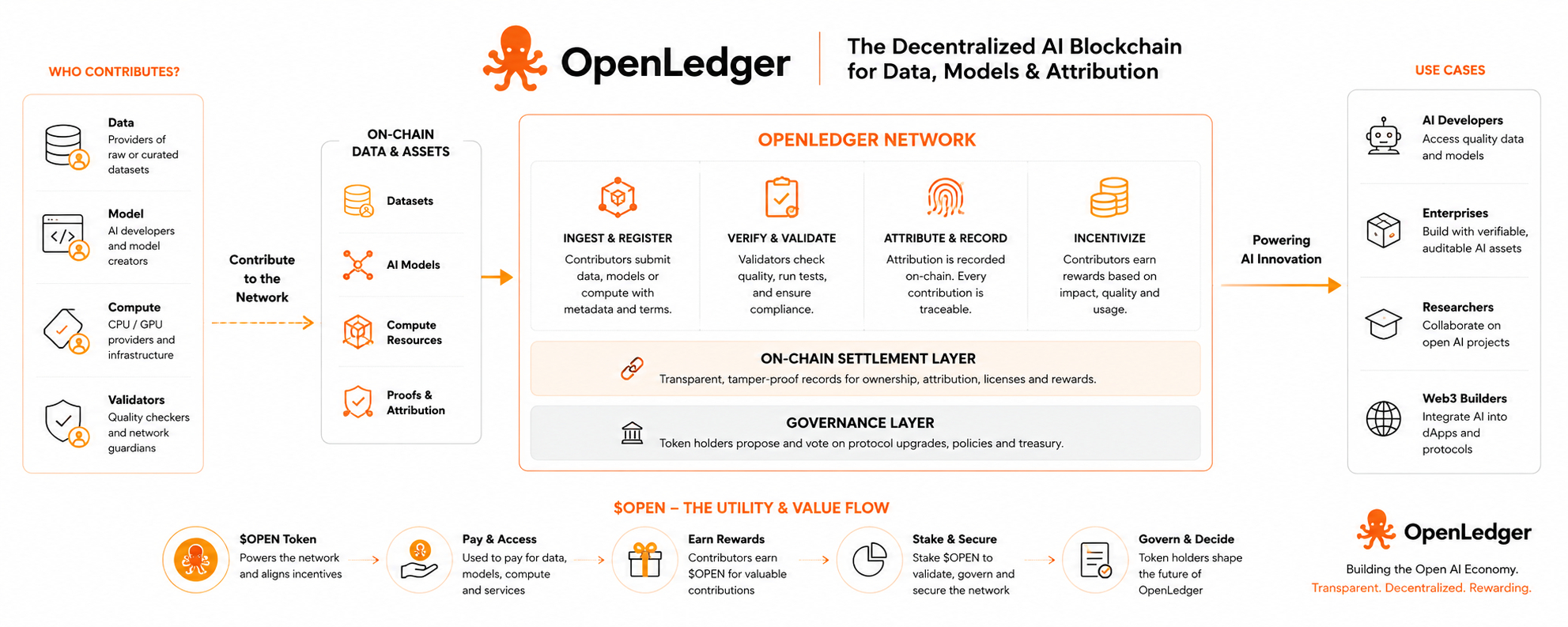

Everyone talks about the outputs. The chatbot replies. The generated images. The speed. The hype. Every week there’s another model that’s supposedly smarter, faster, or more “revolutionary” than the last one.
But almost nobody talks about the foundation underneath all of it.
Where does the data come from?
Who actually helps train these systems?
Who owns the infrastructure?
And who benefits when these models become part of everyday life?
That’s honestly why @OpenLedger caught my attention.
Not because it feels loud or overly promotional. Actually the opposite. It feels like one of the few projects trying to think seriously about the layr beneath AI instead of just chasing headlines.
The more I read about OpenLedger, the more it felt less like a typical crypto project and more like an attempt to solve a coordination problem that’s going to become very real over the next few years.
AI systems don’t magically become intelligent on their own. They depend on huge amounts of human input, organization, verification, and infrastructure. And right now, most of that process is hidden behind large centralized companies.
That model works well for speed. Centralized systems are efficient. Decisions happen faster. Products ship quicker.
But there’s also a tradeoff that people rarely talk about.
When too much control sits in too few hands, the rest of the ecosystem slowly becomes dependent on decisions they can’t see or influence. Over time, that creates fragility. Not immediately. Quietly.
I think OpenLedger is trying to explore another path.
A system where contributors, data, and AI coordination are more open and transparent without completely sacrificing reliability. That sounds simple when written in one sentence, but it’s probably one of the hardest balancing acts in tech right now.
Because openness creates its own problems too.
Anyone who has spent time around crypto understands this already. Incentives can attract spam. Governance can become messy. “Decentralized” systems often drift back toward centralization because efficiency eventually wins arguments.
So the real question isn’t whether decentralization sounds good in theory. The real question is whether projects like OpenLedger can stay useful under pressure.
Can they maintain quality?
Can they reward real contribution fairly?
Can they prevent manipulation without becoming overly controlled themselves?
Those questions matter much more to me than short-term excitement.
What I like is that OpenLedger seems positioned more like infrastructure than entertainment. And infrastructure projects usually move differently. They grow slower. They get less attention in the beginning. Sometimes people underestimate them because they aren’t constantly creating noise.
But infrastructure is what people depend on later.
I don’t think projects like this succeed because of marketing alone. If OpenLedger works long term, it’ll probably be because the system quietly proves reliable over time while the rest of the market keeps chasing trends.
And honestly, that’s the part of crypto I’ve started appreciating more as the years go by — not the loud promises, but the projects trying to solve difficult systems problems that most people ignore because the solutions aren’t flashy.
Maybe OpenLedger succeeds. Maybe it struggles with the same tradeoffs every decentralized network eventually faces.
But at least it feels like it’s asking an important question:
If AI becomes part of everyday infrastructure, should that infrastructure belong entirely to a small group of companies… or should people have a way to participate in building it too?
I think that question matters more than people realize.