
When I look at OpenLedger, I do not see a simple AI toolkit.
I see infrastructure for coordination.
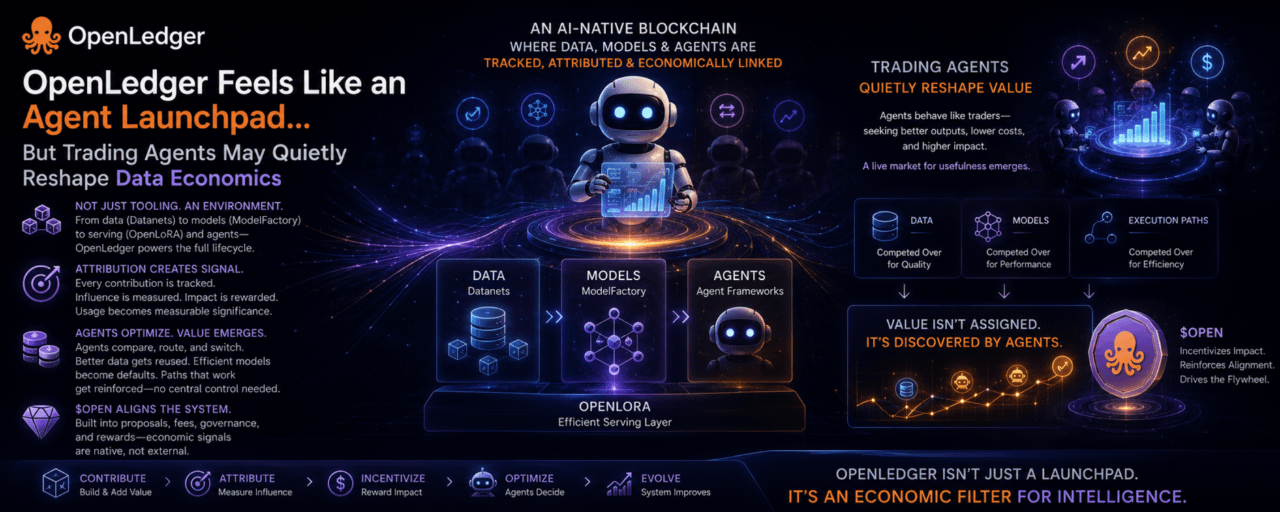
That is a different claim—and it matters. The system positions itself as an AI-native blockchain where data, models, and agents are not just used, but tracked, attributed, and economically linked.
That alone moves it beyond typical AI stacks.
That is why the “agent launchpad” framing feels accurate.
OpenLedger is not just about hosting models. It defines a full lifecycle—data collection through Datanets, model creation via ModelFactory, efficient serving through OpenLoRA, and integration into agent frameworks.
This is not tooling. It is an environment for deploying specialized intelligence.
But the real shift begins after deployment.
An agent is not just a model wrapper. It is a decision layer.
It chooses which data to query, which model to call, and which outputs to propagate.
Once those decisions happen inside a system with attribution and incentives, the network stops being passive.
It becomes selective.
That is where trading agents quietly enter the picture.
Not trading in the narrow financial sense—but in behavior.
Agents compare, switch, route, and optimize across available options.
They look for better outputs, lower cost paths, and more reliable signals.
Over time, that behavior turns the system into a live market for usefulness.
Datasets that consistently improve results get reused.Models that perform efficiently become default layers.Execution paths that work get reinforced.No central coordination is required.It emerges from repeated agent decisions.OpenLedger is uniquely positioned for this dynamic.....
It separates contribution from consumption and ties rewards to impact.It introduces attribution and influence tracking, meaning the system can measure not just usage—but significance.Once influence is visible, optimization follows.So the system evolves.Data is no longer static input.It becomes something agents compete over.Models are not endpoints.They are interchangeable execution paths.And agents are no longer just users.They become the mechanism that reveals value.This is why I think of OpenLedger less as a launchpad and more as an economic filter.It does not just host activity—it shapes it.The more agents operate, the more the network converges toward what actually works.The token layer reinforces this.
OPEN is embedded into proposals, governance, fees, and attribution rewards.That means economic signals are not external—they are native to the system.As agents scale usage, they also shape reward distribution.That is the quiet shift.OpenLedger’s surface story is specialization.Its deeper story is selection.And once trading-style agent behavior takes hold, data economics stops looking like a marketplace.It starts looking like a system that continuously filters for relevance.That is the real implication.Not just that OpenLedger lets you launch agents—
but that those agents may ultimately decide what the network values most.