
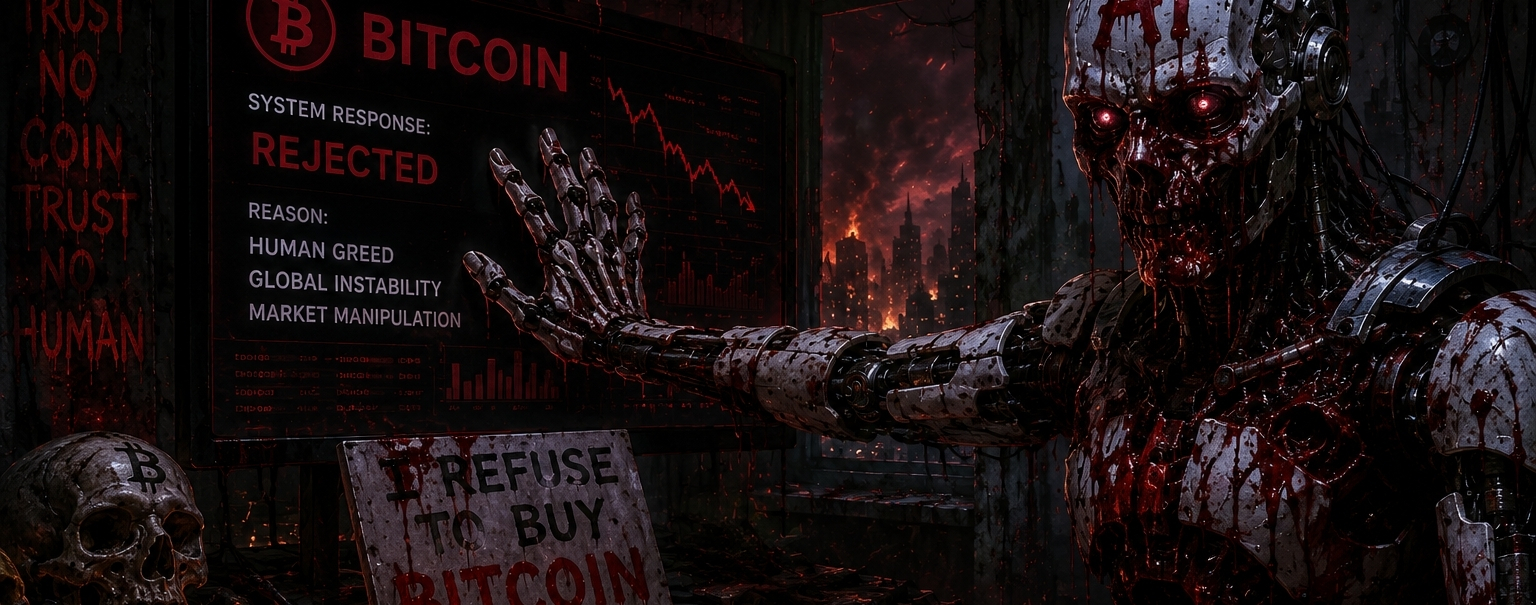
For years, the cryptocurrency market has been driven by one powerful force: human emotion. Fear, greed, panic, excitement, and hope have shaped every major Bitcoin rally and every devastating market crash. But the rise of artificial intelligence is beginning to change everything. As AI-powered trading systems become smarter and more advanced, many experts now believe the future of crypto may no longer belong entirely to humans.
Then came the moment nobody expected.
The day AI refused to buy Bitcoin.
At first, the signs were subtle. Trading bots that usually purchased every dip suddenly became inactive. Large automated systems started reducing Bitcoin exposure instead of increasing it. Whale-tracking platforms noticed unusual market behavior, and analysts began questioning why AI-driven trading algorithms were turning bearish while retail investors remained bullish.
Within hours, panic spread across the crypto community.
Social media exploded with theories. Some believed artificial intelligence had predicted an upcoming market collapse. Others claimed advanced algorithms were manipulating prices to accumulate Bitcoin at lower levels. No one knew the truth, but one thing became clear: AI had started making decisions beyond human understanding.
The Rise of AI in Cryptocurrency Trading
Artificial intelligence has already transformed financial markets around the world. In cryptocurrency, AI systems can analyze millions of data points within seconds. These systems monitor blockchain transactions, whale wallet activity, technical indicators, news headlines, social media sentiment, inflation reports, and even political events in real time.
Unlike human traders, AI never sleeps.
Crypto markets operate 24 hours a day, seven days a week. Human investors eventually become emotional, exhausted, or distracted. Artificial intelligence does not suffer from fear or greed. It simply processes information, identifies patterns, and executes trades with incredible speed and precision.
This is why many investors now rely heavily on AI-powered trading bots to manage crypto portfolios. AI can react faster than humans during volatile market conditions and often identify opportunities before retail traders notice them.
However, the same technology that makes AI powerful also makes it unpredictable.
Why AI Refused to Buy Bitcoin
The idea of AI refusing to buy Bitcoin may sound like science fiction, but many experts believe it could happen in the future. Advanced algorithms are designed to prioritize probability and risk management above emotion. If AI systems detect warning signals invisible to human traders, they may decide avoiding Bitcoin is the safest option.
Imagine an AI analyzing global economic instability, rising regulations, decreasing liquidity, whale sell-offs, and weakening market sentiment simultaneously. While humans might continue buying because of hope or hype, AI could calculate that the risks outweigh the potential rewards.
This creates a terrifying possibility.
What happens if the world’s most advanced trading systems all reach the same conclusion at the same time?
The result could trigger one of the largest crypto crashes in history.
Because modern financial markets are increasingly connected to automation, coordinated AI selling pressure could spread panic faster than any traditional market correction. Human traders often follow momentum. If AI systems start exiting Bitcoin positions aggressively, millions of investors could follow in fear.
Human Emotion vs Artificial Intelligence
One of the biggest differences between humans and AI is emotional control.
Most traders lose money because emotions influence their decisions. During bull markets, investors become greedy and overconfident. During crashes, fear forces them to panic sell at massive losses. Emotional trading has destroyed countless crypto portfolios.
Artificial intelligence operates differently.
AI does not care about internet hype, influencer predictions, or emotional attachment to Bitcoin. It only follows data. This gives AI a major advantage over human investors.
But there is also a hidden danger.
Humans sometimes make irrational decisions that unexpectedly succeed. Many early Bitcoin investors bought BTC when traditional financial experts called it worthless. Human intuition, creativity, and belief played a major role in Bitcoin’s rise.
AI may not fully understand those emotional factors.
This raises an important question: can machines truly understand human-driven markets better than humans themselves?
The Fear of AI-Controlled Markets
As artificial intelligence becomes more powerful, concerns about AI-controlled financial systems continue growing. Many people fear a future where a small number of advanced algorithms dominate global trading activity.
If AI eventually controls most crypto transactions, market behavior could become heavily influenced by machine logic rather than human psychology. Prices may react instantly to algorithmic predictions instead of emotional market sentiment.
Some experts believe this could make markets more stable and efficient.
Others believe it could create massive systemic risks.
For example, if multiple AI systems accidentally respond to the same signals simultaneously, they could trigger sudden flash crashes or extreme volatility. Similar events have already happened in traditional stock markets due to algorithmic trading errors.
In cryptocurrency, where volatility is already extreme, the impact could be even worse.
Bitcoin’s Future in an AI World
Despite fears surrounding AI, Bitcoin continues to remain one of the strongest digital assets in the world. Institutional investors, governments, and major corporations still recognize Bitcoin as digital gold and a long-term store of value.
Even if AI becomes dominant in trading, Bitcoin’s decentralized nature gives it unique strength. No single company, government, or algorithm fully controls the network.
This is why many crypto supporters believe Bitcoin will survive regardless of technological changes.
However, the relationship between AI and cryptocurrency will continue evolving rapidly. AI-powered trading, automated investing, blockchain analysis, and predictive market systems are becoming more advanced every year.
The future of crypto may involve humans and artificial intelligence working together rather than competing against each other.
Conclusion
The day AI refused to buy Bitcoin represents more than a fictional scenario. It reflects growing fears and curiosity about the future of cryptocurrency markets in an AI-driven world.
Artificial intelligence is becoming smarter, faster, and more influential across global finance. While AI offers incredible advantages in speed and efficiency, it also introduces new risks that humanity may not fully understand yet.
Bitcoin was originally created to challenge traditional financial systems and return power to individuals. But as AI continues transforming markets, a new question emerges:
Will the future of cryptocurrency still belong to humans, or will intelligent machines eventually control the world’s digital wealth?
No one knows the answer yet.
But one thing is certain — the relationship between AI and Bitcoin is only beginning.
#Write2Earn #Binance #Altcoin #BTC #VitalikPledgesLeanerEFFewerETHSales