
I've been watching AI infrastructure costs quietly kill smaller projects for months.
Everyone loves to talk about “democratizing AI” — until the AWS bill hits after fine-tuning a single model.
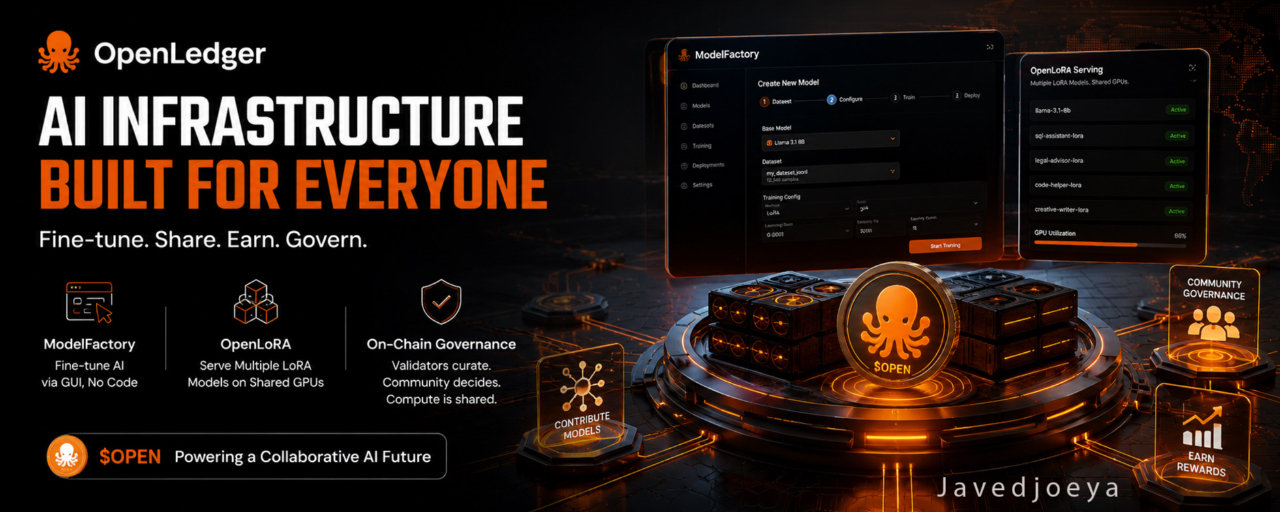
That’s why @OpenLedger ’s ModelFactory caught my attention.
It lets you fine-tune models through a GUI — no code, no heavy setup. I checked it out last week and realized something important:
👉 The technical barrier isn’t the real problem anymore.
👉 Cost is.
And that shift is bigger than it looks.
When contributors can spin up specialized models without a DevOps team, participation changes entirely. It’s no longer limited to well-funded labs.
OpenLoRA adds another layer by serving multiple LoRA models on shared GPUs. I ran some rough numbers on a test setup — and the difference is huge. You’re no longer burning full A100s per model variant.
That’s how specialized AI becomes viable for real communities — not just research teams — especially within the $OPEN ecosystem.
What really stands out, though, is the coordination layer underneath.
If fine-tuning becomes cheap and serving becomes shared, validators suddenly have real incentives:
• Curate which LoRAs get weight
• Allocate shared compute efficiently
• Participate in governance with actual consequences
This is where it gets interesting.
Governance stops being theoretical. You’re not just voting on narratives — you're directing compute resources tied to real utility.
That connection between infrastructure efficiency and on-chain activity is something most “AI x Crypto” projects completely miss.
Of course, it’s still early.
UX could break under scale. Governance could skew toward large GPU providers.
But after watching so many projects optimize for hype instead of cost efficiency, this feels different.
Lower barriers. Real participation. Actual ownership — without needing a PhD or VC backing.
Curious to see how this evolves.